
Search engine for discovering works of Art, research articles, and books related to Art and Culture


Javascript must be enabled to continue!
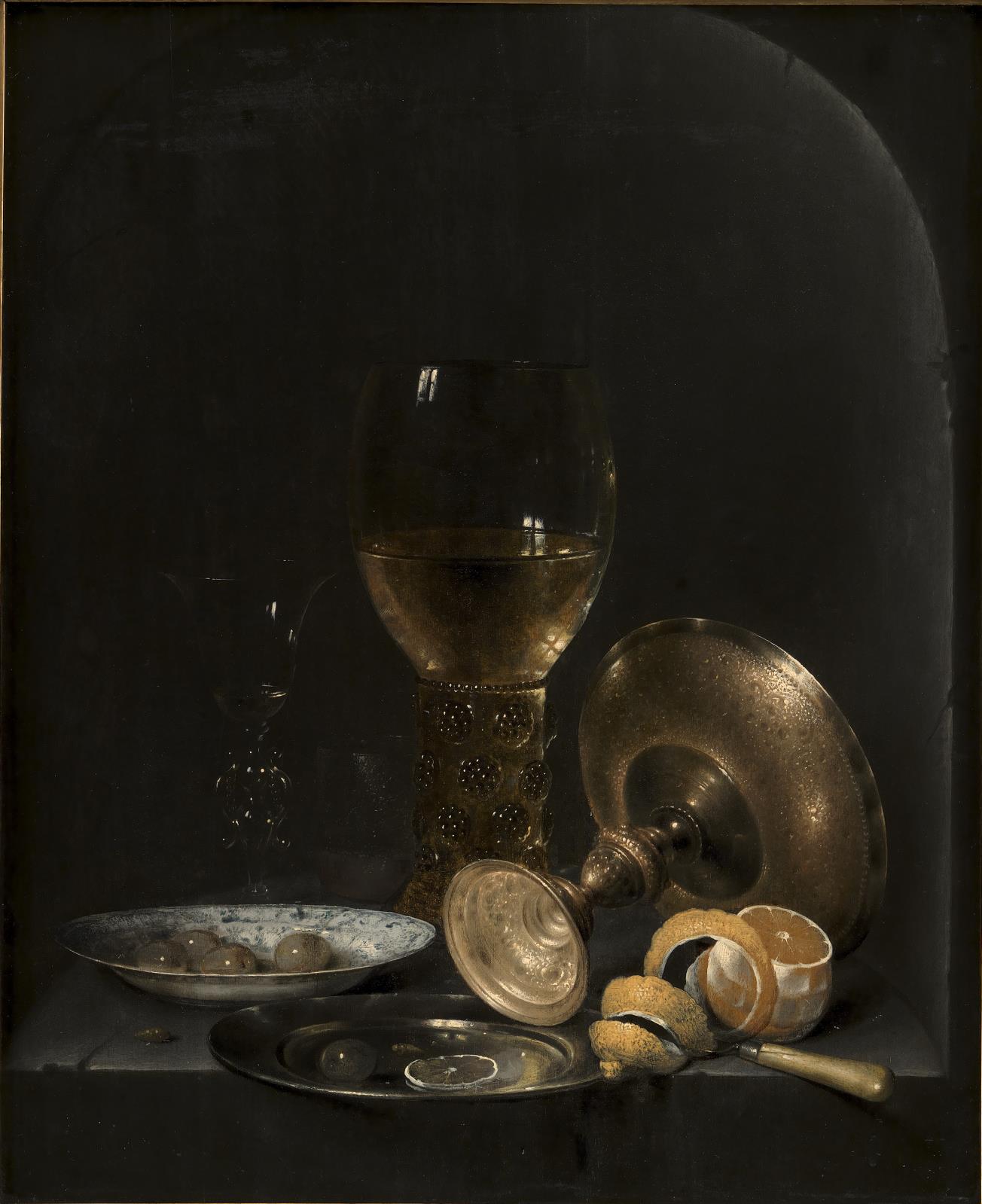
Still life. Breakfast Piece in a Stone Niche
View through National Gallery of Denmark
A special type of still life is about the remains of meal. This theme became popular in the Dutch city of Haarlem, where the almost monochrome fashion of painting developed during the 1630s and 1640s. The protagonist artists are Pieter Claesz (c.1597/98-1660) and Willem Heda (1594-1680). An unknown artist from their immediate circle has painted Still life. Breakfast Piece in a Stone Niche. Someone has eaten what was on the pewter plate; only a bit of olive is left remaining on a plate of Chinese porcelain. On the move, the unfortunate guest has overturned a silver tazza, but two beautiful glasses, half-filled with wine, are left standing. The artist lets us think for a moment that the layout is part of our own reality, because the wall is cut off by the edge of the picture, and the pewter plate and the knife seems to topple out of the picture plane and extend into the viewers space. The deceptive realism is reinforced in the very way of using the brush - the artist imitates the surface structure of the various objects. That is, the lemon's shell is bulging and uneven, the underside of the silver tazza has the silversmith's processing imprinted as tangible surface structure. Both parts make the light in the existing room (i.e., now the museum’s exhibition hall) reflect and flicker in the same way as it would have done in real life. An important element in this and many other still lifes is that the artist wants to deceive his audience.
Title: Still life. Breakfast Piece in a Stone Niche
Description:
A special type of still life is about the remains of meal.
This theme became popular in the Dutch city of Haarlem, where the almost monochrome fashion of painting developed during the 1630s and 1640s.
The protagonist artists are Pieter Claesz (c.
1597/98-1660) and Willem Heda (1594-1680).
An unknown artist from their immediate circle has painted Still life.
Breakfast Piece in a Stone Niche.
Someone has eaten what was on the pewter plate; only a bit of olive is left remaining on a plate of Chinese porcelain.
On the move, the unfortunate guest has overturned a silver tazza, but two beautiful glasses, half-filled with wine, are left standing.
The artist lets us think for a moment that the layout is part of our own reality, because the wall is cut off by the edge of the picture, and the pewter plate and the knife seems to topple out of the picture plane and extend into the viewers space.
The deceptive realism is reinforced in the very way of using the brush - the artist imitates the surface structure of the various objects.
That is, the lemon's shell is bulging and uneven, the underside of the silver tazza has the silversmith's processing imprinted as tangible surface structure.
Both parts make the light in the existing room (i.
e.
, now the museum’s exhibition hall) reflect and flicker in the same way as it would have done in real life.
An important element in this and many other still lifes is that the artist wants to deceive his audience.
Related Results
Emperor Leopold I elevates Johann Alsterle von Aastfeldt, the secretary of the Bohemian Viceroy, to the old Bohemian Knight’s state, improves his coat of arms and confirms the predicate to be mentioned straight next to first names
Emperor Leopold I elevates Johann Alsterle von Aastfeldt, the secretary of the Bohemian Viceroy, to the old Bohemian Knight’s state, improves his coat of arms and confirms the predicate to be mentioned straight next to first names
Character: description on folk. 5a and 5b, miniature on folk. 6a, 156 x 156 mm.
A fourth shield. 1. and 4. in gold is a black crowned eagle with red tongue 1). 2. and 3. in red the...
Ceremonial tobacco pouch
Ceremonial tobacco pouch
Pipe bag; Lakota; ca. 1870-1880 \nHide, glass beads, porcupine quills, pigments; l. 40 cm. (incl. fringe); w. 13 cm.\nRMV 3158-9; purchased from art dealer Leendert Van Lier, Amste...
Tobacco pouch
Tobacco pouch
Tobacco, smoking, ritual, pipes, tobacco bags Tobacco was a stimulant used by the indigenous people in large parts of North, Central and South America as a sedative, medicine again...
MEDIEVAL SCULPTURE
MEDIEVAL SCULPTURE
Fragment of a Medieval stone sculpture of an unidentified secular figure probably dating to c.AD 1320-1450. The fragment consists of the upper torso and shows the figure with their...
Martin Bergström, Lunden, Skredsvik, sitting on a garden couch with a sculpture in front of him on the table.
According to Birgitta Oscarsson, Skfredsvik-Herrestad-Höås homestead association in March 2009:
He may be a stone worker who was temporarily pre
Martin Bergström, Lunden, Skredsvik, sitting on a garden couch with a sculpture in front of him on the table.
According to Birgitta Oscarsson, Skfredsvik-Herrestad-Höås homestead association in March 2009:
He may be a stone worker who was temporarily pre
Martin Bergström, Lunden, Skredsvik, sitting on a garden couch with a sculpture in front of him on the table.
According to Birgitta Oscarsson, Skfredsvik-Herrestad-Höås homestead ...
Hair ornament
Hair ornament
Gold hairpiece. This piece is a typical south-Indian (Tamil Nadu) temple ornament. The piece was worn and sold back to the jeweller. It is customary in India to sell gold jewelry i...
“Breakfast Order in the Kitchen, Eva Eriksson takes her breakfast”
“Breakfast Order in the Kitchen, Eva Eriksson takes her breakfast”
“Breakfast Order in the Kitchen, Eva Eriksson takes her breakfast”...