
Search engine for discovering works of Art, research articles, and books related to Art and Culture


Javascript must be enabled to continue!
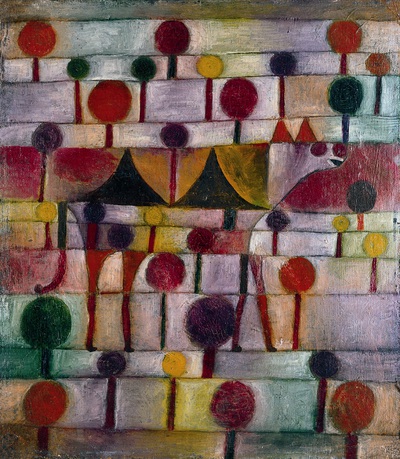
Camel (in Rhythmic Landscape with Trees)
View through Europeana Collections
Post-first-world-war tableaux mark a qualitative highlight in Klee's work at the outset of the middle of his creative period. The "rhythmic landscapes with trees" group emerged from the years 1919-1820. In addition to "Camel (in Rhythmic Landscape with Trees)" are: "Rhythm of Windows and Firs" 1919.204, "Rhythm of Trees in Autumn" 1920.40, "Rhythmic Landscape“1920.41, as well as a proportion of variously titled works in this group. All these tableaux are composed of rhythmically repeated irregular geometric shapes. The surface of the painting "Camel (in Rhythmic Landscape with Trees)" is structured on fine, dark, parallel-leading lines. Circular shapes on vertical shafts are inserted into the resulting horizontal strips of different widths. These vertical structural components separate the dominant horizontal strips forming individual fields that are filled with various different colours. The viewer immediately associates this with a landscape of trees. The vertical components are juxtaposed, creating the impression of an all-round expansion of the area of the picture, thus making it appear that the picture is a section of a limitless, continuous structure in which "Camel (in Rhythmic Landscape with Trees)“ is closely related to the pure landscape paintings "Rhythmic Landscape with Trees“ and "Rhythm of Trees in Autumn". In this case, however, the body of an animal has been interpolated in the rhythm of trees: two triangles for the ears and humps, two circles for the eyes, a perpendicular line with a curled end for the tail and strips for legs, form an overall shape with a dark outline. Despite the camel being placed in the middle of the picture, it does not dominate the picture as a whole; rather, the different parts of the landscape showing through the animal's body integrate it into the landscape. A number of writers have found the combination of linear and circular elements in "Camel (in Rhythmic Landscape with Trees)" reminiscent of musical notes. There are multifarious references to music in Klee's work; he was inspired in a series of works by the graphic form of music scores or individual musical notation. Christiane Dessauer-Reiners points out, however, that the association with music here is not only based on the similarity with musical notes, but also the imprint of the rhythmical arises directly from the interaction between the polar forces. In his fourth lecture at the Bauhaus, delivered on 16 January 1922, Klee coined the contradictory expression "dividual – individual" to define the rhythmical. "Dividual" is a neologism used by Klee to refer to the "divisible“. The dividual, or structural, rhythm is defined in its most basic form as "the addition of whole units moving in a linear direction". This may result in a number of differentiations in the repetitive structure in one or more than one direction. The dividual rhythm in the pictorial is akin to time or timing in the musical.
Title: Camel (in Rhythmic Landscape with Trees)
Description:
Post-first-world-war tableaux mark a qualitative highlight in Klee's work at the outset of the middle of his creative period.
The "rhythmic landscapes with trees" group emerged from the years 1919-1820.
In addition to "Camel (in Rhythmic Landscape with Trees)" are: "Rhythm of Windows and Firs" 1919.
204, "Rhythm of Trees in Autumn" 1920.
40, "Rhythmic Landscape“1920.
41, as well as a proportion of variously titled works in this group.
All these tableaux are composed of rhythmically repeated irregular geometric shapes.
The surface of the painting "Camel (in Rhythmic Landscape with Trees)" is structured on fine, dark, parallel-leading lines.
Circular shapes on vertical shafts are inserted into the resulting horizontal strips of different widths.
These vertical structural components separate the dominant horizontal strips forming individual fields that are filled with various different colours.
The viewer immediately associates this with a landscape of trees.
The vertical components are juxtaposed, creating the impression of an all-round expansion of the area of the picture, thus making it appear that the picture is a section of a limitless, continuous structure in which "Camel (in Rhythmic Landscape with Trees)“ is closely related to the pure landscape paintings "Rhythmic Landscape with Trees“ and "Rhythm of Trees in Autumn".
In this case, however, the body of an animal has been interpolated in the rhythm of trees: two triangles for the ears and humps, two circles for the eyes, a perpendicular line with a curled end for the tail and strips for legs, form an overall shape with a dark outline.
Despite the camel being placed in the middle of the picture, it does not dominate the picture as a whole; rather, the different parts of the landscape showing through the animal's body integrate it into the landscape.
A number of writers have found the combination of linear and circular elements in "Camel (in Rhythmic Landscape with Trees)" reminiscent of musical notes.
There are multifarious references to music in Klee's work; he was inspired in a series of works by the graphic form of music scores or individual musical notation.
Christiane Dessauer-Reiners points out, however, that the association with music here is not only based on the similarity with musical notes, but also the imprint of the rhythmical arises directly from the interaction between the polar forces.
In his fourth lecture at the Bauhaus, delivered on 16 January 1922, Klee coined the contradictory expression "dividual – individual" to define the rhythmical.
"Dividual" is a neologism used by Klee to refer to the "divisible“.
The dividual, or structural, rhythm is defined in its most basic form as "the addition of whole units moving in a linear direction".
This may result in a number of differentiations in the repetitive structure in one or more than one direction.
The dividual rhythm in the pictorial is akin to time or timing in the musical.
Related Results
Krishna and Radha Riding a Camel Composed of Dancers
Krishna and Radha Riding a Camel Composed of Dancers
Krishna, the eighth avatar of the Hindu god Vishnu who is worshiped as a deity in his own right, kisses his consort, Radha, while about to fire an arrow. They are both seated on a ...
Peri Astride a Composite Camel Made of Three Female Dancers (pounce)
Peri Astride a Composite Camel Made of Three Female Dancers (pounce)
A peri, a winged fairy-like spirit of Persian mythology, sits on top of a composite camel made up of three female dancers. The barefoot dancers wear large-leafed skirts and gold je...
Landscript
Landscript
An album leaf, this painting depicts a thatched-roof cottage set in a lush landscape. The cottage sits at the very center of the composition, nestled between a small lake in the fo...
Tethered Camel and Rider (drawing, recto; calligraphy, verso), folio from an album
Tethered Camel and Rider (drawing, recto; calligraphy, verso), folio from an album
The drawing on the recto of this folio depicts a man wearing a Safavid turban who faces a camel. The man holds the camel by a ring on its bridle. Both man and beast are portrayed i...
Panoramic Landscape with a City in the Background
Panoramic Landscape with a City in the Background
Landscape was a leading genre in 17th-century Dutch painting. During that century Dutch artists succeeded in formulating a type of representation that allowed them to depict the wo...
A Creek in the Woods
A Creek in the Woods
“Have just returned from a tour in search of the picturesque, ” wrote Thomas Cole in his diary on 8 July 1837, “[...] To Mr Durand the scenery was entirely new and I am happy in ha...
Pastoral Landscape with the Flight into Egypt
Pastoral Landscape with the Flight into Egypt
Claude Lorraine, whose artistic inspiration derived from the Roman Campagna, can be considered one of the great figures of 17th-century classical landscape painting. He arrived in ...