
Search engine for discovering works of Art, research articles, and books related to Art and Culture


Javascript must be enabled to continue!
The View from the Temple of Athena on the Acropolis
View through National Gallery of Denmark
On the back of Rørbye’s painting there is an advertisement for the manufacturer and trader of the millboard Rørbye used to paint The View from the Temple of Athena on the Acropolis. The business was owned by the English paint dealer, frame maker, and restorer Robert Davy (c. 1771-1843), who sold art supplies from his shop on Newman Street in London. Rørbye never visited London, but could have purchased the millboard on his travels in southern Europe then brought it back to Denmark, where he made the painting in 1844. The advertisement claims Davy to be the sole manufacturer of ‘genuine Flemish grounds’ on wooden panels and millboards, at the same time as promoting a new sketching block with 30 pages for sketching in oil. In the 1800s artists usually bought their art supplies from grocers and chemists, then later from specialised ‘artists’ colourmen’ like Robert Davy.
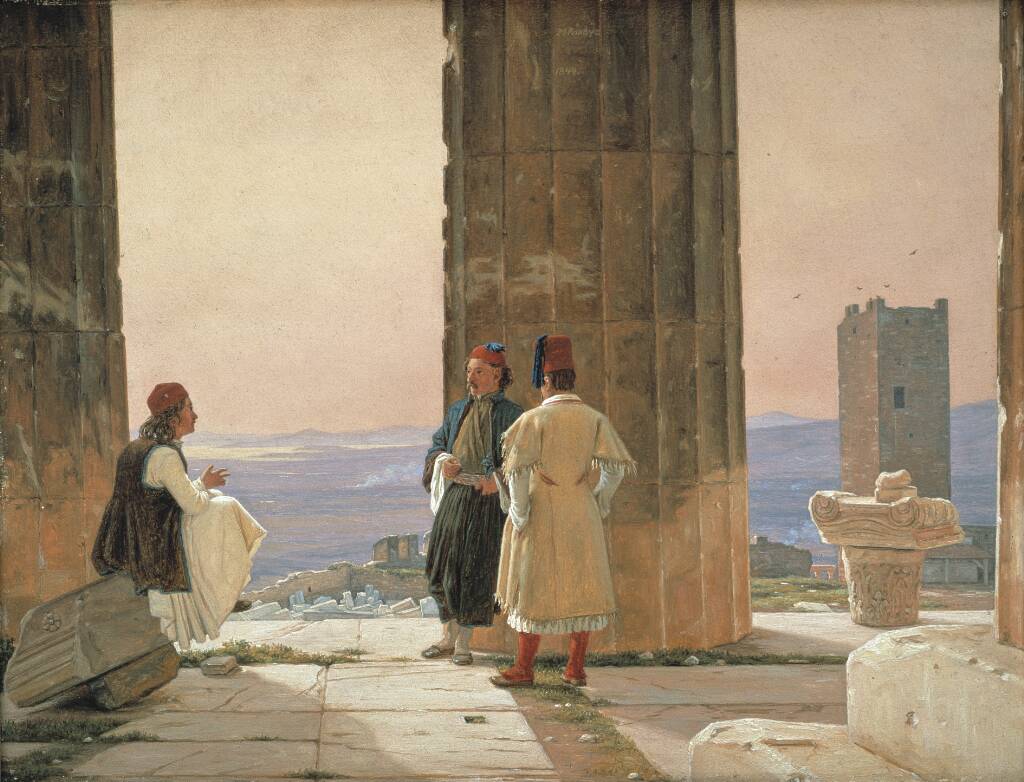
Title: The View from the Temple of Athena on the Acropolis
Description:
On the back of Rørbye’s painting there is an advertisement for the manufacturer and trader of the millboard Rørbye used to paint The View from the Temple of Athena on the Acropolis.
The business was owned by the English paint dealer, frame maker, and restorer Robert Davy (c.
1771-1843), who sold art supplies from his shop on Newman Street in London.
Rørbye never visited London, but could have purchased the millboard on his travels in southern Europe then brought it back to Denmark, where he made the painting in 1844.
The advertisement claims Davy to be the sole manufacturer of ‘genuine Flemish grounds’ on wooden panels and millboards, at the same time as promoting a new sketching block with 30 pages for sketching in oil.
In the 1800s artists usually bought their art supplies from grocers and chemists, then later from specialised ‘artists’ colourmen’ like Robert Davy.
Related Results
The Parthenon Frieze. Block E V
The Parthenon Frieze. Block E V
The portrayal of the gods continues on this block, with Hera (29) and Zeus (30) and a small youthful figure (28) identified either as Nike or more likely as Iris, the wingèd messen...
The Parthenon Frieze. Block E V
The Parthenon Frieze. Block E V
The portrayal of the gods continues on this block, with Hera (29) and Zeus (30) and a small youthful figure (28) identified either as Nike or more likely as Iris, the wingèd messen...
figur, skulptur, sculpture
figur, skulptur, sculpture
Function: Statue of Vajrapani, a major Mahayana Bodhisattva, to be placed in a temple hall, preferably at its entrance since he is variously fierce and compassionate. He appears a...
Athena-gruppen. Athena, Alkyoneus, Ge og Nike
Athena-gruppen. Athena, Alkyoneus, Ge og Nike
The altar was built to commemorate King Eumenes II’s victory over the Celtic Galatians and other tribes. The sides of the altar show a merciless struggle between gods and giants. W...
Fragment from Balustrade of the Temple of Athena Nike, Acropolis, Athens
Fragment from Balustrade of the Temple of Athena Nike, Acropolis, Athens
Albumen silver print from glass negative...
Prime Minister Konstantinos Karamanlis visits the Acropolis in order to be informed about what must be done for the monuments protection.
Prime Minister Konstantinos Karamanlis visits the Acropolis in order to be informed about what must be done for the monuments protection.
Prime Minister Konstantinos Karamanlis visits the Acropolis in order to be informed about what must be done for the protection of the monument and the improvement of the archaeolog...
Jejuri Mahoba Temple, Jejuri, Maharashtra, India
Jejuri Mahoba Temple, Jejuri, Maharashtra, India
The photograph is 15 by 15 inches and the image fills the entire sheet. The photograph is a Chromogenic Dye Coupler Dye Print. The subject of the photograph is the interior of a ...
Terracotta Antefix from Temple of Assos, Turkey
Terracotta Antefix from Temple of Assos, Turkey
The Temple of Assos was a temple of Athena in the Marmara region of Turkey. The temple was discovered by archaeologists in October of 1881....