
Search engine for discovering works of Art, research articles, and books related to Art and Culture


Javascript must be enabled to continue!
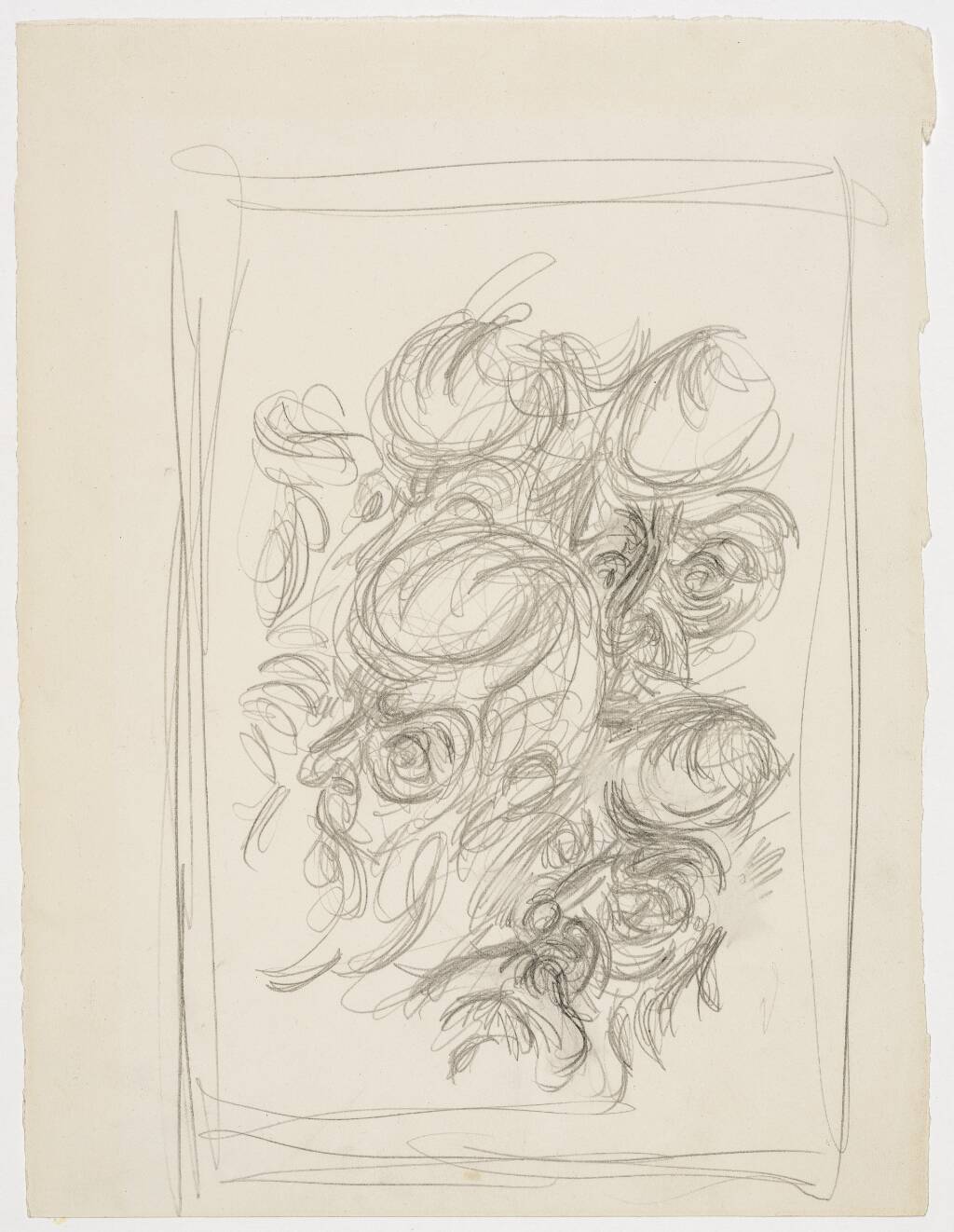
Efter Cimabue. Detalje fra korsfæstelsen i den øvre langkirke i Assisi
View through National Gallery of Denmark
This drawing is not an original work in the traditional sense,
but a copy. Alberto Giacometti copied art from all of Western
art history. By copying the works of older artists, he gained
insight into the nature of imitation. One might say that he
imitated his predecessors, who in turn imitated reality. The
representation of reality has always been a fundamental
matter for the visual arts.
As a rule, Giacometti did not copy directly from
original works of art, but from photographic reproductions
in books. The original for this drawing is in the church of
S. Francesco in the Italian city of Assisi, but the copy was
done after a photograph, not in front of the fresco. Created by
the Italian Renaissance artist Cimabue, the fresco depicts a
crucifixion scene. In Giacometti’s drawing, however, we do not
see the crucified figure. Instead, Giacometti focused on the
heads which in the fresco belong to spectators from the crowd
below the cross. Thus, this drawing is about observing. At the
level of its subject matter, it is about being a spectator, and in a
wider sense, the piece is about observing when copying (50 Favorites in the SMK Collection).
Title: Efter Cimabue. Detalje fra korsfæstelsen i den øvre langkirke i Assisi
Description:
This drawing is not an original work in the traditional sense,
but a copy.
Alberto Giacometti copied art from all of Western
art history.
By copying the works of older artists, he gained
insight into the nature of imitation.
One might say that he
imitated his predecessors, who in turn imitated reality.
The
representation of reality has always been a fundamental
matter for the visual arts.
As a rule, Giacometti did not copy directly from
original works of art, but from photographic reproductions
in books.
The original for this drawing is in the church of
S.
Francesco in the Italian city of Assisi, but the copy was
done after a photograph, not in front of the fresco.
Created by
the Italian Renaissance artist Cimabue, the fresco depicts a
crucifixion scene.
In Giacometti’s drawing, however, we do not
see the crucified figure.
Instead, Giacometti focused on the
heads which in the fresco belong to spectators from the crowd
below the cross.
Thus, this drawing is about observing.
At the
level of its subject matter, it is about being a spectator, and in a
wider sense, the piece is about observing when copying (50 Favorites in the SMK Collection).
Related Results
The Virgin and Child enthroned with Saints Dominic and Martin, and two angels
The Virgin and Child enthroned with Saints Dominic and Martin, and two angels
This panel of the Virgin and Child is the oldest painting in the Thyssen-Bornemisza collection. Its attribution to the Master of the Magdalen was made by Evelyn Sandberg-Vavalà and...
X-radiograph(s) of "Madonna and Child"
X-radiograph(s) of "Madonna and Child"
X-Radiograph Description: X-Radiograph; Negative; Detail : face and hand of Virgin
Burroughs Number: 407
X-Radiograph(s) of:
Artist: School of Cimabue
Title: Madonna and C...
X-radiograph(s) of "Madonna Enthroned"
X-radiograph(s) of "Madonna Enthroned"
X-Radiograph Description: Print (little Shows)
Burroughs Number: 3259
X-Radiograph(s) of:
Artist: Cimabue, Italian, ca.1240-ca.1302
Title: Madonna Enthroned
Owner: Galler...
X-radiograph(s) of "Madonna and Child"
X-radiograph(s) of "Madonna and Child"
X-Radiograph Description: X-Radiograph
X-Radiograph Settings: 5 ma, 45 kv, 1 min.
Burroughs Number: 4135
X-Radiograph(s) of:
Artist: School of Cimabue
Title: Madonna an...