
Search engine for discovering works of Art, research articles, and books related to Art and Culture


Javascript must be enabled to continue!
Faun and Nymph
View through National Gallery of Denmark
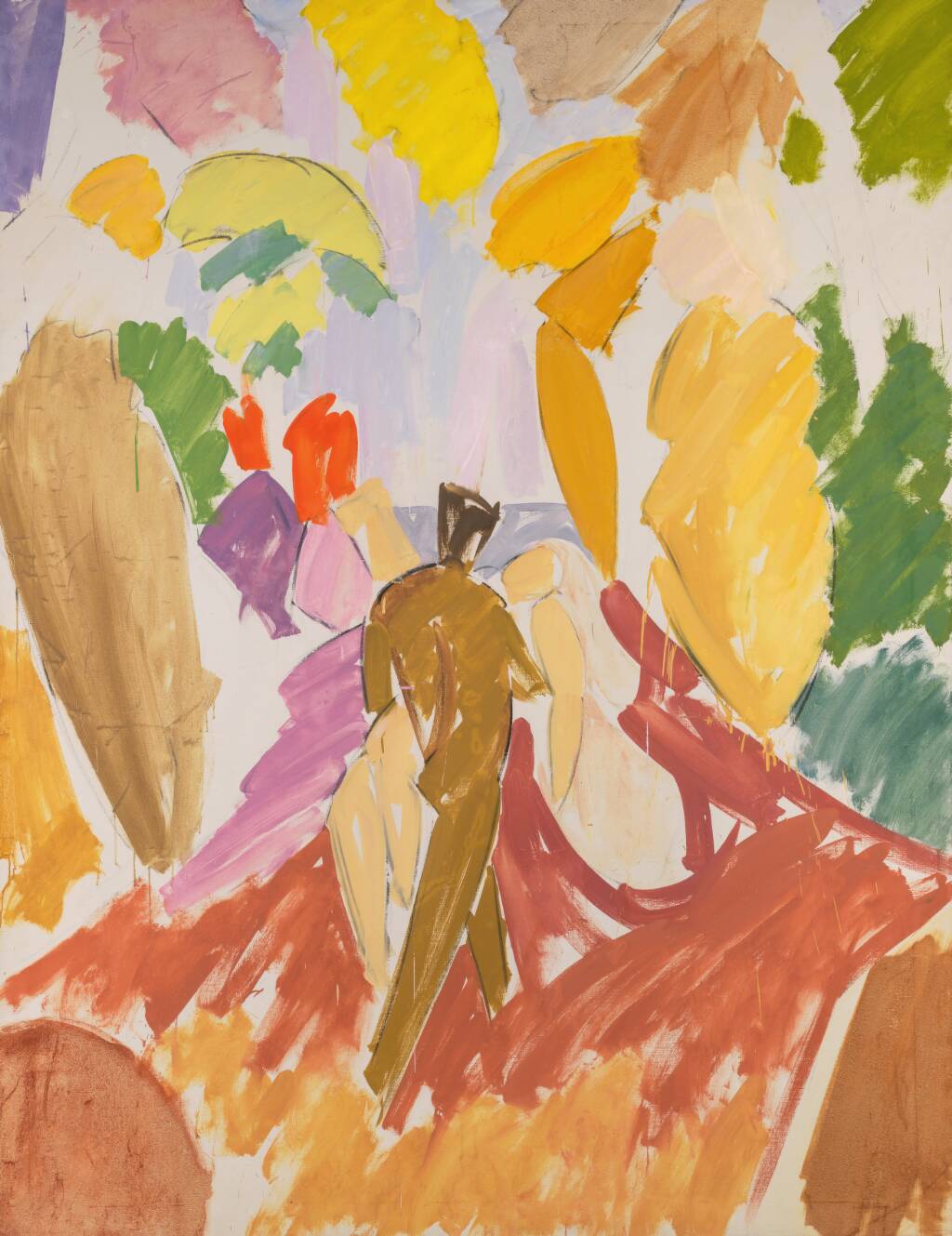
Faun and Nymph is the latest and most famous of Weie’s large-scale compositions. The picture was created in the summer of 1941, the last of Weie’s active years as an artist. It marks the end of his lifelong work with mythological and literary motifs. Faun and nymph united Weie got his subject matter from Paul Cézanne’s (1839-1906) painting The Abduction from 1867, but it also ties in with his own earlier mythological pictures where fauns and nymphs appear as the main characters. Here they are united: the faun, his back to us, carries his beloved, a nymph, towards the sea and the sky while she rests, yielding, in his arms. Pure harmonies of colour The idea for the landscape with the road leading towards the sea comes from Weie’s own landscape Mindet, Christiansø from 1912. In this late picture, however, the landscape has been simplified. The green leaves of the tree have been depicted as an almost crystalline structure composed of stringently defined fields of colour. All lines lead to the couple in the middle, drawing them into the picture: from the earth to the sea and further on into the sky. The picture marks the culmination of Weie’s ambition to compose a picture consisting entirely of pure harmonies of colour, serving here as accompaniment to an ideal image of the world where man and woman are united, where matter becomes spirit.
Værkdatering: (1940-41)
Påbegyndt: dokumenteret afsluttet: dokumenteret
Title: Faun and Nymph
Description:
Faun and Nymph is the latest and most famous of Weie’s large-scale compositions.
The picture was created in the summer of 1941, the last of Weie’s active years as an artist.
It marks the end of his lifelong work with mythological and literary motifs.
Faun and nymph united Weie got his subject matter from Paul Cézanne’s (1839-1906) painting The Abduction from 1867, but it also ties in with his own earlier mythological pictures where fauns and nymphs appear as the main characters.
Here they are united: the faun, his back to us, carries his beloved, a nymph, towards the sea and the sky while she rests, yielding, in his arms.
Pure harmonies of colour The idea for the landscape with the road leading towards the sea comes from Weie’s own landscape Mindet, Christiansø from 1912.
In this late picture, however, the landscape has been simplified.
The green leaves of the tree have been depicted as an almost crystalline structure composed of stringently defined fields of colour.
All lines lead to the couple in the middle, drawing them into the picture: from the earth to the sea and further on into the sky.
The picture marks the culmination of Weie’s ambition to compose a picture consisting entirely of pure harmonies of colour, serving here as accompaniment to an ideal image of the world where man and woman are united, where matter becomes spirit.
Related Results
The Nymph at the Fountain
The Nymph at the Fountain
In addition to religious compositions and portraiture, Cranach cultivated the genre of mythology in which he developed an innovative type of female nude that had little to do with ...
Satyr and Nymph
Satyr and Nymph
Two attendants of the wine god Bacchus – a satyr and a bacchante – are kissing, closely intertwined on a tree stump. The satyr has a goat’s legs and ears, and on the ground are his...
Pan and Syrinx
Pan and Syrinx
Both panels were acquired for the Collection in 1929 from Lucerne Fine Art, Switzerland. One month later, Georg Gronau wrote a report in which he praised the quality and artistic m...
Ladon and Syrinx
Ladon and Syrinx
Both panels were acquired for the Collection in 1929 from Lucerne Fine Art, Switzerland. One month later, Georg Gronau wrote a report in which he praised the quality and artistic m...
The Barberini Faun [Sleeping Faun], from "Classical Statues in Rome"
The Barberini Faun [Sleeping Faun], from "Classical Statues in Rome"
Etching, Classical Statues in Rome...