
Search engine for discovering works of Art, research articles, and books related to Art and Culture


Javascript must be enabled to continue!
Goldfish
View through National Gallery of Denmark
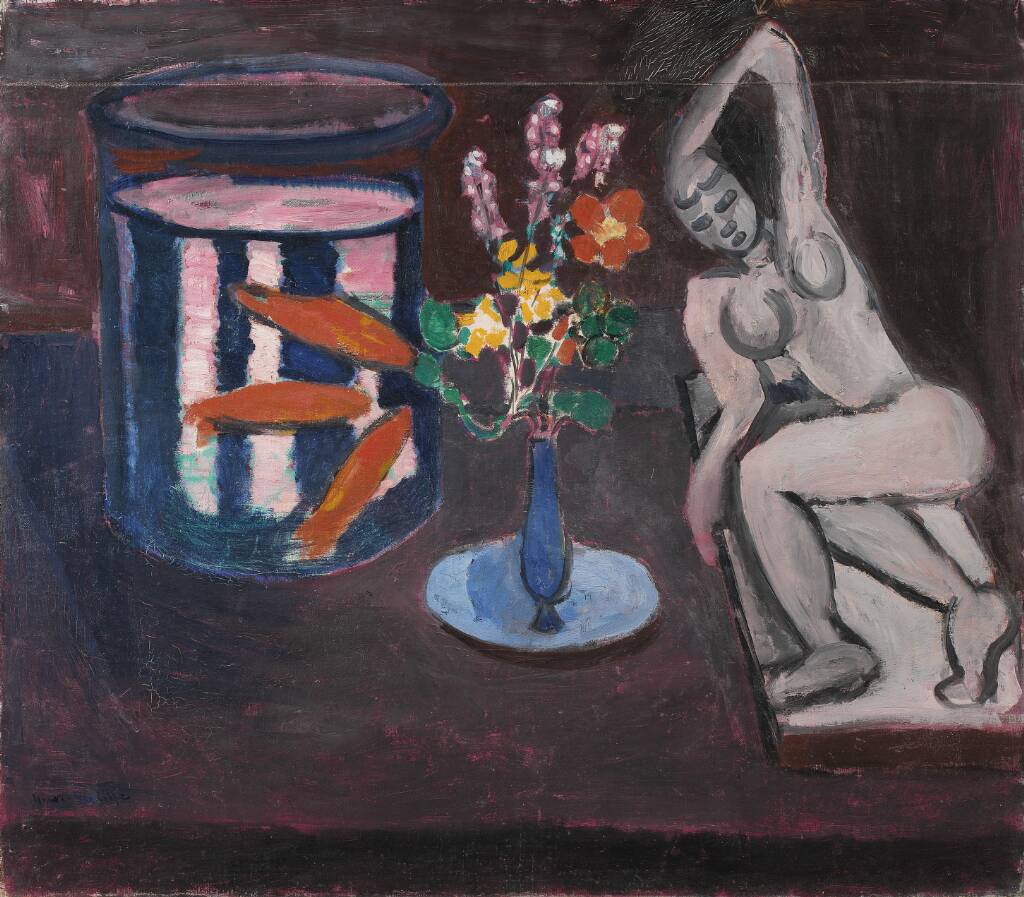
Goldfish have been part of European culture since the 17th century. Originally bred around 1,000 years before in China, the fish were used for decoration and as a luxury commodity. In the 19th century they were particularly popular in middle-class homes. In this painting they have been reduced to their most distinctive feature: a strong orange colour. Like three arrows they point towards the edge of the glass and the statuette of a reclining, naked woman. The work is composed out of smouldering colours, and has a melancholy and perhaps wistful air. Matisse's painting is always very much about how colours create moods. Presumably the goldfish have no allegorical significance that requires previous knowledge. Rather, they act here as symbols of something unattainable. The art historian Jack Flam has read the work as a story about a broken relationship and Matisse's yearning for love lost.
Title: Goldfish
Description:
Goldfish have been part of European culture since the 17th century.
Originally bred around 1,000 years before in China, the fish were used for decoration and as a luxury commodity.
In the 19th century they were particularly popular in middle-class homes.
In this painting they have been reduced to their most distinctive feature: a strong orange colour.
Like three arrows they point towards the edge of the glass and the statuette of a reclining, naked woman.
The work is composed out of smouldering colours, and has a melancholy and perhaps wistful air.
Matisse's painting is always very much about how colours create moods.
Presumably the goldfish have no allegorical significance that requires previous knowledge.
Rather, they act here as symbols of something unattainable.
The art historian Jack Flam has read the work as a story about a broken relationship and Matisse's yearning for love lost.
Related Results
Commercial Postcard with "The Philosopher" by Petro Longhi
Commercial Postcard with "The Philosopher" by Petro Longhi
Good example of interwoven text. Use of mass-produced commodity. Recto: reproduction of image by Pietro Longhi, "The Philosopher". Verso: addressed to: Dr. Mr. Prof. / Mark haxthau...
Tetsukazu Moriyama, Goldfish Bowl and Aquatic Plant(金魚鉢と水草) (Around 2003)
Tetsukazu Moriyama, Goldfish Bowl and Aquatic Plant(金魚鉢と水草) (Around 2003)
Reverse glass painting, 14.5 × 10 cm...
painting (gouache): ["Man At a Table with a Musical Instrument and a Servant"]
painting (gouache): ["Man At a Table with a Musical Instrument and a Servant"]
A man sits at a decorative green table, with open work at the sides and a scrolled base the length of the sides. He has one hand resting on a Guqin [seven-string musical instrument...