
Search engine for discovering works of Art, research articles, and books related to Art and Culture


Javascript must be enabled to continue!
Emperor Xuanzong (Japanese: Gensō) and Daoist Magician Lo Gongyuan Arising from an Inkstone; “Ink” (Sumi), from Four Friends of the Writing Table for the Ichiyō Poetry Circle (Ichiyō-ren Bunbō shiyū) From the Spring Rain Collection (Harusame shū), vol. 1
View through The Met
Woodblock print (surimono); ink and color on paper, Edo period (1615–1868), Japan
Rights: Public Domain
Asian Art, Metropolitan Museum of Art New York NY, H. O. Havemeyer Collection Bequest of Mrs. H. O. Havemeyer 1929
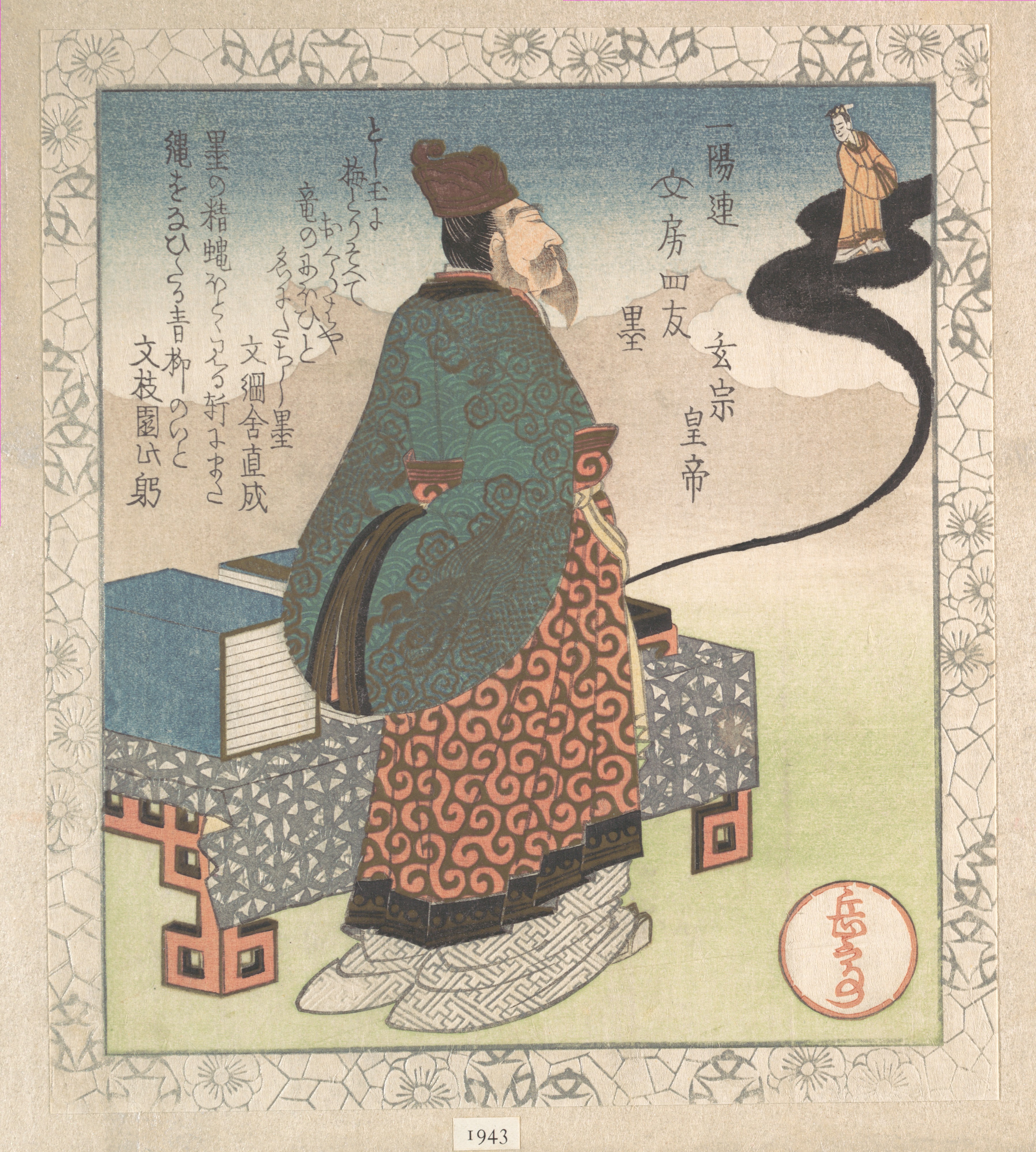
Title: Emperor Xuanzong (Japanese: Gensō) and Daoist Magician Lo Gongyuan Arising from an Inkstone; “Ink” (Sumi), from Four Friends of the Writing Table for the Ichiyō Poetry Circle (Ichiyō-ren Bunbō shiyū)
From the Spring Rain Collection (Harusame shū), vol. 1
Description:
Woodblock print (surimono); ink and color on paper, Edo period (1615–1868), Japan.
Related Results
Album of Drawings
Album of Drawings
1) Pen and brown ink brush and gray wash.
2) Pen and brown ink over black chalk.
3)
4) Black chalk.
5) Pen and brown ink over black chalk.
6) Pen and br...
The Chinese Calligrapher Boying (Japanese: Hakuei; also known as the “Sage of Cursive Script”); “Inkstone” (Suzuri), from Four Friends of the Writing Table for the Ichiyō Poetry Circle (Ichiyō-ren Bunbō shiyū)
From the Spring Rain Collection (Harusame
The Chinese Calligrapher Boying (Japanese: Hakuei; also known as the “Sage of Cursive Script”); “Inkstone” (Suzuri), from Four Friends of the Writing Table for the Ichiyō Poetry Circle (Ichiyō-ren Bunbō shiyū)
From the Spring Rain Collection (Harusame
Woodblock print (surimono); ink and color on paper, Edo period (1615–1868), Japan...
Nuji (Japanese: Joki; female attendant who compiled writings by Daoist sages); “Paper” (Kami), from Four Friends of the Writing Table for the Ichiyō Poetry Circle (Ichiyō-ren Bunbō shiyū)
From the Spring Rain Collection (Harusame shū), vol. 1
Nuji (Japanese: Joki; female attendant who compiled writings by Daoist sages); “Paper” (Kami), from Four Friends of the Writing Table for the Ichiyō Poetry Circle (Ichiyō-ren Bunbō shiyū)
From the Spring Rain Collection (Harusame shū), vol. 1
Woodblock print (surimono); ink and color on paper, Edo period (1615–1868), Japan...
The Heian Court Calligrapher Ono no Tōfū (894–966); “Calligraphy Brush” (Fude), from Four Friends of the Writing Table for the Ichiyō Poetry Circle (Ichiyō-ren Bunbō shiyū)
From the Spring Rain Collection (Harusame shū), vol. 1
The Heian Court Calligrapher Ono no Tōfū (894–966); “Calligraphy Brush” (Fude), from Four Friends of the Writing Table for the Ichiyō Poetry Circle (Ichiyō-ren Bunbō shiyū)
From the Spring Rain Collection (Harusame shū), vol. 1
Woodblock print (surimono); ink and color on paper, Edo period (1615–1868), Japan...
Myth (Expression of the Sea)
Myth (Expression of the Sea)
This vertically oriented, rectangular, multicolor woodblock print comprises four compositional units. Printed in purple, a five-armed octopus- or starfish-shaped emblem dominates t...
Scroll 1 from Song of Lasting Sorrow (Chōgonka gakan)
Scroll 1 from Song of Lasting Sorrow (Chōgonka gakan)
Handscroll painting, Scroll 1 from 'Song of Lasting Sorrow' (Chōgonka gakan), painted by Kanō Sansetsu (1590-1651) in ink, colours and gold on silk, in Japan in the late 1640s. The...