
Search engine for discovering works of Art, research articles, and books related to Art and Culture


Javascript must be enabled to continue!
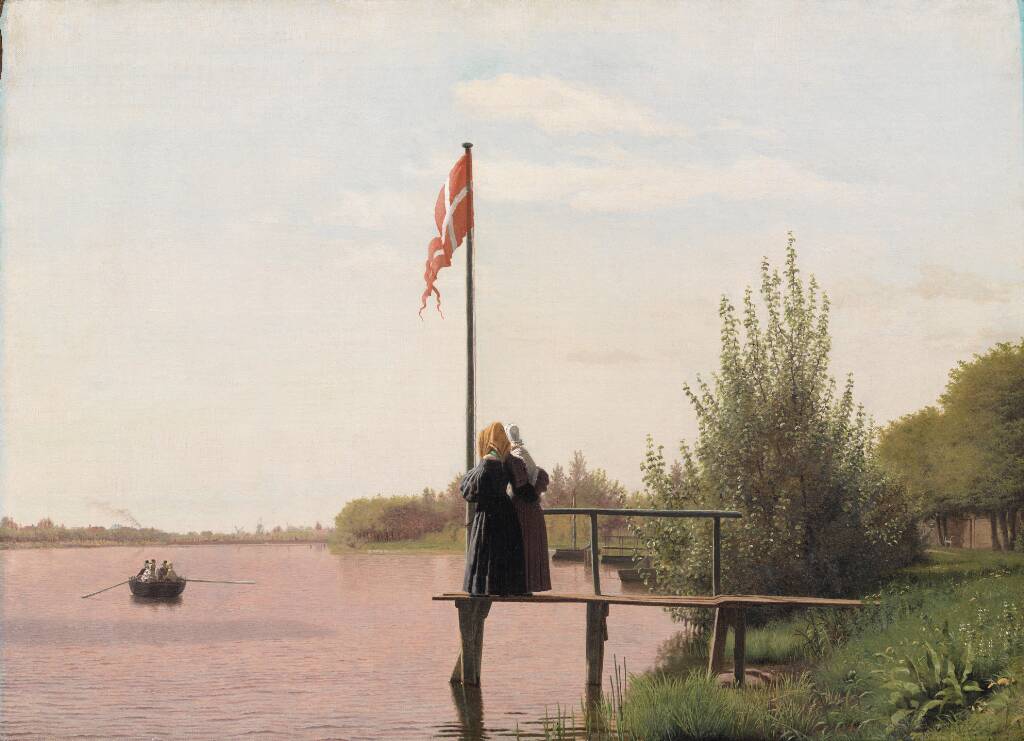
A View of Lake Sortedam from Dosseringen Looking towards the Suburb Nørrebro outside Copenhagen
View through National Gallery of Denmark
The painting was created at a time when national sentiments grew greatly in strength and scope. Indeed, the work cultivates the atmospheric and the romantic, while the flag accentuates the fact that we are looking at a Danish suburban landscape.
On a quiet summer night two young women stand on a bridge looking at a rowing boat slowly moving away on the lake. There is no defined narrative staged here, but nevertheless a story is told. It is a story without words or action; an atmospheric moment striking up a theme of departure and separation. The prosaic fact that the party could not have travelled very far away on the tiny lake has no impact on the message conveyed by the image.
Despite its relatively modest format, the painting is numbered among Købke’s large, carefully finished compositions. The painting is based on a small oil study of the same view as well as on several drawings; the artist has made several significant adjustments to the motif along the way. Købke leaned on his preliminary studies, but he tightened up the composition and all its lines, ranging from the lakeshore to the flagpole. Here, an otherwise unprepossessing suburban scene becomes stately and monumental. He also radically changed the colour scheme. The oil study had a warm feel to it with its light blue sky and water and yellowy-green grass and leaves, but in the large paintings these colours have been replaced with cooler hues. The sky has taken on a faint greenish tint to its cool blue colour, and the lake has taken on a light reddish-purple (which may seem like an optical impossibility, but the phenomenon can actually still be observed on the lake when the sun sets, which it does to the right of the section shown here). The change in colour scheme helps to highlight the fact that the time of day has been changed, too. The sunny day depicted in the study has been replaced by a more atmospheric, poetic late afternoon shortly before sunrise (although a slip-up on the artist’s part means that the light still falls from the left, i.e. from the south!). The scene has taken on a definite Romantic quality, elevating it above the everyday.
The flag is a very important addition to the painting. It makes the composition more striking, and the red of the flag balances out the cool nuances. At the same time the flag accentuates the atmospheric and romantic qualities of the painting, emphasising that we are looking at a Danish suburban scene. This links the painting to the nationalist sentiments that grew greatly in strength and scope around this time.
Købke had a similar painting from the Sortedam Lake exhibited at Charlottenborg in 1838, where it was well received by a critic at the journal Portefeuillen for 1839. However, the critic also demonstrated that he did not appreciate the artist’s previous work: "In almost all his work this artist has been remarkable for conscientious verisimilitude and simplicity, but unfortunately also for a striking carelessness in his choice of subject matter; this latter fact is certainly to be deplored insofar as Nature has in it much that is dull and ignoble and cannot be termed worthy subjects of art. It is a joy, therefore, to see in this painting a choice worthy of the artist’s brush: The serene twilight of the summer night is most excellently executed, the sunlight falling upon the trees to the left is warm and illuminating; the figures are well drawn, and it seems as if the inky shadows of night are tiptoeing their way into the scene. The entire scene is an exquisite Idyll before which we are happy to linger."
The painting was acquired by The Royal Collection of Paintings (the present-day National Gallery of Denmark) in 1839 - and was the first of the two paintings bought while the artist was still alive.
Title: A View of Lake Sortedam from Dosseringen Looking towards the Suburb Nørrebro outside Copenhagen
Description:
The painting was created at a time when national sentiments grew greatly in strength and scope.
Indeed, the work cultivates the atmospheric and the romantic, while the flag accentuates the fact that we are looking at a Danish suburban landscape.
On a quiet summer night two young women stand on a bridge looking at a rowing boat slowly moving away on the lake.
There is no defined narrative staged here, but nevertheless a story is told.
It is a story without words or action; an atmospheric moment striking up a theme of departure and separation.
The prosaic fact that the party could not have travelled very far away on the tiny lake has no impact on the message conveyed by the image.
Despite its relatively modest format, the painting is numbered among Købke’s large, carefully finished compositions.
The painting is based on a small oil study of the same view as well as on several drawings; the artist has made several significant adjustments to the motif along the way.
Købke leaned on his preliminary studies, but he tightened up the composition and all its lines, ranging from the lakeshore to the flagpole.
Here, an otherwise unprepossessing suburban scene becomes stately and monumental.
He also radically changed the colour scheme.
The oil study had a warm feel to it with its light blue sky and water and yellowy-green grass and leaves, but in the large paintings these colours have been replaced with cooler hues.
The sky has taken on a faint greenish tint to its cool blue colour, and the lake has taken on a light reddish-purple (which may seem like an optical impossibility, but the phenomenon can actually still be observed on the lake when the sun sets, which it does to the right of the section shown here).
The change in colour scheme helps to highlight the fact that the time of day has been changed, too.
The sunny day depicted in the study has been replaced by a more atmospheric, poetic late afternoon shortly before sunrise (although a slip-up on the artist’s part means that the light still falls from the left, i.
e.
from the south!).
The scene has taken on a definite Romantic quality, elevating it above the everyday.
The flag is a very important addition to the painting.
It makes the composition more striking, and the red of the flag balances out the cool nuances.
At the same time the flag accentuates the atmospheric and romantic qualities of the painting, emphasising that we are looking at a Danish suburban scene.
This links the painting to the nationalist sentiments that grew greatly in strength and scope around this time.
Købke had a similar painting from the Sortedam Lake exhibited at Charlottenborg in 1838, where it was well received by a critic at the journal Portefeuillen for 1839.
However, the critic also demonstrated that he did not appreciate the artist’s previous work: "In almost all his work this artist has been remarkable for conscientious verisimilitude and simplicity, but unfortunately also for a striking carelessness in his choice of subject matter; this latter fact is certainly to be deplored insofar as Nature has in it much that is dull and ignoble and cannot be termed worthy subjects of art.
It is a joy, therefore, to see in this painting a choice worthy of the artist’s brush: The serene twilight of the summer night is most excellently executed, the sunlight falling upon the trees to the left is warm and illuminating; the figures are well drawn, and it seems as if the inky shadows of night are tiptoeing their way into the scene.
The entire scene is an exquisite Idyll before which we are happy to linger.
"
The painting was acquired by The Royal Collection of Paintings (the present-day National Gallery of Denmark) in 1839 - and was the first of the two paintings bought while the artist was still alive.
Related Results
JLM LOl1422
JLM LOl1422
Särvjöbor photographed around 1915. The farm in the background: Lake SärvG3: 4. Standing Fr v: Per Oskar Olofssoon/Hedmark Särvjön 3: 17 “Backen” born 1907-09-01. Olov Persson Lake...
City map and view of Berlin, ca.1: 9 000, Kupferst., 1737
City map and view of Berlin, ca.1: 9 000, Kupferst., 1737
Basic crack of the king Prussia Residentz Berlin: which contains the cities A. Berlin. B. Cölln. C. Fridr.-Werder. D. Neustadt. E. Friederich-Stadt. F. Cöllische Suburb. G. Berlin ...
Greenwood Lake
Greenwood Lake
Just as Frederic Church and Albert Bierstadt had homes built on the banks of the Hudson River when they reached the height of their careers, Jasper F. Cropsey had a mansion erected...
The Fire on the Wall
The Fire on the Wall
The Christian Free Church Faderhuset, which has bought the Youth House in Nørrebro in Copenhagen, believes that its residents are occupied by demons....