
Search engine for discovering works of Art, research articles, and books related to Art and Culture


Javascript must be enabled to continue!
A Coach House. Partenkirchen
View through National Gallery of Denmark
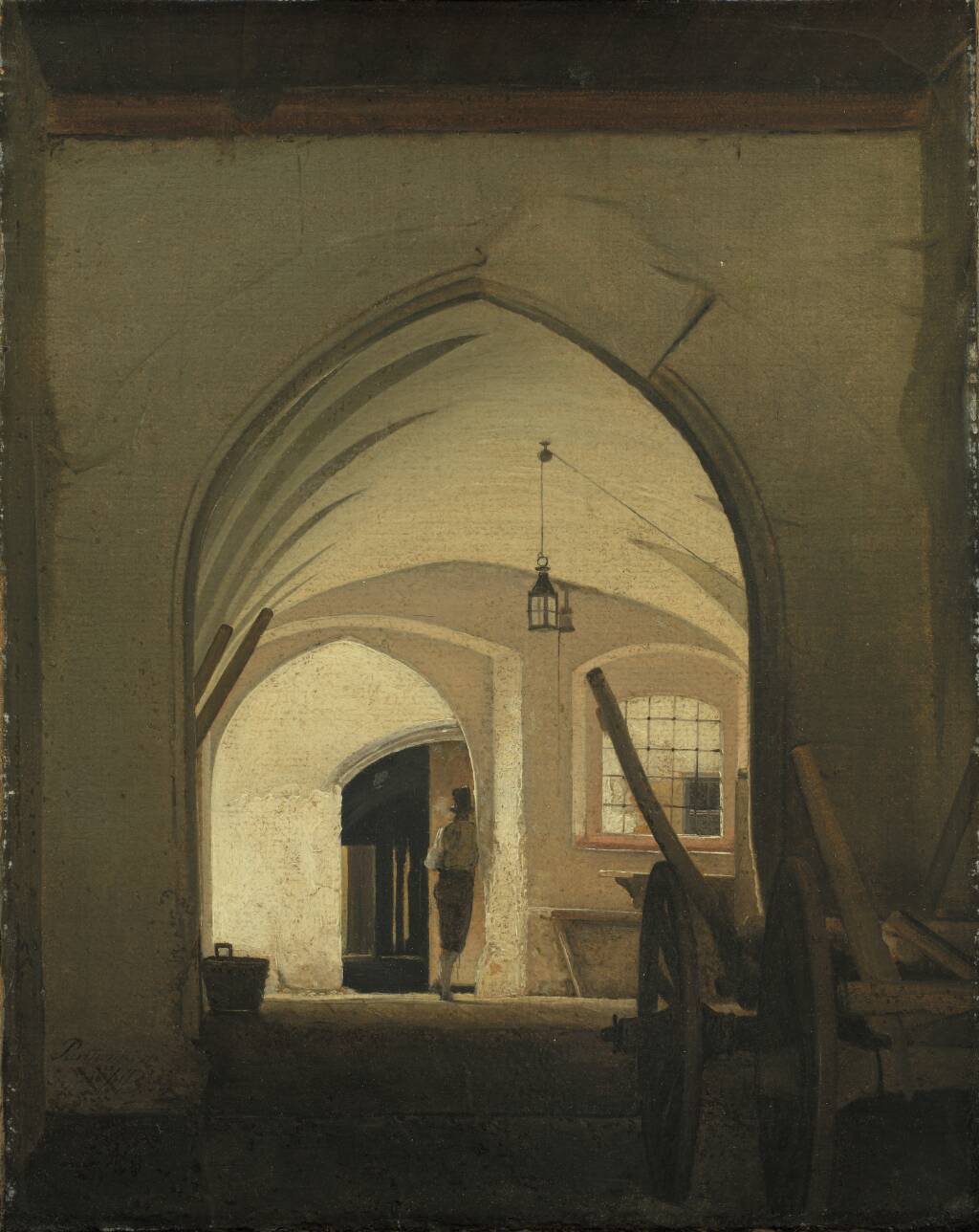
The imagery of Golden Age art is infused with a positive view of life. The paintings often accentuate the positive qualities of everyday life. Only rarely is attention focused on the darker aspects of the mind. This painting may be among the rare exceptions. During his Grand Tour, conducted in 1831-32, Bendz painted a coach house in Partenkirchen in the south of Germany. The painting showcases the artist's keen sense for depicting architecture, but it shows more than that. The artist would have been standing in the dark, looking towards the dimly lit arches. A solitary figure, his back turned to us, leads our gaze onwards - not towards the light, but further into the darkness. The man is different from most of the many similarly posed figures from the period's art insofar as he does not appear to be looking out towards the world around him; rather, he hints at introspection and reflection. The almost claustrophobic space and the dominant darkness give the painting a sombre, melancholy air.
Title: A Coach House. Partenkirchen
Description:
The imagery of Golden Age art is infused with a positive view of life.
The paintings often accentuate the positive qualities of everyday life.
Only rarely is attention focused on the darker aspects of the mind.
This painting may be among the rare exceptions.
During his Grand Tour, conducted in 1831-32, Bendz painted a coach house in Partenkirchen in the south of Germany.
The painting showcases the artist's keen sense for depicting architecture, but it shows more than that.
The artist would have been standing in the dark, looking towards the dimly lit arches.
A solitary figure, his back turned to us, leads our gaze onwards - not towards the light, but further into the darkness.
The man is different from most of the many similarly posed figures from the period's art insofar as he does not appear to be looking out towards the world around him; rather, he hints at introspection and reflection.
The almost claustrophobic space and the dominant darkness give the painting a sombre, melancholy air.
Related Results
Billy the state coachman
Billy the state coachman
BILLY THE STATE COACHMAN Leaving his Helpmates in the Lurch after assisting him to Mount the Box\nPubd May 18th 1804 by SW Fores No 50 Piccadilly\nHere Pitt has captured the coachm...
The Garden and Coach House of 524 Keizersgracht in Amsterdam
The Garden and Coach House of 524 Keizersgracht in Amsterdam
Nicolaas Doekscheer, who lived at 524 Keizersgracht, built a grand, Rococo coach house on the Kerkstraat, which adjoined the back of his garden. He is here depicted conversing with...
Portrait series Richard Strauss
Portrait series Richard Strauss
Strauss, Richard (1864-1949; composer, conductor). Garmisch-Partenkirchen, 1931...
Adriaan van der Hoop’s Trotter ‘De Rot’ at the Coach House
Adriaan van der Hoop’s Trotter ‘De Rot’ at the Coach House
The prizewinning racehorse ‘De Rot’ wears a decorated bridle, and its tail is tied up and embellished with a rosette in the latest fashion à l’anglaise (in the English manner). In ...