
Search engine for discovering works of Art, research articles, and books related to Art and Culture


Javascript must be enabled to continue!
The Holy Family. The Rest on the Flight into Egypt
View through National Gallery of Denmark
A Mary full of sorrow bends to the Christ Child who returns her gaze with equal passion. The Passion is also implicitly present in the crossshaped pose of the Christ Child, stretching across the entire surface, and in the red anemones Mary holds in her hand. The mood of the painting The apocryphal writings known as the Pseudo-Gospel of Matthew states how anemones sprang from the ground around the base of the Cross in the evening of Good Friday. The mood of the painting is very much created by contrasts between light and shadow which also serve to prefigure what lies ahead for the small family. An anticipation of the Baroque painting Giulio Cesare Procaccini began his career as a sculptor, a fact which might explain his solid sense of the plastic. From around 1600 he turned conclusively to painting, developing it in the direction of a refined and elegant Mannerist figural style with clear links to his fellow artist Parmigianino (1503-1540). However, the depth and intensity with which he renders human emotion anticipates Baroque painting.
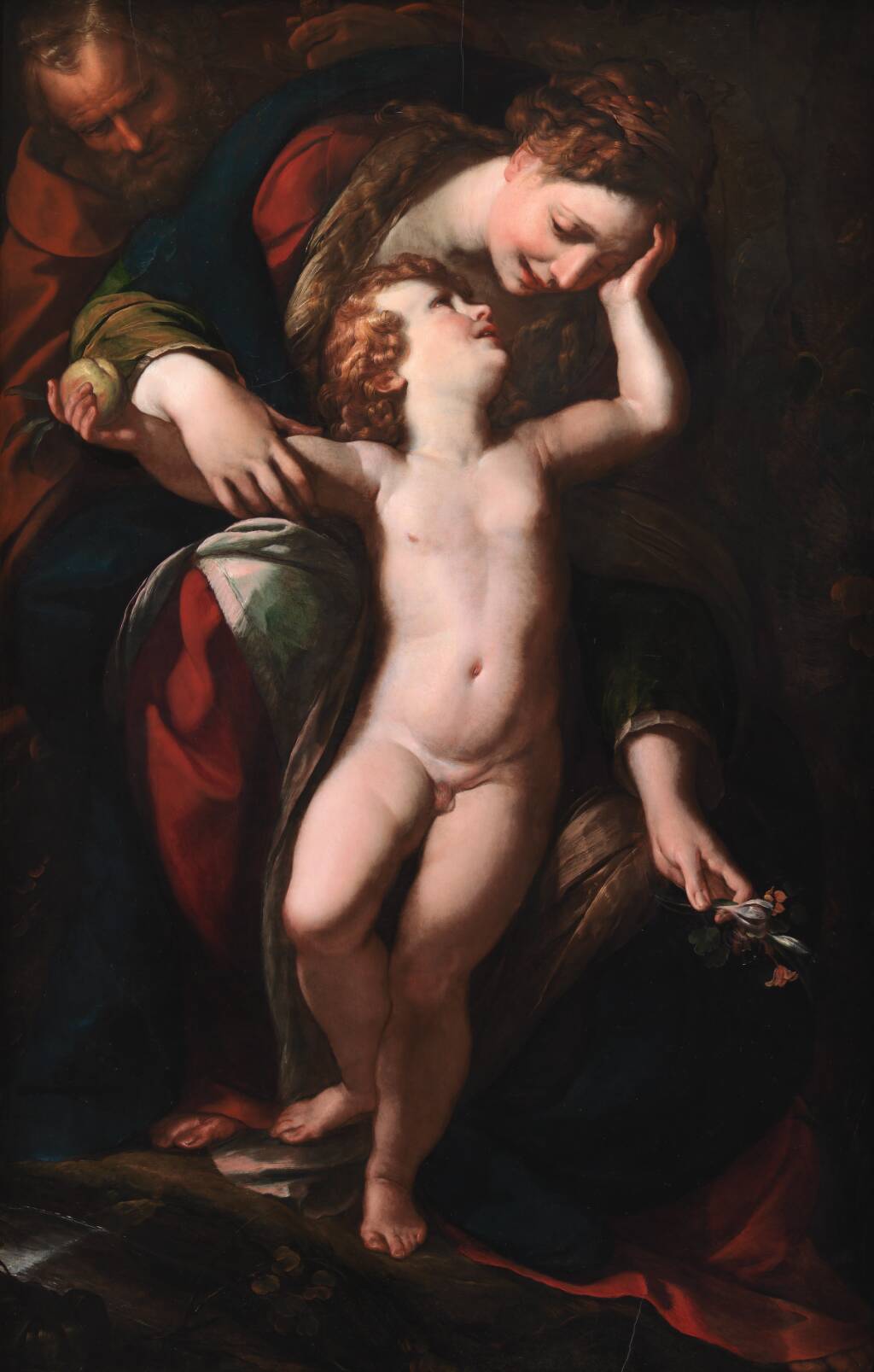
Title: The Holy Family. The Rest on the Flight into Egypt
Description:
A Mary full of sorrow bends to the Christ Child who returns her gaze with equal passion.
The Passion is also implicitly present in the crossshaped pose of the Christ Child, stretching across the entire surface, and in the red anemones Mary holds in her hand.
The mood of the painting The apocryphal writings known as the Pseudo-Gospel of Matthew states how anemones sprang from the ground around the base of the Cross in the evening of Good Friday.
The mood of the painting is very much created by contrasts between light and shadow which also serve to prefigure what lies ahead for the small family.
An anticipation of the Baroque painting Giulio Cesare Procaccini began his career as a sculptor, a fact which might explain his solid sense of the plastic.
From around 1600 he turned conclusively to painting, developing it in the direction of a refined and elegant Mannerist figural style with clear links to his fellow artist Parmigianino (1503-1540).
However, the depth and intensity with which he renders human emotion anticipates Baroque painting.
Related Results
The Virgin and Child with Saint Elizabeth and Saint John the Baptist
The Virgin and Child with Saint Elizabeth and Saint John the Baptist
Within Rubens’ enormous output as a painter, which covered the principal pictorial genres (all of which he handled with equal skill), religious painting occupies a prominent positi...
painting (oil): ["Rest on the Flight Into Egypt"] aka "Virgin, Child and St Joseph in Landscape"
painting (oil): ["Rest on the Flight Into Egypt"] aka "Virgin, Child and St Joseph in Landscape"
The rest (or repose) on the flight into Egypt is taken from the statement in Matthew which relates how Joseph, warned in a dream that King Herod was searching for the infant Jesus ...
Rest on the Flight into Egypt
Rest on the Flight into Egypt
Giovanni Battista Pittoni was one of the leading representatives of 18th-century Venetian painting. He trained in his native city with his uncle Francesco and perfected his style b...
The Rest on the Flight into Egypt (The Repose of the Holy Family in Egypt)
The Rest on the Flight into Egypt (The Repose of the Holy Family in Egypt)
Watercolor pen and black ink over graphite...
painting (oil): ["Rest on the Flight Into Egypt"]
painting (oil): ["Rest on the Flight Into Egypt"]
Angels hovering overhead or bringing food on dishes are a common feature of the subject of the rest (or repose) on the flight to Egypt, where Joseph took Jesus and his mother to es...
X-radiograph(s) of "Rest of the Flight into Egypt"
X-radiograph(s) of "Rest of the Flight into Egypt"
X-Radiograph Description: X-Radiograph
Burroughs Number: 3128
X-Radiograph(s) of:
Artist: Correggio, Italian, ca. 1489-1534
Title: Rest of the Flight into Egypt
Date: 145...