
Search engine for discovering works of Art, research articles, and books related to Art and Culture


Javascript must be enabled to continue!
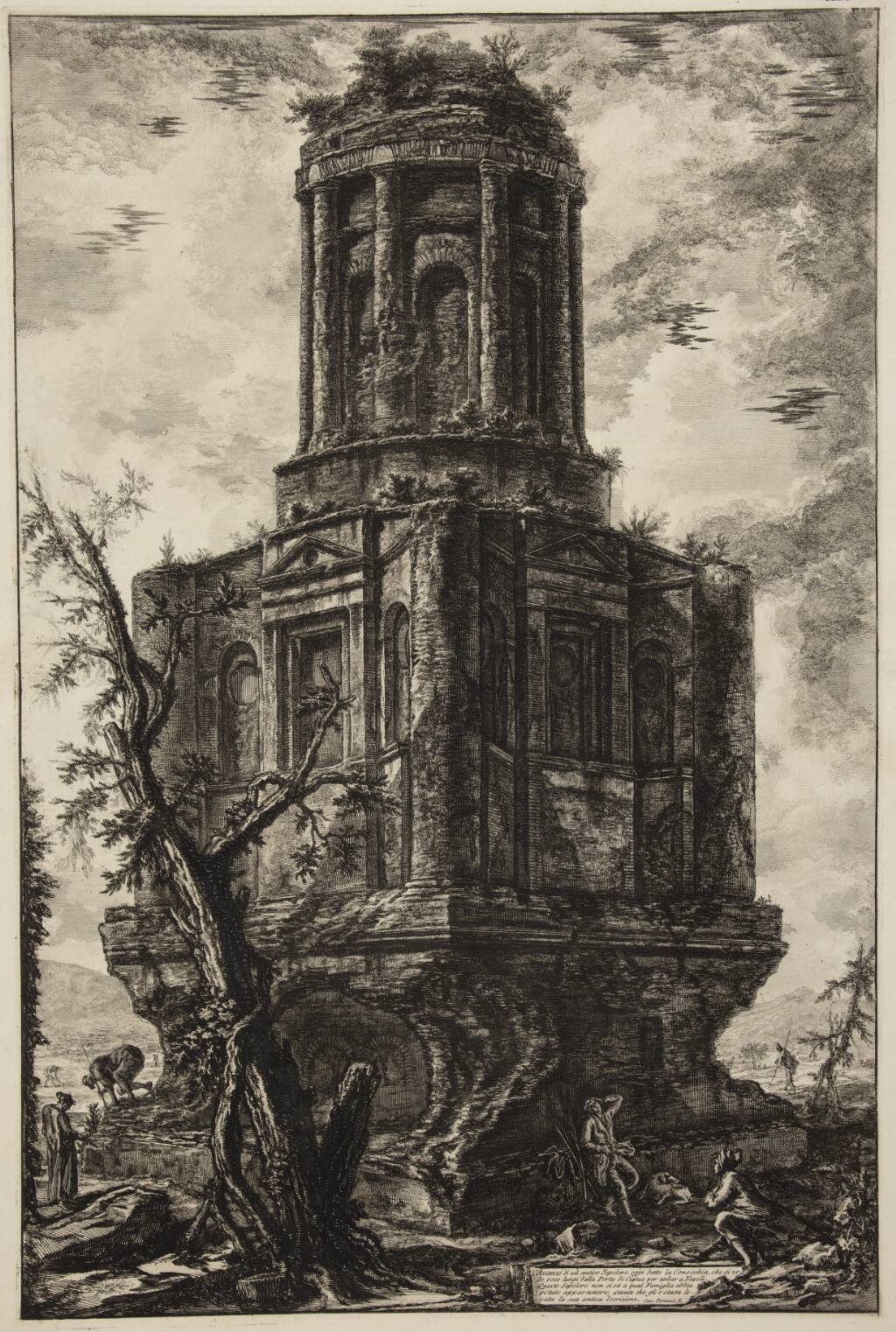
View of the ancient tomb, called La Conocchia, on the Appian Way, near Capua
View through National Gallery of Denmark
Giovanni Battista Piranesi was one of the finest printmakers
in eighteenth-century Italy. And one of the most productive.
His many etchings (numbering more than 1,000 in total) are
distinctive in several ways, including in terms of size. Their
formats are unusually large for prints. The copper plates used
to create etchings were expensive, and the larger the format,
the more expensive the work – and therefore more difficult to
sell. Piranisi’s motifs are almost exclusively actual buildings
from Rome and the surrounding area, and he was particularly
interested in architecture from antiquity.
Although most of the buildings can be recognised
from real life, they seem strangely alien and unrealistic.
Piranesi has distorted their proportions, as is the case in
this representation of an antique sepulchral monument,
which in the real world is quite modest in scale. Here it
seems impressive and grand. The tiny, eerie figures crawling
around the edifice partly serve to indicate scale and partly
help give the scene a darkly disturbing air: it becomes
incomprehensible, difficult to grasp. The large piece of paper,
on which the printing ink clearly asserts itself as material,
speaks to our senses – and makes the scene almost magical (50 Favorites in the SMK Collection).
Title: View of the ancient tomb, called La Conocchia, on the Appian Way, near Capua
Description:
Giovanni Battista Piranesi was one of the finest printmakers
in eighteenth-century Italy.
And one of the most productive.
His many etchings (numbering more than 1,000 in total) are
distinctive in several ways, including in terms of size.
Their
formats are unusually large for prints.
The copper plates used
to create etchings were expensive, and the larger the format,
the more expensive the work – and therefore more difficult to
sell.
Piranisi’s motifs are almost exclusively actual buildings
from Rome and the surrounding area, and he was particularly
interested in architecture from antiquity.
Although most of the buildings can be recognised
from real life, they seem strangely alien and unrealistic.
Piranesi has distorted their proportions, as is the case in
this representation of an antique sepulchral monument,
which in the real world is quite modest in scale.
Here it
seems impressive and grand.
The tiny, eerie figures crawling
around the edifice partly serve to indicate scale and partly
help give the scene a darkly disturbing air: it becomes
incomprehensible, difficult to grasp.
The large piece of paper,
on which the printing ink clearly asserts itself as material,
speaks to our senses – and makes the scene almost magical (50 Favorites in the SMK Collection).
Related Results
Antichità Romane de' Tempi della Repubblica e de' primi Imperatori
Antichità Romane de' Tempi della Repubblica e de' primi Imperatori
Includes the following plates in this order:
Title Plate (Wilton-Ely 103)
pl. 2 Dedication to Giovanni Bottari (W-E 104)
pl. 3 Transcription of various ancient Latin inscripti...
Remains of an ancient tomb, called La Conocchia, which is located just outside the Porta di Capua on the road to Naples, from "Vedute di Roma" (Roman Views), part II
Remains of an ancient tomb, called La Conocchia, which is located just outside the Porta di Capua on the road to Naples, from "Vedute di Roma" (Roman Views), part II
Etching; first state of three (Hind), Vedute di Roma...
Avanzi di un antico Sepolcro, oggi detto la Conocchia che si vede poco lungi dalla Porta di Capua per andar a Napoli [Material gráfico]
Avanzi di un antico Sepolcro, oggi detto la Conocchia che si vede poco lungi dalla Porta di Capua per andar a Napoli [Material gráfico]
The iron is preserved in the Calcography of Rome...
View of the Tomb of Licinianus Piso on the ancient Appian Way [...] B. Tomb of the Cornelii [...], from "Vedute di Roma" (Roman Views), part II
View of the Tomb of Licinianus Piso on the ancient Appian Way [...] B. Tomb of the Cornelii [...], from "Vedute di Roma" (Roman Views), part II
Etching; first state of three (Hind), Vedute di Roma...
Latin Funerary Inscription of Q. Caecilius Hilarus and Caecilia Eleutheris
Latin Funerary Inscription of Q. Caecilius Hilarus and Caecilia Eleutheris
Marble Latin Funerary Inscription of Caecilius Hilarius, physician to Caecilia Metella. Excellent condition. Thin crack from right-of-center bottom to middle of fourth row of inscr...
Crystal Palace interior view of a medieval style hall with arches and gothic detailing. In the foreground is a tomb with a recumbent figure of with hands in prayer position on a plinth. This is the Tomb of the Black Prince.
Crystal Palace interior view of a medieval style hall with arches and gothic detailing. In the foreground is a tomb with a recumbent figure of with hands in prayer position on a plinth. This is the Tomb of the Black Prince.
Crystal Palace interior view of a medieval style hall with arches and gothic detailing. In the foreground is a tomb with a recumbent figure of with hands in prayer position on a pl...
Gateway to Akbar's tomb with carriage in front, Sikandar, negative no. 221
Gateway to Akbar's tomb with carriage in front, Sikandar, negative no. 221
A stately view of the entranceway to the tomb of the Mughal Emperor Akbar (d. 1605). The entrance gate sits in the center of the composition on a low horizon line created by the ga...