
Search engine for discovering works of Art, research articles, and books related to Art and Culture


Javascript must be enabled to continue!
painting, drawing,
View through Europeana Collections
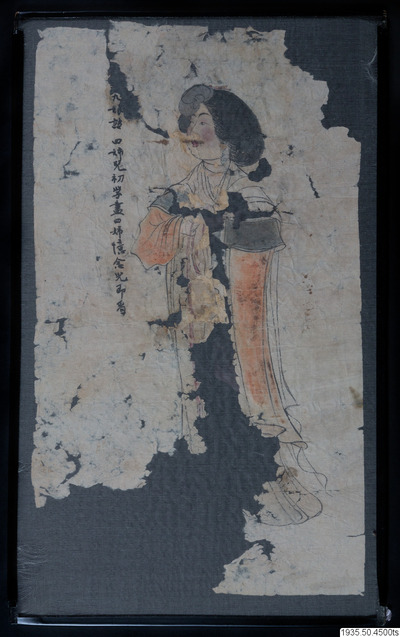
One can see at a glance that this is an original work from the
T'ang period. It is a sketch which — judging by the accompanying
text — is intended as a greeting from a lady to a close relative,
perhaps a proud mother's boasting about the achievements of her
talented son.
The fragment can best be described as a water-coloured drawing
in Indian ink, on an uncut sheet of paper in the original size
(23.5 X 40.5 cm.) it,had when it left the paper-maker's workshop.
The central part of it is occupied by the figure of a standing woman,
her head in half-profile, looking to the left. Her right hand is raised
to her breast, holding a narrow ribbon, one end of which hangs far
down along the dress. Her hair has been put up in the fashion which
seems to have been prevalent among ladies of high society during
the T'ang dynasty. Grave figures from this period show numerous
variations of this fashion,, which, however, all have a common
characteristic in that the hair falls in heavy pads around the head
and is gathered up in a knot over the forehead. In our drawing, as
in many other cases, the topknot is evidently wrapped in a piece of
grey cloth and fastened with pins which can be glimpsed at the top
....
At one side of the picture, another hand has written a row of bold
characters reading in translation: "The ninth lady said — The son
of the fourth elder sister began to learn drawing. Whenever the
fourth elder sister thinks of her son, she looks (may look) at this."
The sketch bears witness that the son of the fourth elder sister was
really well advanced in his art. His drawing is lifelike, sensitive, and
sure in style. Perhaps this may be an anonymous early work of one
of the great artists of the period (Montell 1950)
Title: painting, drawing,
Description:
One can see at a glance that this is an original work from the
T'ang period.
It is a sketch which — judging by the accompanying
text — is intended as a greeting from a lady to a close relative,
perhaps a proud mother's boasting about the achievements of her
talented son.
The fragment can best be described as a water-coloured drawing
in Indian ink, on an uncut sheet of paper in the original size
(23.
5 X 40.
5 cm.
) it,had when it left the paper-maker's workshop.
The central part of it is occupied by the figure of a standing woman,
her head in half-profile, looking to the left.
Her right hand is raised
to her breast, holding a narrow ribbon, one end of which hangs far
down along the dress.
Her hair has been put up in the fashion which
seems to have been prevalent among ladies of high society during
the T'ang dynasty.
Grave figures from this period show numerous
variations of this fashion,, which, however, all have a common
characteristic in that the hair falls in heavy pads around the head
and is gathered up in a knot over the forehead.
In our drawing, as
in many other cases, the topknot is evidently wrapped in a piece of
grey cloth and fastened with pins which can be glimpsed at the top
.
At one side of the picture, another hand has written a row of bold
characters reading in translation: "The ninth lady said — The son
of the fourth elder sister began to learn drawing.
Whenever the
fourth elder sister thinks of her son, she looks (may look) at this.
"
The sketch bears witness that the son of the fourth elder sister was
really well advanced in his art.
His drawing is lifelike, sensitive, and
sure in style.
Perhaps this may be an anonymous early work of one
of the great artists of the period (Montell 1950).
Related Results
painting, painting, painting, painting, painting, painting, painting, painting, painting, painting, painting, painting, painting, painting, painting, painting, painting, painting, painting, painting, painting, painting, painting, painting, painting, paint
painting, painting, painting, painting, painting, painting, painting, painting, painting, painting, painting, painting, painting, painting, painting, painting, painting, painting, painting, painting, painting, painting, painting, painting, painting, paint
"Here is portrayed three Moods of the Sky and the effects on the Fish and Animals. Sharks and Turtles come to the Surface when it is Raining. Wallabies and Kangaroos are out feedin...
The West Façade of the Church of Saint Mary in Utrecht
The West Façade of the Church of Saint Mary in Utrecht
Among the new genres in Dutch painting developed during the Golden Age was that of paintings of architectural motifs. This sub-genre took on its own independent existence, in a man...
Luminescence
Luminescence
In 1925, at the first exhibition of the OST, the painter I. Kudriashov presented two series of paintings: the Construction of Straight Line Movement and the Construction of Curvili...
Midvinterblot
Midvinterblot
The painting shows a naked man with his head held high standing on a gilded sleigh drawn by four strong men, two pulling and two pushing. A one-eyed priest is shown in the centre o...
Pierrot Content
Pierrot Content
Pierrot content is one of a group of early works by Watteau in which the artist developed the theme of the fête galante that would be so highly appreciated during the 18th century....
Heimdal överlämnar Brisingasmycket till Freja
Heimdal överlämnar Brisingasmycket till Freja
New acquisition, September 2013: Competition entry by Nils Andersson Nils Andersson's painting Heimdal Returns Brisingamen to Freya is an evocative example of the images of ancient...
The Mother of God of Trakai
The Mother of God of Trakai
It is one of the oldest easel paintings in Lithuania, closely linked to Vytautas, the Grand Duke of Lithuania (reigning 1401-1430), and early Christianisation in Lithuania. Up unti...