
Search engine for discovering works of Art, research articles, and books related to Art and Culture


Javascript must be enabled to continue!
minneshuvud, bronshuvud, commemorative head, bronze head, Oba
View through Europeana Collections
Royal memorial head bronze.
Several large heads of this type-probably six or eight of them, made for a newly succeeding Oba of Benin to consecrate on the altar of his predecessor-mark the sudden decline of the great Benin style into the characteristic (and only occasionally avoided) bathos of the Late period (about 1650-1897), after a hundred years or more of artistic stability-the period of the rectangular plaques (see above), or Middle Period (lasting from about 1525 or 1550 to 1650). Seen by itself, this piece is still quite impressive; but decline from the dignified mean, the gravitas, of the Middle period becomes obvious enough when it is placed beside any of the 50 or more royal heads of the previous century, or indeed beside the bronze plaque in this collection.
Exaggerations have crept in wich are apparently designed to increase the importance and visible pomp of royal representation: for example, the high beaded collar has now become impossibly high. The casting technique also now exhibits more imperfections.
By William Fagg. The Georg von Békésy Collection. Page 172-173.
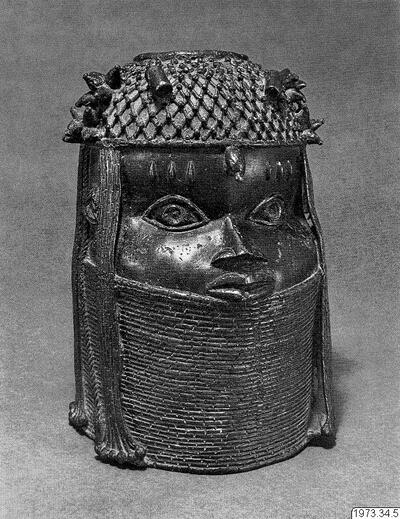
Title: minneshuvud, bronshuvud, commemorative head, bronze head, Oba
Description:
Royal memorial head bronze.
Several large heads of this type-probably six or eight of them, made for a newly succeeding Oba of Benin to consecrate on the altar of his predecessor-mark the sudden decline of the great Benin style into the characteristic (and only occasionally avoided) bathos of the Late period (about 1650-1897), after a hundred years or more of artistic stability-the period of the rectangular plaques (see above), or Middle Period (lasting from about 1525 or 1550 to 1650).
Seen by itself, this piece is still quite impressive; but decline from the dignified mean, the gravitas, of the Middle period becomes obvious enough when it is placed beside any of the 50 or more royal heads of the previous century, or indeed beside the bronze plaque in this collection.
Exaggerations have crept in wich are apparently designed to increase the importance and visible pomp of royal representation: for example, the high beaded collar has now become impossibly high.
The casting technique also now exhibits more imperfections.
By William Fagg.
The Georg von Békésy Collection.
Page 172-173.
Related Results
skulptur, minneshuvud, sculpture, bronze head, commemorative head
skulptur, minneshuvud, sculpture, bronze head, commemorative head
Commemorative head of an Oba
This head made of brass was placed on a royal
altar. The eyes are placed somewhat asymmetrically
and seem to be looking in different directions.
Is thi...
Late Bronze Age, Bronze Cauldron, HCA 458
Late Bronze Age, Bronze Cauldron, HCA 458
This bronze cauldron was discovered at Toome near Ballyscullion, Co. Antrim. The body and rim are made from eight pieces of beaten bronze, each hammered to a thickness of about 1mm...
Enamelled gold commemorative ring, set with a rose-cut diamond cipher of King Louis Philippe of France, with a brilliant-cut diamond border, French warranty mark from 1838, France, ca. 1840. Enamelled gold commemorative ring, set with diamonds. The oval b
Enamelled gold commemorative ring, set with a rose-cut diamond cipher of King Louis Philippe of France, with a brilliant-cut diamond border, French warranty mark from 1838, France, ca. 1840. Enamelled gold commemorative ring, set with diamonds. The oval b
Enamelled gold commemorative ring, set with a rose-cut diamond cipher of King Louis Philippe of France, with a brilliant-cut diamond border, French warranty mark from 1838, France,...
Memory Head, Bronze Head, Head, Principle Head, Oba
Memory Head, Bronze Head, Head, Principle Head, Oba
Commemorative head of an Oba commissioned sometime in the 19th century by one of the three kings Osemwede, Adolo or Owonramwen. The head wears a caplike beaded crown with winglike ...
Uhunmwu-Elao (commemorative head of an oba)
Uhunmwu-Elao (commemorative head of an oba)
This work is one of the bronze, ivory and wooden artworks broadly known as the “Benin Bronzes."...
elefantbete, carved altar tusk, elephant tusk
elefantbete, carved altar tusk, elephant tusk
Exhibition text STADEN 1998, Benin City:
“WHERE THE KING OF GRACE PREVAILS OVER LIFE AND DEATH”
The Kingdom of Benin is located in the tropical rainforest in southern Nigeria. The...
elefantbete, carved altar tusk, elephant tusk
elefantbete, carved altar tusk, elephant tusk
Exhibition text STADEN 1998, Benin City:
“WHERE THE KING OF GRACE PREVAILS OVER LIFE AND DEATH”
The Kingdom of Benin is located in the tropical rainforest in southern Nigeria. The...