
Search engine for discovering works of Art, research articles, and books related to Art and Culture


Javascript must be enabled to continue!
Seven-Panel Buddhist Monk’s Vestment (Shichijō kesa) with Floral-Lozenge Pattern
View through The Met
Twill-weave silk with supplementary weft patterning, Edo period (1615–1868), Japan
Asian Art, Metropolitan Museum of Art New York NY, Purchase Joseph Pulitzer Bequest 1919
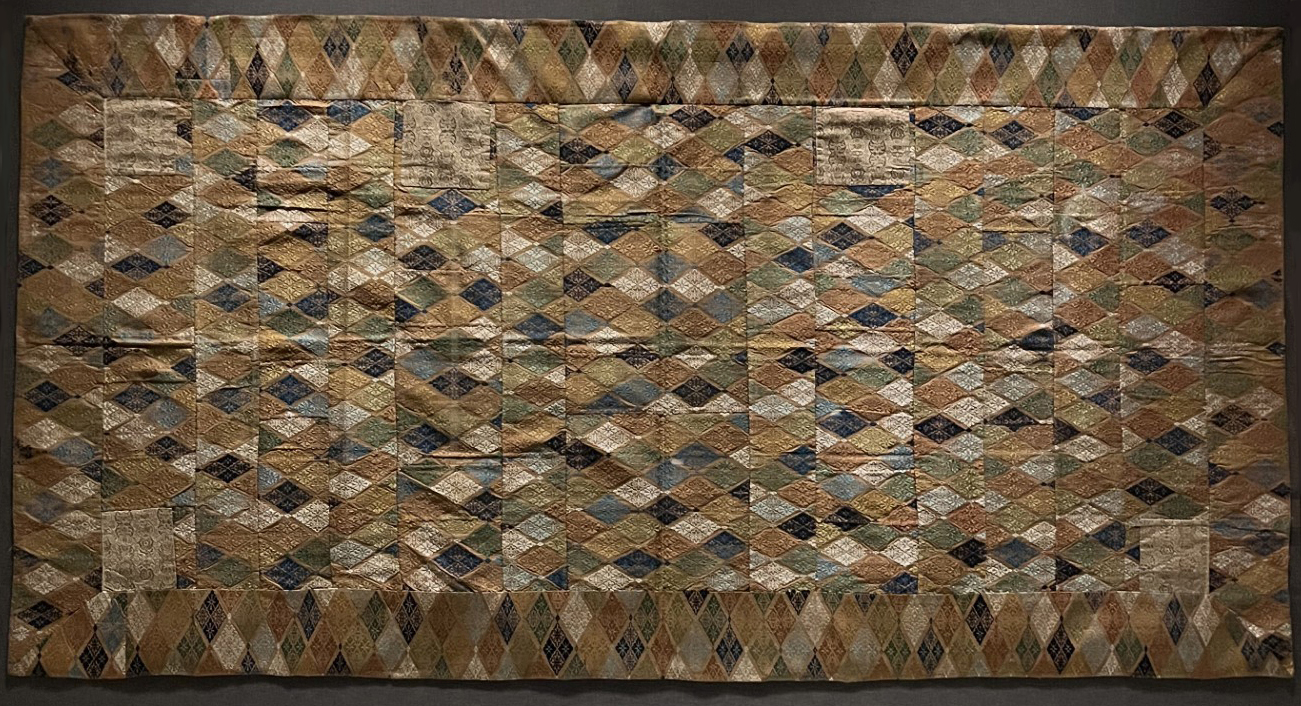
Title: Seven-Panel Buddhist Monk’s Vestment (Shichijō kesa) with Floral-Lozenge Pattern
Description:
Twill-weave silk with supplementary weft patterning, Edo period (1615–1868), Japan.
Related Results
Buddhist Monk Kŭmp’adang Seated on a Mat and Holding a Staff in His Left Hand and a Buddhist Rosary in His Right Hand
Buddhist Monk Kŭmp’adang Seated on a Mat and Holding a Staff in His Left Hand and a Buddhist Rosary in His Right Hand
Painted in ink, mineral colors, and gold leaf on coarsely woven silk, this painting represents an elderly Buddhist monk seated cross-legged on a bamboo mat decorated with geometric...
Baby's dress of hand-knitted cotton thread, made by Sarah Ann Cunliffe, Saffron Walden, 1851. Baby's dress of hand-knitted cotton thread with a wide neck edged with a straight scalloped border in a diamond pattern, straight sleeves to match, bodice with a
Baby's dress of hand-knitted cotton thread, made by Sarah Ann Cunliffe, Saffron Walden, 1851. Baby's dress of hand-knitted cotton thread with a wide neck edged with a straight scalloped border in a diamond pattern, straight sleeves to match, bodice with a
Baby's dress of hand-knitted cotton thread, made by Sarah Ann Cunliffe, Saffron Walden, 1851. Baby's dress of hand-knitted cotton thread with a wide neck edged with a straight scal...
Seated Chijang Posal (Chinese, Dizang Pusa; Sanskrit, Bodhisattva Ksitigarbha) Flanked by the Ten Kings of Hell, Monk Tomyŏng (Chinese, Daoming), and Three Officials
Seated Chijang Posal (Chinese, Dizang Pusa; Sanskrit, Bodhisattva Ksitigarbha) Flanked by the Ten Kings of Hell, Monk Tomyŏng (Chinese, Daoming), and Three Officials
This painting depicts Chijang Posal (Chinese, Dizang Pusa; Sanskrit, Bodhisattva Ksitigarbha) seated at the center of the composition and surrounded by the Ten Kings of Hell, Monk ...
Buddhist Priest's Robe (Kesa) with Abstract and Stylized Gourd Decor
Buddhist Priest's Robe (Kesa) with Abstract and Stylized Gourd Decor
A Buddhist priest's robe known in Japan as a kesa (Sanskrit, kasaya), this rectangular garment is made up of mulitple pieces of the same cloth that together form a patchwork of col...
Seven-Panel Buddhist Monk’s Vestment (Shichijō kesa) with Lotus Arabesque
Seven-Panel Buddhist Monk’s Vestment (Shichijō kesa) with Lotus Arabesque
Twill-weave silk with gold supplementary weft patterning (kinran), Muromachi period (1392–1573), Japan...
Seven-Panel Buddhist Monk’s Vestment (Shichijō kesa) Made from a Chinese Robe
Seven-Panel Buddhist Monk’s Vestment (Shichijō kesa) Made from a Chinese Robe
Silk satin brocaded with silk and metallic thread; silk embroidery, Edo period (1615–1868), Japan...
Seven-Panel Buddhist Monk’s Vestment (Shichijō Kesa) with Stylized Chinese Flowers
Seven-Panel Buddhist Monk’s Vestment (Shichijō Kesa) with Stylized Chinese Flowers
Satin-weave silk lampas, Edo period (1615–1868), Japan...
Seven-Panel Buddhist Monk’s Vestment (Shichijō Kesa) with Peony and Paulownia Arabesques
Seven-Panel Buddhist Monk’s Vestment (Shichijō Kesa) with Peony and Paulownia Arabesques
Satin-weave silk with gold supplementary weft patterning (kinran), Edo period (1615–1868), Japan...