
Search engine for discovering works of Art, research articles, and books related to Art and Culture


Javascript must be enabled to continue!
The Marriage of Philip the Fair to Joanna of Austria; Maximilian Recaptures the Occupied Territories from Hungary; The Conquest of Hungary; The Swiss War; The Liberation of Naples; and The Battle of Wenzenberg, from the Arch of Honor, proof, dated 1515, p
View through The Met
Woodcut and letterpress
Rights: Public Domain
Drawings and Prints, Metropolitan Museum of Art New York NY, Harris Brisbane Dick Fund 1928
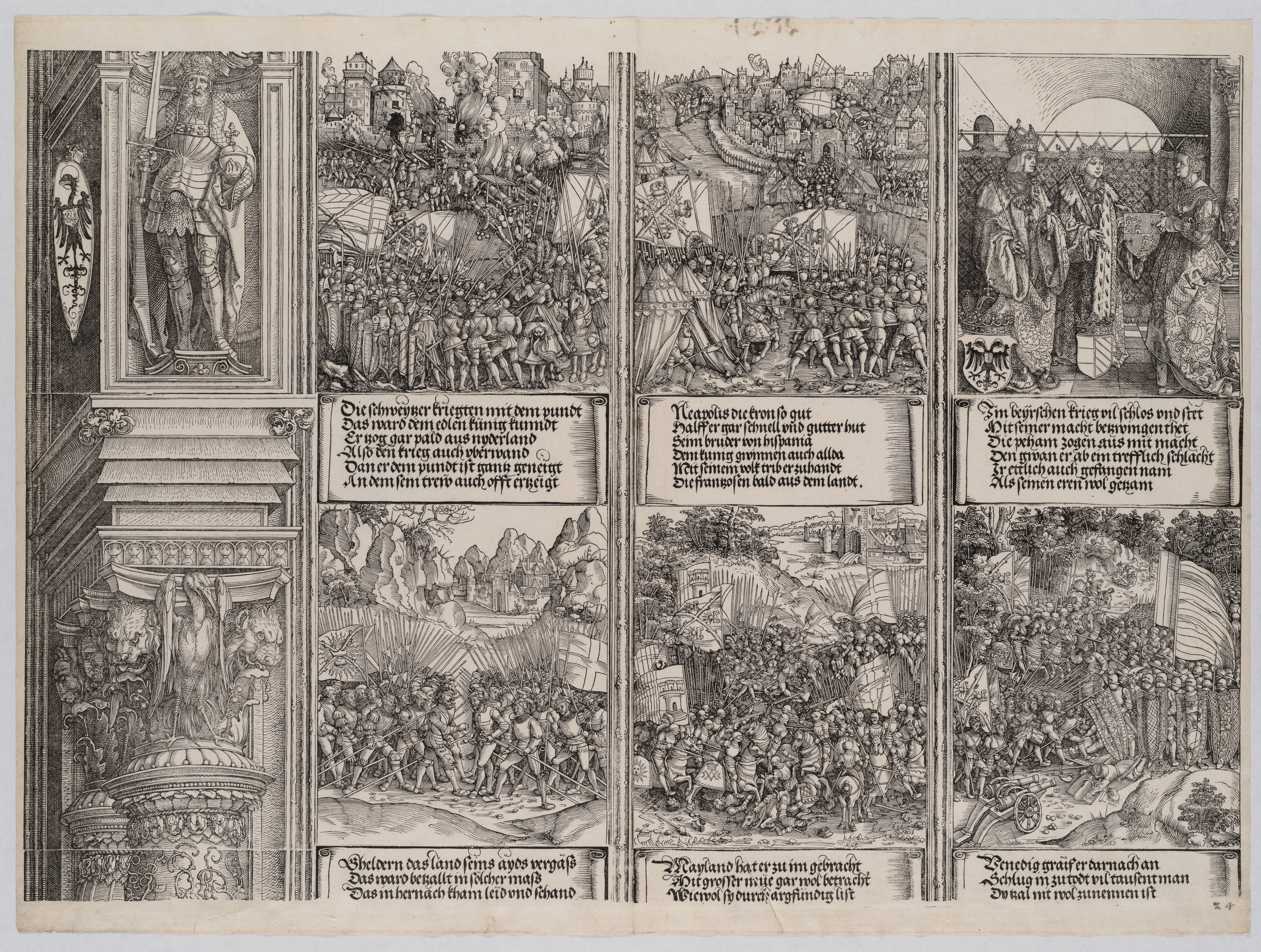
Title: The Marriage of Philip the Fair to Joanna of Austria; Maximilian Recaptures the Occupied Territories from Hungary; The Conquest of Hungary; The Swiss War; The Liberation of Naples; and The Battle of Wenzenberg, from the Arch of Honor, proof, dated 1515, p
Description:
Woodcut and letterpress.
Related Results
Das heutige Europa - Landkarte - Propaganda -Illustrierte Broschüre - [2 Szenarien mit Karten] - Berlin
Das heutige Europa - Landkarte - Propaganda -Illustrierte Broschüre - [2 Szenarien mit Karten] - Berlin
"Opposing the “Europe of the Future” in the Allied Brains. Today’s Europe after the war map, as they designed the allied army of the central powers. Answer and fist pledge against ...
Antichità Romane de' Tempi della Repubblica e de' primi Imperatori
Antichità Romane de' Tempi della Repubblica e de' primi Imperatori
Includes the following plates in this order:
Title Plate (Wilton-Ely 103)
pl. 2 Dedication to Giovanni Bottari (W-E 104)
pl. 3 Transcription of various ancient Latin inscripti...