
Search engine for discovering works of Art, research articles, and books related to Art and Culture


Javascript must be enabled to continue!
Marsk Stigs døtre
View through National Gallery of Denmark
After the murder of King Erik V, known
as ‘Klipping’, in Finderup Barn in 1286, Stig Andersen Hvide, known as Marsk Stig, was singled out as one of the conspirators behind the death. The accusation was presumably completely unfounded, but Marsk Stig was among those who opposed the king, and the king’s murder was seized as an opportunity to get rid of prominent rebels. Stig Andersen Hvide and his family were made outlaws and stripped of their property. He fled to Norway and lived under the protection of the Norwegian king, who made him steward of the castle Hjelm in the Kattegat.
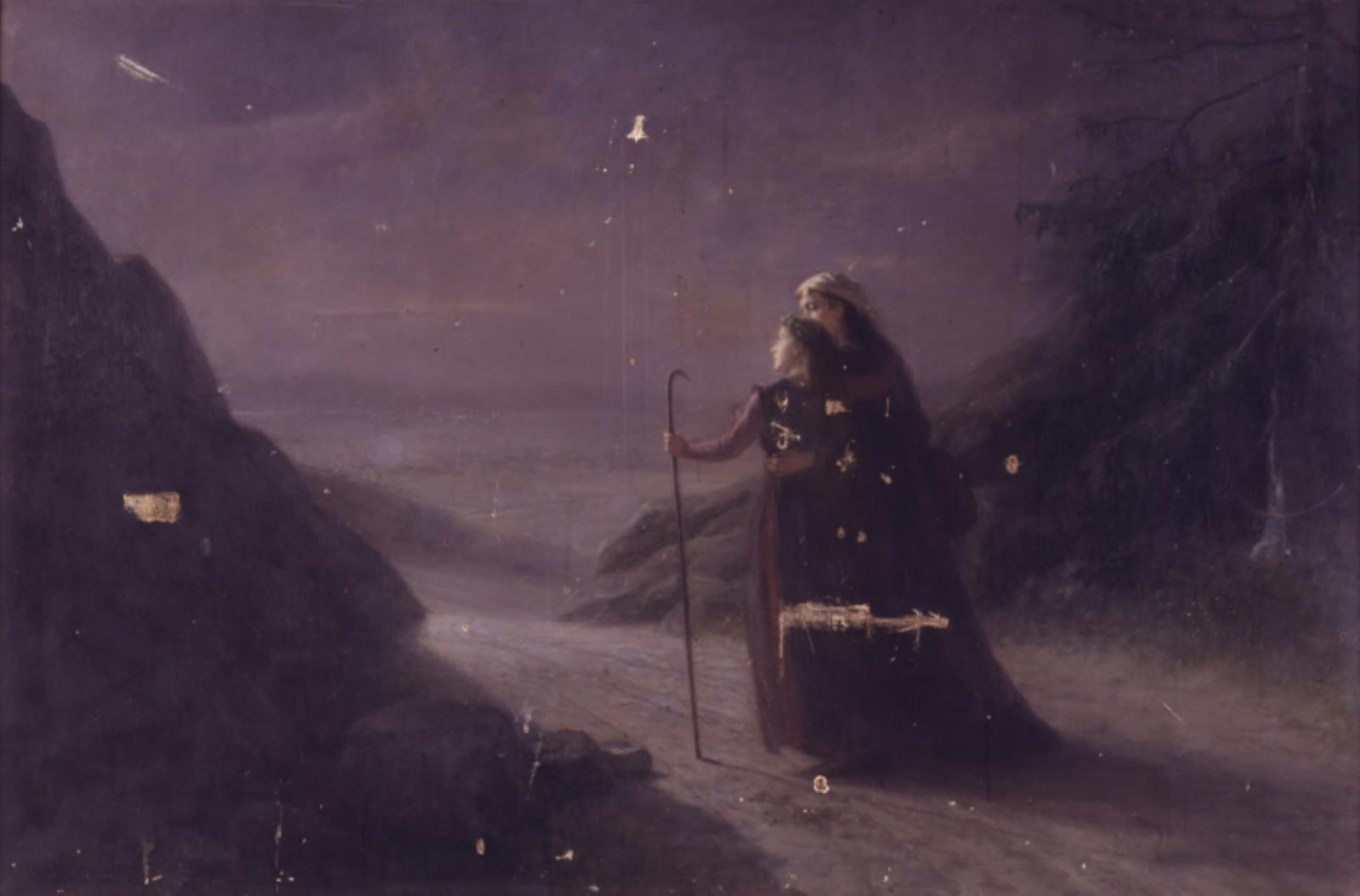
Our knowledge of the Hvide family is sparse. However, a rich folk song tradition tells the tale of Marsk Stig’s two daughters, who, as outlaws, were forced to wander the world in search of protection. The banished daughters served as subject matter for paintings by artists such as Dankvart Dreyer (1839), Elisabeth Jerichau-Baumann (1873)
and Geskel Saloman (1893).
A successful portrait painter, Saloman was a pupil of Eckersberg and schooled in the realistic rendering of details typical of Danish Golden Age art. During a trip to Gothenburg in 1850, Saloman received several commissions for portraits, prompting him to settle in the city.
Saloman has remained on the peripheries of Danish art history because his work was primarily done in Sweden for more than fifty years. A much-needed restoration of Marsk Stig’s Daughters might perhaps give rise to renewed interest in the artist. The painting appears to be a very deliberate attempt on
the part of Saloman to inscribe himself in the symbolically oriented Stimmungsmalerei (‘evovative paintings’) of the time, a genre which was very prominent in 1890s Nordic art. The dominant role played by the landscape in this depiction of a bleak journey towards an uncertain fate fits in well with the period’s great focus on emigration and with the Jewish artist’s preoccupation with migration, homelessness and belonging.
Title: Marsk Stigs døtre
Description:
After the murder of King Erik V, known
as ‘Klipping’, in Finderup Barn in 1286, Stig Andersen Hvide, known as Marsk Stig, was singled out as one of the conspirators behind the death.
The accusation was presumably completely unfounded, but Marsk Stig was among those who opposed the king, and the king’s murder was seized as an opportunity to get rid of prominent rebels.
Stig Andersen Hvide and his family were made outlaws and stripped of their property.
He fled to Norway and lived under the protection of the Norwegian king, who made him steward of the castle Hjelm in the Kattegat.
Our knowledge of the Hvide family is sparse.
However, a rich folk song tradition tells the tale of Marsk Stig’s two daughters, who, as outlaws, were forced to wander the world in search of protection.
The banished daughters served as subject matter for paintings by artists such as Dankvart Dreyer (1839), Elisabeth Jerichau-Baumann (1873)
and Geskel Saloman (1893).
A successful portrait painter, Saloman was a pupil of Eckersberg and schooled in the realistic rendering of details typical of Danish Golden Age art.
During a trip to Gothenburg in 1850, Saloman received several commissions for portraits, prompting him to settle in the city.
Saloman has remained on the peripheries of Danish art history because his work was primarily done in Sweden for more than fifty years.
A much-needed restoration of Marsk Stig’s Daughters might perhaps give rise to renewed interest in the artist.
The painting appears to be a very deliberate attempt on
the part of Saloman to inscribe himself in the symbolically oriented Stimmungsmalerei (‘evovative paintings’) of the time, a genre which was very prominent in 1890s Nordic art.
The dominant role played by the landscape in this depiction of a bleak journey towards an uncertain fate fits in well with the period’s great focus on emigration and with the Jewish artist’s preoccupation with migration, homelessness and belonging.