
Search engine for discovering works of Art, research articles, and books related to Art and Culture


Javascript must be enabled to continue!
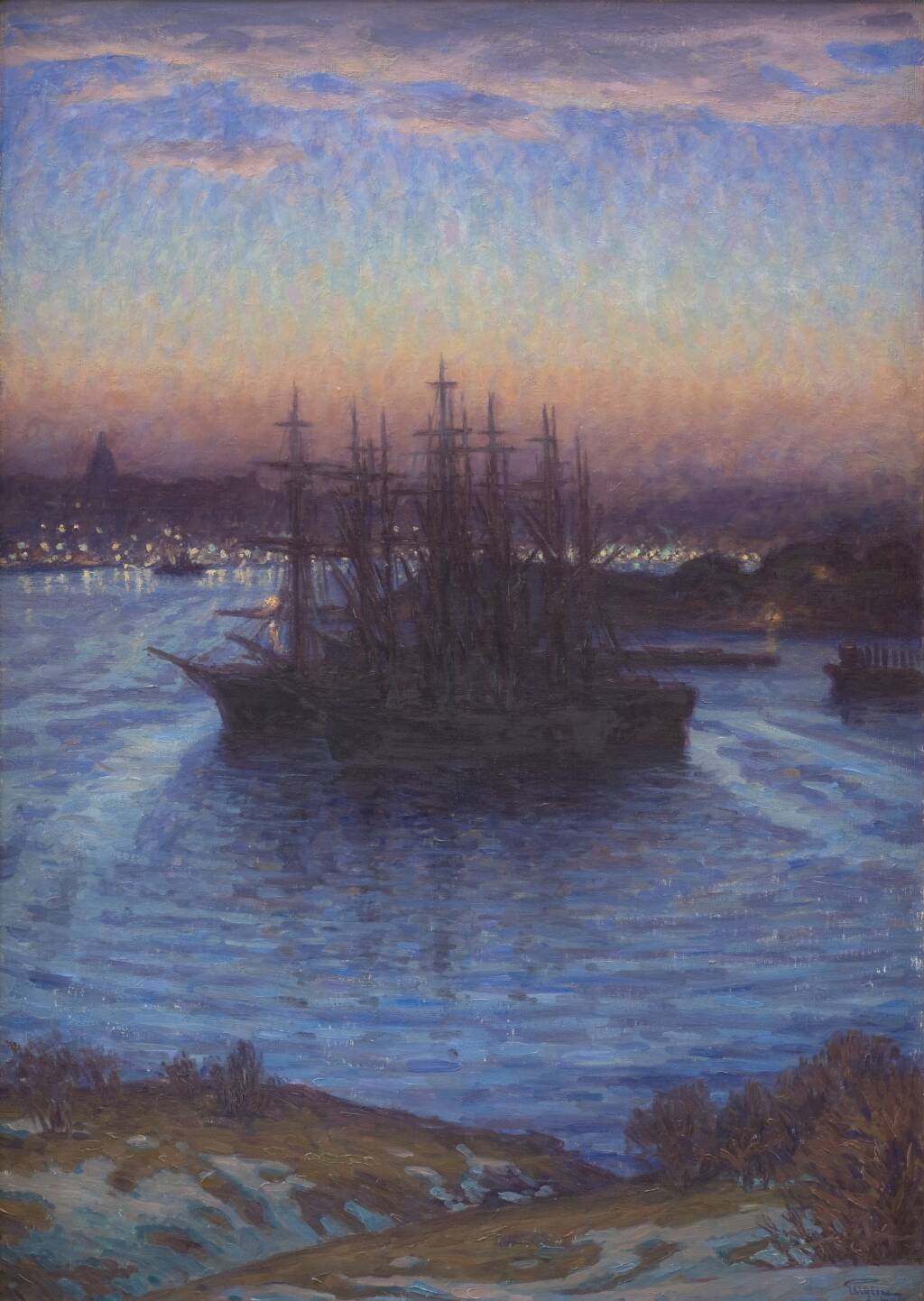
Ships at Anchor. Winter
View through National Gallery of Denmark
Prince Eugen has painted the view from his home with a strong intensity of colour and atmosphere. Twilight scenes such as these won Prince Eugen a central position within the Nordic art of the period.
The scene is from the skerries of Stockholm. From the rocks by Prince Eugen’s home, Waldemarsudde, we see the view across the water towards Stockholm. It is winter, and the ships are anchored in the harbour. This atmospheric landscape is typical of Prince Eugen’s paintings from the decades around 1900. The motifs typically take their point of departure in a recognisable setting, but the main point of the works resides in how they convey a particular dense atmosphere, often imbued with an ethereal mystique and intensity of colour.
With his twilight landscapes and nocturnal scenes Prince Eugen occupied a central position within the Nordic art of the time. He was also a leading figure on the Swedish art scene. Brother to the King, he was an active patron and collector of art and had close links to Denmark and Danish artists such as L.A. Ring, Hammershøi, and the artist brothers Niels and Joakim Skovgaard.
Title: Ships at Anchor. Winter
Description:
Prince Eugen has painted the view from his home with a strong intensity of colour and atmosphere.
Twilight scenes such as these won Prince Eugen a central position within the Nordic art of the period.
The scene is from the skerries of Stockholm.
From the rocks by Prince Eugen’s home, Waldemarsudde, we see the view across the water towards Stockholm.
It is winter, and the ships are anchored in the harbour.
This atmospheric landscape is typical of Prince Eugen’s paintings from the decades around 1900.
The motifs typically take their point of departure in a recognisable setting, but the main point of the works resides in how they convey a particular dense atmosphere, often imbued with an ethereal mystique and intensity of colour.
With his twilight landscapes and nocturnal scenes Prince Eugen occupied a central position within the Nordic art of the time.
He was also a leading figure on the Swedish art scene.
Brother to the King, he was an active patron and collector of art and had close links to Denmark and Danish artists such as L.
A.
Ring, Hammershøi, and the artist brothers Niels and Joakim Skovgaard.
Related Results
The Dutch Fleet in the Goeree Roads
The Dutch Fleet in the Goeree Roads
Willem van de Velde II was one of the leading 17th-century Dutch marine painters. Trained by his father, Willem van de Velde I, with whom he later worked, he continued his studies ...
Hamnbild. Oljemålning på duk.
Hamnbild. Oljemålning på duk.
Longground bay between fortress on the right and cliff on the left. One ship is keeled, another is adjacent to the shore. Several ships on the shipowner.
Kilad span frame. New ten...
Porträt Charles Edward Stuart (1720-1788)
Porträt Charles Edward Stuart (1720-1788)
Portrait of Charles Edward Stuart. The presenter of the throne, born in Rome, is shown here as a chest, as a young man with a friendly view. He wears a long, curly wig and a part o...
Dutch Ships at Anchor
Dutch Ships at Anchor
Pen and brown ink brush and gray wash over black chalk...
Dutch East Indiaman
Dutch East Indiaman
Etching; first state of two, Navium Variæ Figuræ et Formæ (Dutch Ships): Twelve plates including the title (New Hollstein 956-967)...
Horse Nose, 20 January 1966
The picture shows two girls' faces. Central to the foreground of the picture is a girl dressed in winter clothes. The girl has mittens on her hands that she holds at her cheeks, her palms face in against her cheeks. The second
Horse Nose, 20 January 1966
The picture shows two girls' faces. Central to the foreground of the picture is a girl dressed in winter clothes. The girl has mittens on her hands that she holds at her cheeks, her palms face in against her cheeks. The second
Horse Nose, 20 January 1966
The picture shows two girls' faces. Central to the foreground of the picture is a girl dressed in winter clothes. The girl has mittens on her hands tha...