
Search engine for discovering works of Art, research articles, and books related to Art and Culture


Javascript must be enabled to continue!
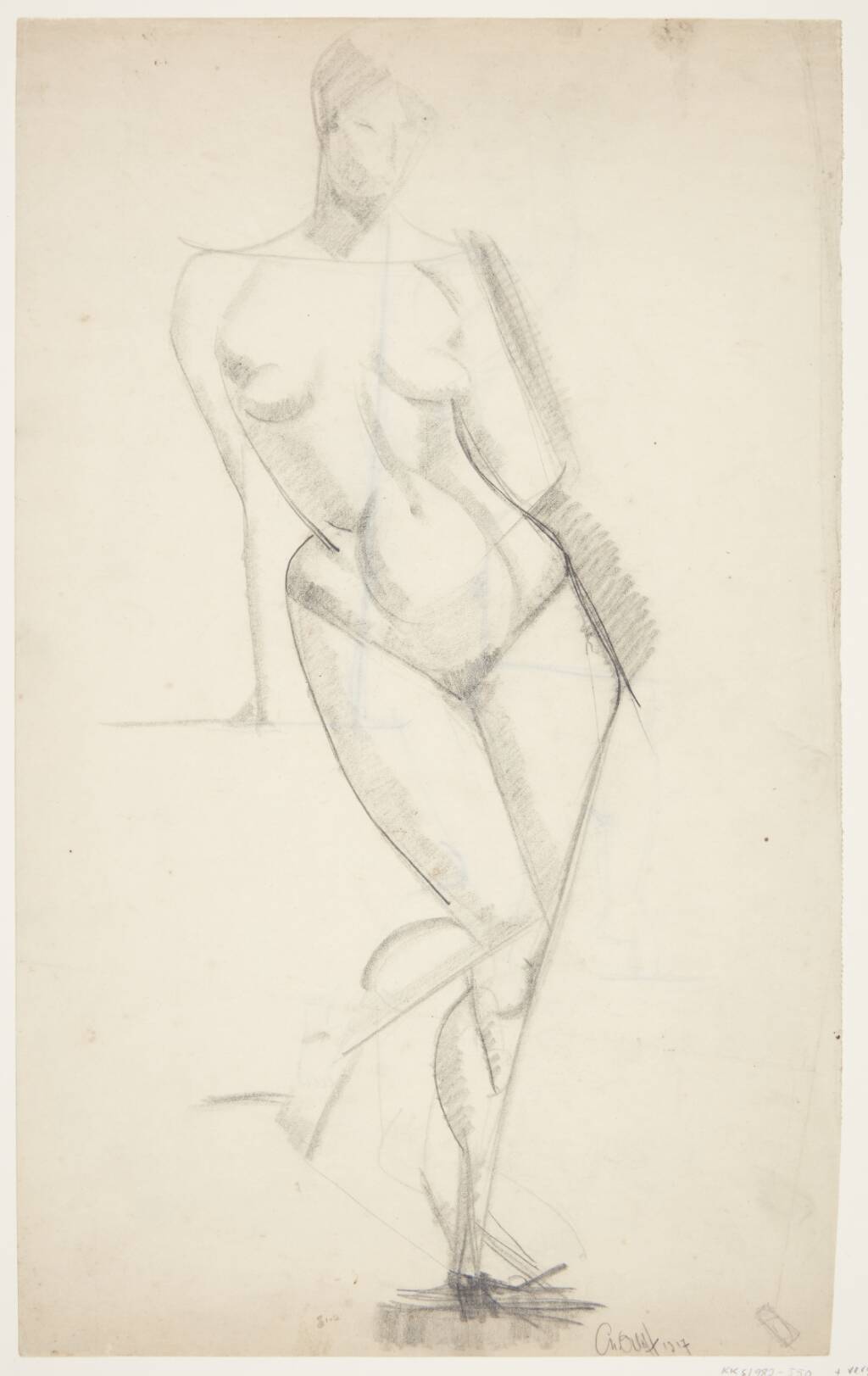
Stående kvindelig model, set forfra
View through National Gallery of Denmark
Chana Orloff’s drawing simultaneously depicts the shapes of a female body and examines its geometry – perhaps in preparation for a sculpture. Another study of a nude appears on the other side of the sheet. Around 1917, Orloff’s sculptural idiom was characterised
by full, flowing, rounded forms. Her favourite subjects were women, mothers with children, birds and other animals depicted with a keen sense of the vital forces in humanity and nature. Towards the end of her career, her expression veered towards sharper, crisper lines and a greater degree of movement and action in the subjects.
At the time when she executed these drawings, Orloff was still at the outset of her career as a sculptor. She was born in what was then the Russian Empire (now Ukraine), but due to anti-Semitism, she emigrated with her family to Palestine in 1905 and trained as a seamstress. In 1910, Orloff moved to Paris to continue her education in the fashion industry but changed her plans, choosing instead to apply for admission to an art school. She soon became part of the city’s international art scene where she made the acquaintance of the Danish artist Adam Fischer. The drawings once belonged to Adam and Ellen Fischer’s collection. They were donated to SMK by the couple’s daughter, Tora Garde, in 1982.
Title: Stående kvindelig model, set forfra
Description:
Chana Orloff’s drawing simultaneously depicts the shapes of a female body and examines its geometry – perhaps in preparation for a sculpture.
Another study of a nude appears on the other side of the sheet.
Around 1917, Orloff’s sculptural idiom was characterised
by full, flowing, rounded forms.
Her favourite subjects were women, mothers with children, birds and other animals depicted with a keen sense of the vital forces in humanity and nature.
Towards the end of her career, her expression veered towards sharper, crisper lines and a greater degree of movement and action in the subjects.
At the time when she executed these drawings, Orloff was still at the outset of her career as a sculptor.
She was born in what was then the Russian Empire (now Ukraine), but due to anti-Semitism, she emigrated with her family to Palestine in 1905 and trained as a seamstress.
In 1910, Orloff moved to Paris to continue her education in the fashion industry but changed her plans, choosing instead to apply for admission to an art school.
She soon became part of the city’s international art scene where she made the acquaintance of the Danish artist Adam Fischer.
The drawings once belonged to Adam and Ellen Fischer’s collection.
They were donated to SMK by the couple’s daughter, Tora Garde, in 1982.