
Search engine for discovering works of Art, research articles, and books related to Art and Culture


Javascript must be enabled to continue!
mask
View through Europeana Collections
1916.9.264
Name and identification of character
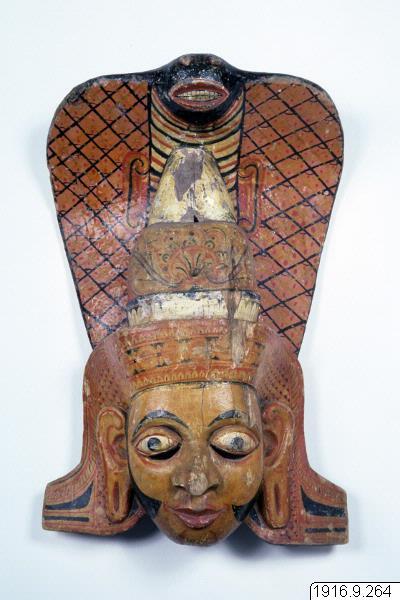
The king of the cobras, na-rajjuruvo or naga raja (Sin.).
Context
A mythological character presenting a solo-dance in stage two in a Kolam performance.
Material
Wood, vel-kaduru (Sin.) (Nux vomica).
Iconography
The mask comprises a naturalistic face surmounted by an imposing upper frame consisting of a broad and spread out cobra hood. It shelters a dagoba (Sin.), a Buddhist relic chamber, sculpted in three tiers. The whole conception reminds one of an incident in the life of the Buddha. When the Buddha was seated under a banian tree, a naga (snake) chieftain named Maha-kela na Raju sheltered the Buddha from rain. The dagoba sculpted within the dilated hood in this mask denotes a distinct area of religious experience. The tiers of the dagoba are decorated with petal and creeper designs. The mask is tall and broad with a small face. Shoulder blades have been fixed in order to facilitate the dancer to balance the mask while in dance action, as in the masks depicting kings.
Comments on the Umlauff Catalogue
The identification of the mask as depicting ¿Naga canyabe¿ is wrong, both phonetically and in meaning. Naga kanyava (Sin.) means cobra maiden, but this cannot be a cobra maiden since these do not sport side-burns.
2000 07 06
Dr. M. H. Goonatilleka
Title: mask
Description:
1916.
9.
264
Name and identification of character
The king of the cobras, na-rajjuruvo or naga raja (Sin.
).
Context
A mythological character presenting a solo-dance in stage two in a Kolam performance.
Material
Wood, vel-kaduru (Sin.
) (Nux vomica).
Iconography
The mask comprises a naturalistic face surmounted by an imposing upper frame consisting of a broad and spread out cobra hood.
It shelters a dagoba (Sin.
), a Buddhist relic chamber, sculpted in three tiers.
The whole conception reminds one of an incident in the life of the Buddha.
When the Buddha was seated under a banian tree, a naga (snake) chieftain named Maha-kela na Raju sheltered the Buddha from rain.
The dagoba sculpted within the dilated hood in this mask denotes a distinct area of religious experience.
The tiers of the dagoba are decorated with petal and creeper designs.
The mask is tall and broad with a small face.
Shoulder blades have been fixed in order to facilitate the dancer to balance the mask while in dance action, as in the masks depicting kings.
Comments on the Umlauff Catalogue
The identification of the mask as depicting ¿Naga canyabe¿ is wrong, both phonetically and in meaning.
Naga kanyava (Sin.
) means cobra maiden, but this cannot be a cobra maiden since these do not sport side-burns.
2000 07 06
Dr.
M.
H.
Goonatilleka.
Related Results
Ivory pendant in the shape of a miniature mask
Ivory pendant in the shape of a miniature mask
There are various interpretations of its function in the literature. One emphasizes the protective and healing influence of the pendant on the wearer. The other states that the pen...
mask, kiwoyo
mask, kiwoyo
The Georg von Békesy Collection, page 182-183.
Wooden dance mask
The Eastern Bapende live in a large L-shaped area on the Loange and Kasai rivers, in the middle of wich lies the ...