
Search engine for discovering works of Art, research articles, and books related to Art and Culture


Javascript must be enabled to continue!
Latinus Offering his Daughter Lavinia to Aeneas in Matrimony
View through National Gallery of Denmark
Decorative sequences came to play a major role in the works of Giambattista Tiepolo. He received several commissions to carry out entire decorative schemes, both in his home town of Venice and abroad. For example, this oval painting is believed to have been part of a series of six mythological scenes originally created as overdoors for a large house, the Palazzo Barbaro in Venice. A decorative feature Being a decorative feature above a doorway, the painting was intended to be viewed from below, a fact which explains its di sotto in sù perspective, meaning “from below and up”. The worm’s eye view is accentuated in the scene itself, where the foremost male figure looks at the woman from below. The painting's decorative aspect The decorative aspect is apparent in the fact that the figure group and the marble columns have been drawn forward, giving them the appearance of being close to the decorated surface itself. Behind them, the space is emphatically restricted by a balustrade running parallel with the picture’s surface. The motif The kneeling man proffering a ring to the woman is Aeneas, the founder of Rome whose tale is told by Virgil (70 BCE - 19 BCE) in the Aeneid. After escaping the Greek conquest of Troy Aeneas reached the estuary of the Tiber, where the king of Latium gave him his daughter Lavinia to be his wife.
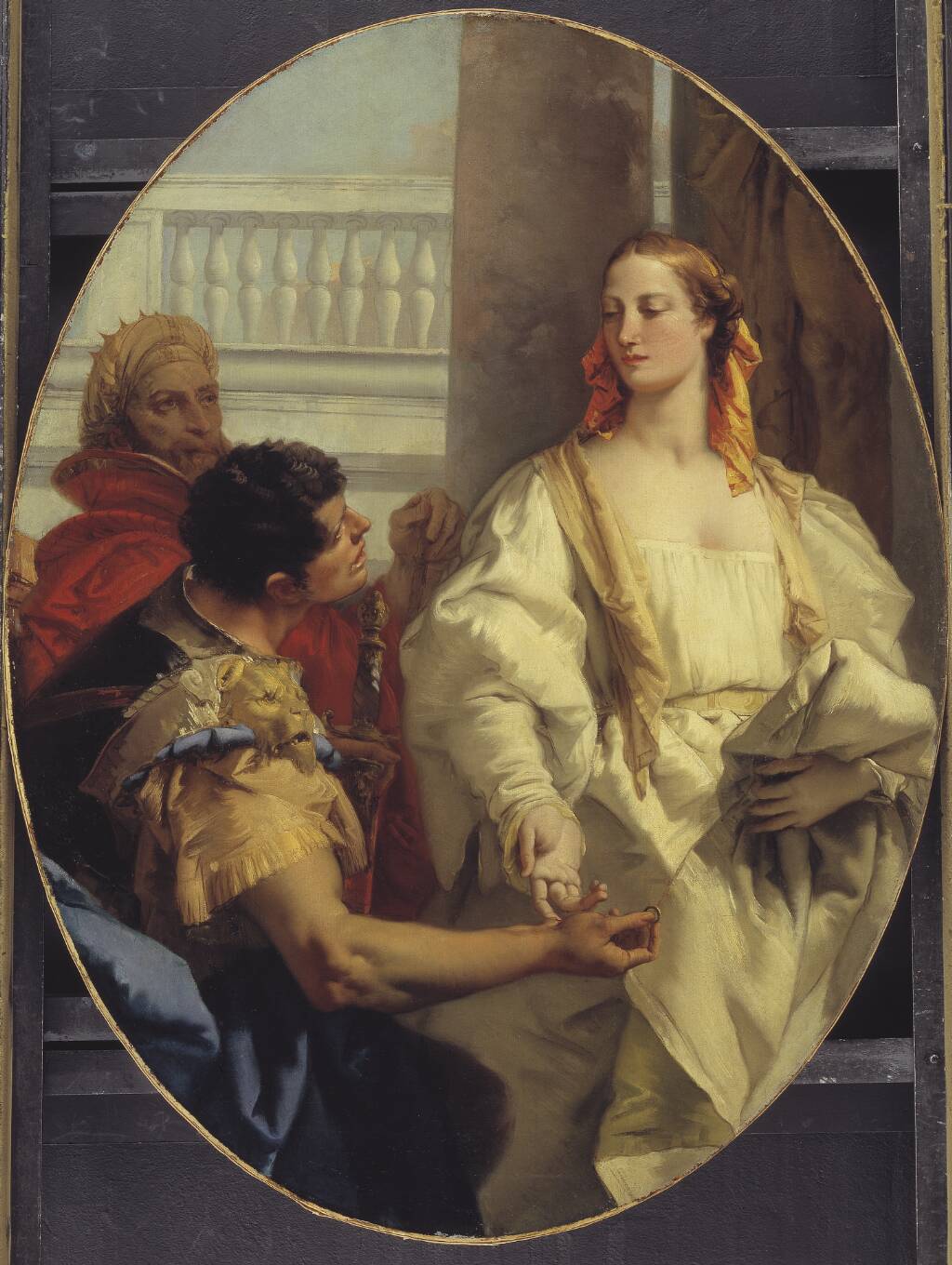
Title: Latinus Offering his Daughter Lavinia to Aeneas in Matrimony
Description:
Decorative sequences came to play a major role in the works of Giambattista Tiepolo.
He received several commissions to carry out entire decorative schemes, both in his home town of Venice and abroad.
For example, this oval painting is believed to have been part of a series of six mythological scenes originally created as overdoors for a large house, the Palazzo Barbaro in Venice.
A decorative feature Being a decorative feature above a doorway, the painting was intended to be viewed from below, a fact which explains its di sotto in sù perspective, meaning “from below and up”.
The worm’s eye view is accentuated in the scene itself, where the foremost male figure looks at the woman from below.
The painting's decorative aspect The decorative aspect is apparent in the fact that the figure group and the marble columns have been drawn forward, giving them the appearance of being close to the decorated surface itself.
Behind them, the space is emphatically restricted by a balustrade running parallel with the picture’s surface.
The motif The kneeling man proffering a ring to the woman is Aeneas, the founder of Rome whose tale is told by Virgil (70 BCE - 19 BCE) in the Aeneid.
After escaping the Greek conquest of Troy Aeneas reached the estuary of the Tiber, where the king of Latium gave him his daughter Lavinia to be his wife.
Related Results
Olpe: Aeneas fleeing from Troy
Olpe: Aeneas fleeing from Troy
Orangish-buff fabric. Plain mouthed olpe with low strap handle. Checkerboard pattern at lip. On front of vessel is a large figured panel framed at the top by a zig-zag pattern b...
Jambavan Offers His Daughter, Jambavati, to Krishna, an illustration from the Bhagavata Purana
Jambavan Offers His Daughter, Jambavati, to Krishna, an illustration from the Bhagavata Purana
This painting depicts the episode of Jambavan, king of the bears, offering his daughter, Jambavati, to Krishna for marriage. The illustration can be divided into three vignettes. S...
Dish (coppa): The story of Aeneas: Queen Dido of Carthage welcomes Aeneas and his son.
Dish (coppa): The story of Aeneas: Queen Dido of Carthage welcomes Aeneas and his son.
Maiolica (tin-glazed earthenware), Italian Castel Durante...
Portrait of a Young Woman with a Rosary
Portrait of a Young Woman with a Rosary
This portrait of an unidentified female sitter can be dated to between 1609 and 1610 when Rubens was established in Antwerp following his return from Italy in 1608. The year 1609 s...