
Search engine for discovering works of Art, research articles, and books related to Art and Culture


Javascript must be enabled to continue!
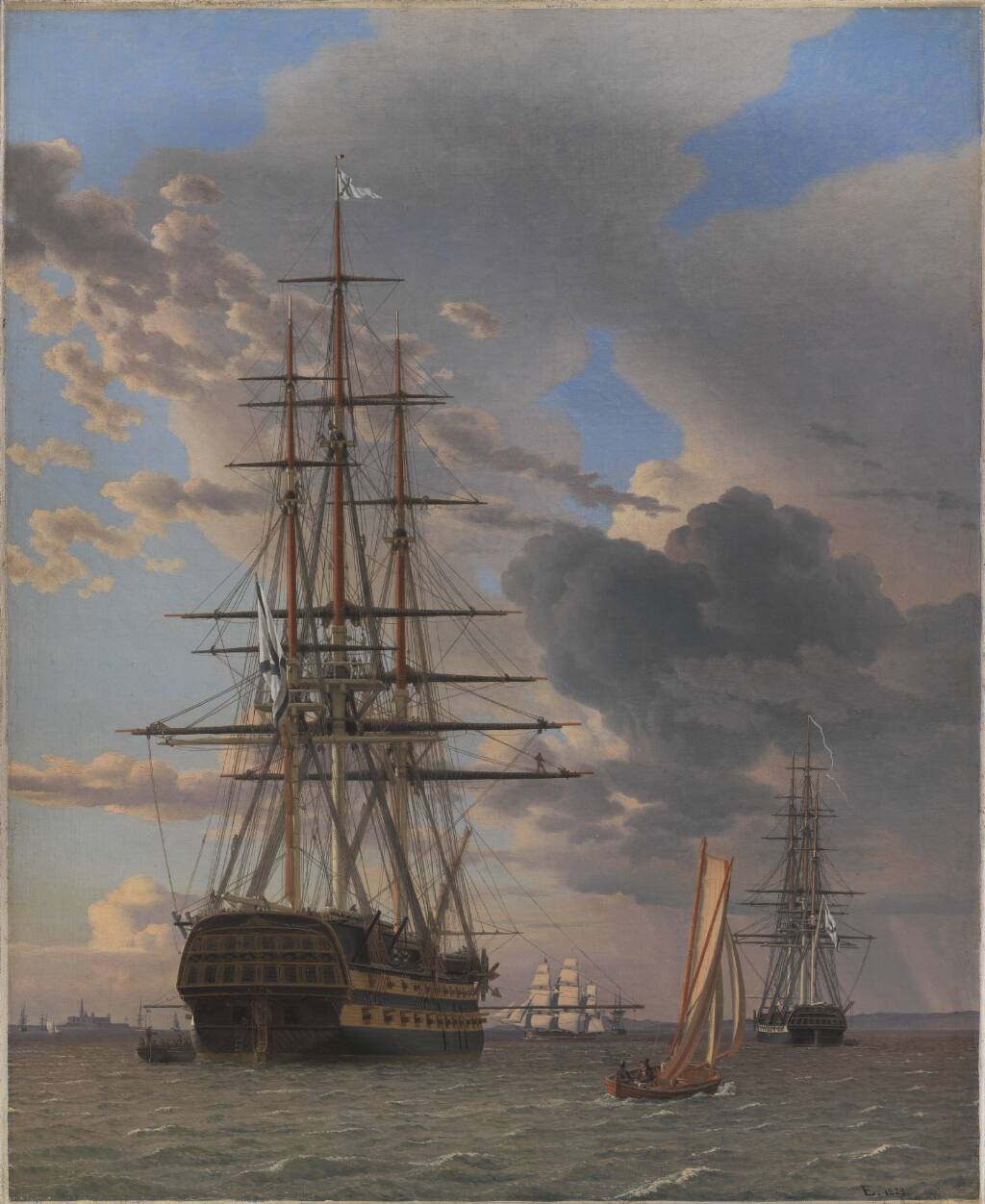
The Russian Ship of the Line "Asow" and a Frigate at Anchor near Elsinore
View through National Gallery of Denmark
C.W. Eckersberg had studied Russian ships of the line on two occasions before embarking on the painting of the “Asow” in 1828. Both times, however, his studies were made at Copenhagen, not Elsinore as shown in this picture. Thus, this painting is not a faithful reproduction of a single, specific scene; it is a presentation of what the ship would look like if viewed from a favourable position on the Oresund.
As realistically as possible
Eckersberg prepared the painting with great care. He borrowed plans of ships of the line from the Danish navy, and he painstakingly calculated the relative positions of the ships on the water. He also studied the light, wind, and other meteorological conditions before commencing work, taking extra care to paint the cloud formations as realistically as possible.
Seascapes as favourite subject
After 1821 seascapes had become Eckersberg’s favourite subject. They allowed him to bring together his interest in nature, ships, and meteorology, and over the next three decades he had the opportunity to depict almost every conceivable type of ship in every marine situation imaginable.
Værkdatering: 1828
Ifølge kunstnerens dagbog blev maleriet påbegyndt den 1. september 1828 og fuldført den 17. december samme år (Eckersbergs dagbøger, 2008, p. 318, 321, 330, 331, 332).
Title: The Russian Ship of the Line "Asow" and a Frigate at Anchor near Elsinore
Description:
C.
W.
Eckersberg had studied Russian ships of the line on two occasions before embarking on the painting of the “Asow” in 1828.
Both times, however, his studies were made at Copenhagen, not Elsinore as shown in this picture.
Thus, this painting is not a faithful reproduction of a single, specific scene; it is a presentation of what the ship would look like if viewed from a favourable position on the Oresund.
As realistically as possible
Eckersberg prepared the painting with great care.
He borrowed plans of ships of the line from the Danish navy, and he painstakingly calculated the relative positions of the ships on the water.
He also studied the light, wind, and other meteorological conditions before commencing work, taking extra care to paint the cloud formations as realistically as possible.
Seascapes as favourite subject
After 1821 seascapes had become Eckersberg’s favourite subject.
They allowed him to bring together his interest in nature, ships, and meteorology, and over the next three decades he had the opportunity to depict almost every conceivable type of ship in every marine situation imaginable.
Related Results
A Russian Fleet at Anchor near Elsinore
A Russian Fleet at Anchor near Elsinore
The painting is the first marine that Eckersberg did after having painted numerous studies of clouds in early September 1826 [cat. 63–64]. Immediately afterwards, on 10 September, ...
Signal of Distress
Signal of Distress
In December 1890Winslow Homer wrote to his brother Charles, “I have got a fine picture called The Distress Signal a scene in mid ocean.” The painter was referring to the work in th...
Frigate of Neptune carried by Jakob Zeller, circa 1620
Frigate of Neptune carried by Jakob Zeller, circa 1620
Hassebrauk, Ernst: Frigate of Neptune carried by Jakob Zeller, circa 1620. Drawing. (Positive template: SLUB, estate, Hassebrauk, Ernst. Mscr.Dresd.App.2534.1092)...
Porträt Charles Edward Stuart (1720-1788)
Porträt Charles Edward Stuart (1720-1788)
Portrait of Charles Edward Stuart. The presenter of the throne, born in Rome, is shown here as a chest, as a young man with a friendly view. He wears a long, curly wig and a part o...