
Search engine for discovering works of Art, research articles, and books related to Art and Culture


Javascript must be enabled to continue!
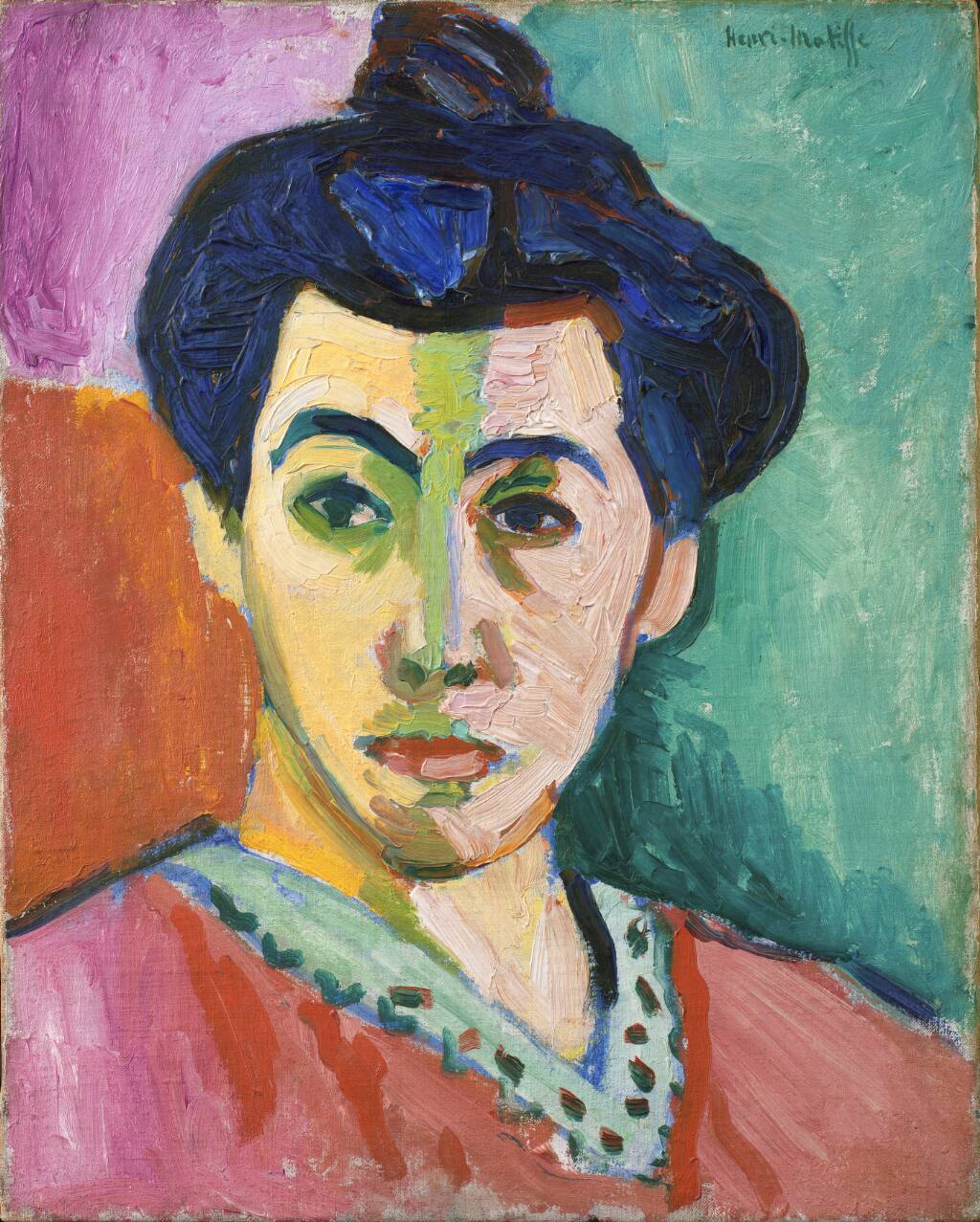
Portrait of Madame Matisse. The Green Line
View through National Gallery of Denmark
This depiction of the artist’s wife, Amélie, is one of Matisse’s most famous paintings and a masterpiece within 20th century portraiture. Much of its strength resides in its simple geometric structure and in the way in which the colours are combined. Spatial modulation is pared back to a minimum. Effects of light and shadow, which would have added depth to the image, have been translated into planes of colour instead. The painting was presumably painted in the autumn of 1905, when Matisse had returned to Paris after spending a summer in the fishing village of Collioure. Here, he and André Derain engaged in ever-wilder painterly experiments intended to release colour from its descriptive function, allowing it to act as a force in its own right. With its unorthodox use of colour, the painting is built on those experiments.
Title: Portrait of Madame Matisse. The Green Line
Description:
This depiction of the artist’s wife, Amélie, is one of Matisse’s most famous paintings and a masterpiece within 20th century portraiture.
Much of its strength resides in its simple geometric structure and in the way in which the colours are combined.
Spatial modulation is pared back to a minimum.
Effects of light and shadow, which would have added depth to the image, have been translated into planes of colour instead.
The painting was presumably painted in the autumn of 1905, when Matisse had returned to Paris after spending a summer in the fishing village of Collioure.
Here, he and André Derain engaged in ever-wilder painterly experiments intended to release colour from its descriptive function, allowing it to act as a force in its own right.
With its unorthodox use of colour, the painting is built on those experiments.
Related Results
Henri Matisse: Paper Cut-Outs
Henri Matisse: Paper Cut-Outs
Blue nudes, red hearts, and multicolored flowers fill [Henri Matisse](/artist/henri-matisse)’s paper cut-outs—the technique that fascinated the artist for the final decade of his c...
Image frieze over Queen Victoria’s of England coronation procession 1838-06-28, published by Fore 's Sporting & Fine Print Repository, London.
Image frieze over Queen Victoria’s of England coronation procession 1838-06-28, published by Fore 's Sporting & Fine Print Repository, London.
Image frieze on the short ends with glued joints attached sheets paper, l: 185 mm, h: 10.3 mm. Attached to a pearl cardboard sleeve with glued brown pink (?) fabric with pressed fr...
Sketchbook
Sketchbook
Sketchbook with blue- and black-fabric-covered cardboard covers. Sewn page block; pages of off-white wove paper, each 27.6 x 21.6 cm. Each sheet numbered on verso at l.l. Drawin...
Trouser suit, pale green cotton, designed by William Brown, Great Britain, ca. 1980; Jacket, pale green cotton, designed by William Brown, Great Britain, ca. 1980; Trousers, pale green cotton, designed by William Brown, Great Britain, ca. 1980. Pale green
Trouser suit, pale green cotton, designed by William Brown, Great Britain, ca. 1980; Jacket, pale green cotton, designed by William Brown, Great Britain, ca. 1980; Trousers, pale green cotton, designed by William Brown, Great Britain, ca. 1980. Pale green
Trouser suit, pale green cotton, designed by William Brown, Great Britain, ca. 1980; Jacket, pale green cotton, designed by William Brown, Great Britain, ca. 1980; Trousers, pale g...
Portrait of Madame Bouret as Diana
Portrait of Madame Bouret as Diana
Like his brother Jean-Baptiste, Jean-Marc Nattier first trained in his family circle. His father was a portrait painter and his mother was familiar with the technique of miniature ...
Pierre-Numa Bassaget and Jean-Denis Nargeot. Two women's day dresses by Mme Provost and Mme Oudot-Manoury; and a baby gown. Hand-coloured engraving from the Journal des Dames et des Modes, 1836. Two women in an interior, one holding a baby. In the foregro
Pierre-Numa Bassaget and Jean-Denis Nargeot. Two women's day dresses by Mme Provost and Mme Oudot-Manoury; and a baby gown. Hand-coloured engraving from the Journal des Dames et des Modes, 1836. Two women in an interior, one holding a baby. In the foregro
Pierre-Numa Bassaget and Jean-Denis Nargeot. Two women's day dresses by Mme Provost and Mme Oudot-Manoury; and a baby gown. Hand-coloured engraving from the Journal des Dames et de...
Evening and day dresses by Madame Oudot-Manoury with hats by Monsieur Lemonnier. Published by Le Bon Ton, France, 1837. Fashion plate showing two women, one left, seated in an armchair, in a raspberry pink evening dress trimmed with bows and lace, wearing
Evening and day dresses by Madame Oudot-Manoury with hats by Monsieur Lemonnier. Published by Le Bon Ton, France, 1837. Fashion plate showing two women, one left, seated in an armchair, in a raspberry pink evening dress trimmed with bows and lace, wearing
Evening and day dresses by Madame Oudot-Manoury with hats by Monsieur Lemonnier. Published by Le Bon Ton, France, 1837. Fashion plate showing two women, one left, seated in an armc...