
Search engine for discovering works of Art, research articles, and books related to Art and Culture


Javascript must be enabled to continue!
Stående kvinde, Afrodite fra Melos. Venus fra Milo
View through National Gallery of Denmark
Venus (Aphrodite) is the goddess of love. She was depicted in the nude or in various stages of nudity (and painted). The figure is executed in the Hellenistic style and famed for its sensuous appearance. It supposedly lost its arms in a struggle arising between two groups of soldiers who sought to claim it as loot when it was first discovered on the island of Milos. The statue’s fame is partly the result of propaganda. It was discovered in 1820 and acquired by the French state shortly after Napoleon’s fall in 1815, at which point the French had to return another Venus figure, the Venus Medici (KAS1241) to Italy after Napoleon had seized it as spoils of war. To compensate for their loss the French promoted the Venus de Milo as the loveliest of all antique statues of woman. An Englishman even commissioned a plaster cast as early as 1822, despite the fact that the French and the English were arch-enemies at the time, and today the statue remains far more famous than the Venus Medici.
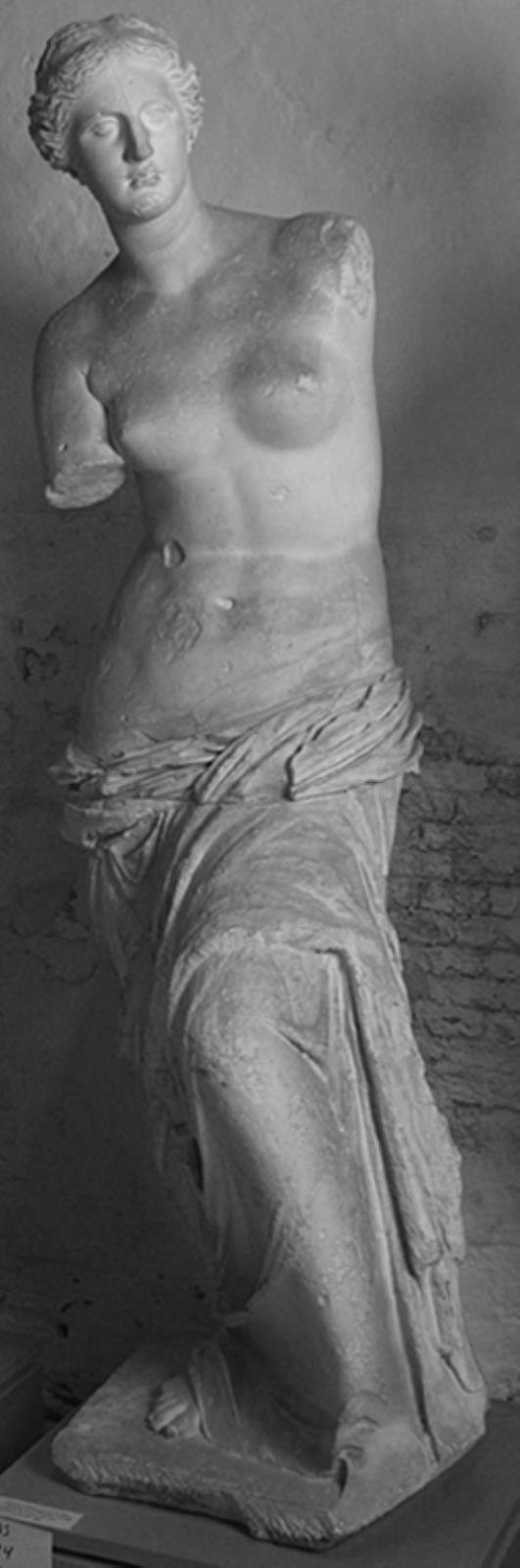
Title: Stående kvinde, Afrodite fra Melos. Venus fra Milo
Description:
Venus (Aphrodite) is the goddess of love.
She was depicted in the nude or in various stages of nudity (and painted).
The figure is executed in the Hellenistic style and famed for its sensuous appearance.
It supposedly lost its arms in a struggle arising between two groups of soldiers who sought to claim it as loot when it was first discovered on the island of Milos.
The statue’s fame is partly the result of propaganda.
It was discovered in 1820 and acquired by the French state shortly after Napoleon’s fall in 1815, at which point the French had to return another Venus figure, the Venus Medici (KAS1241) to Italy after Napoleon had seized it as spoils of war.
To compensate for their loss the French promoted the Venus de Milo as the loveliest of all antique statues of woman.
An Englishman even commissioned a plaster cast as early as 1822, despite the fact that the French and the English were arch-enemies at the time, and today the statue remains far more famous than the Venus Medici.
Related Results
Venus and Cupid
Venus and Cupid
In his Arte de la Pintura, Pacheco left a significant account of Rubens’ second trip to Spain of 1628–29 (following his first trip of 1603). Pacheco mentions some of Rubens’ activi...