
Search engine for discovering works of Art, research articles, and books related to Art and Culture


Javascript must be enabled to continue!
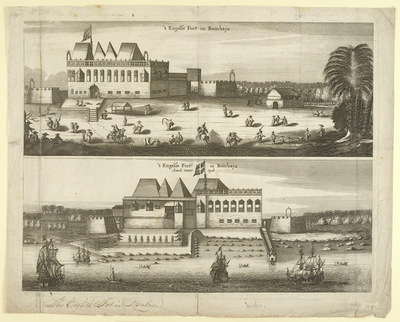
't Engelse Fort in Bombaja. 't Engelse Fort in Bombaja aande water zyde
View through Europeana Collections
Engraving by an anonymous artist of the Fort at
Bombay in Maharashtra, dated between 1700 and 1750. The print is
captioned 't Engelse Fort in Bombaja; 't Engelse Fort in Bombaja
aande water zyde.'; and is inscribed in ink: 'The English Fort in
Bombay'.The area of Bombay was controlled by the Portuguese from
1534 until 1661, when it was ceded to the English as part of the
marriage dowry Catherine of Braganza. In 1668, the directors of the
English East India ordered the construction of a custom house,
warehouse and quay around the Portuguese settlement on Bombay
Island. In the 1670s, under the governorship of Gerald Aungier,
Bombay was developed as a trading centre. In 1716, his plans for a
walled town with bastions were implemented by a later governor,
Charles Boone. By 1710, the fort included a magazine, quarters for
soldiers and two water tanks. This engraving shows two views of the
fort, one from the landward side and the other from the
harbour.
Title: 't Engelse Fort in Bombaja. 't Engelse Fort in Bombaja aande
water zyde
Description:
Engraving by an anonymous artist of the Fort at
Bombay in Maharashtra, dated between 1700 and 1750.
The print is
captioned 't Engelse Fort in Bombaja; 't Engelse Fort in Bombaja
aande water zyde.
'; and is inscribed in ink: 'The English Fort in
Bombay'.
The area of Bombay was controlled by the Portuguese from
1534 until 1661, when it was ceded to the English as part of the
marriage dowry Catherine of Braganza.
In 1668, the directors of the
English East India ordered the construction of a custom house,
warehouse and quay around the Portuguese settlement on Bombay
Island.
In the 1670s, under the governorship of Gerald Aungier,
Bombay was developed as a trading centre.
In 1716, his plans for a
walled town with bastions were implemented by a later governor,
Charles Boone.
By 1710, the fort included a magazine, quarters for
soldiers and two water tanks.
This engraving shows two views of the
fort, one from the landward side and the other from the
harbour.
Related Results
View of Amber fort from the valley, negative no. 182
View of Amber fort from the valley, negative no. 182
This horizontal format albumen silver print depicts a view of the walls and ramparts of the late 16th century Amber Fort from the opposite hillside. The fort itself lies on a terr...
Pond with Water Lilies
Pond with Water Lilies
From his earliest years as a painter, Monet’s art was rooted in the direct and prolonged analysis of nature. Throughout his career, he grappled with the task of developing techniqu...
Pump for Raising Water (painting, recto; text, verso), folio from a manuscript of the Kitab fi Ma'rifat al-Hiyal al-Handasiyya (Book of Ingenious Mechanical Devices) of al-Jazari
Pump for Raising Water (painting, recto; text, verso), folio from a manuscript of the Kitab fi Ma'rifat al-Hiyal al-Handasiyya (Book of Ingenious Mechanical Devices) of al-Jazari
Badi’ al-Zaman Abu al-Izz Isma’il b. al-Razzaz al-Jazari's compendium of mechanical devices stands out for combining theory with practice and providing the earliest mentions of mec...