
Search engine for discovering works of Art, research articles, and books related to Art and Culture


Javascript must be enabled to continue!
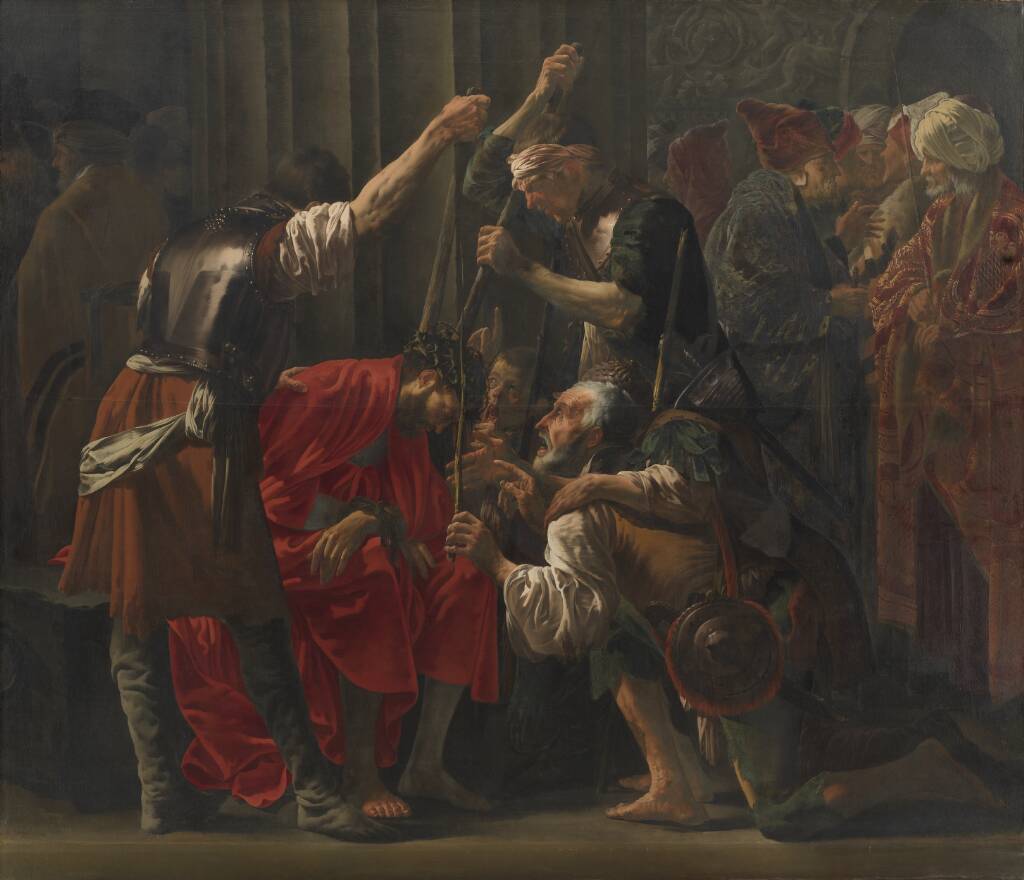
Christ Crowned with Thorns
View through National Gallery of Denmark
Christ is shown with his head down, quietly suffering in the forecourt of Pilate’s palace, surrounded by jeering soldiers.
The scene depicts one of the torments that Christ was subjected to on the long Friday that ended in his death upon the Cross. Mockingly he has been called the King of the Jews, and now his tormentors have crowned him with thorns and wrapped him in a scarlet cloak to indicate his kingly stature.
One of the soldiers kneels before Christ in mock humility, handing him a stick in lieu of a sceptre.
The Utrecht Caravaggists
Hendrick Ter Brugghen spent his formative years in Rome where the painter Caravaggio (1571-1610) became the main influence. Upon his return Ter Brugghen became the prime mover of a new school, the Utrecht Caravaggists, whose trademark style was an insistent naturalism combined with a high-contrast vein of painting known as clair obscur (light-dark).
The North European tradition
Even so, Ter Brugghen’s painting did not completely abandon North European tradition. The soldiers’ leering faces and the slightly angular body language has roots stretching back to late Gothic altarpieces and print series depicting the Passion, e.g. those by Albrecht Dürer (1471-1528).
Title: Christ Crowned with Thorns
Description:
Christ is shown with his head down, quietly suffering in the forecourt of Pilate’s palace, surrounded by jeering soldiers.
The scene depicts one of the torments that Christ was subjected to on the long Friday that ended in his death upon the Cross.
Mockingly he has been called the King of the Jews, and now his tormentors have crowned him with thorns and wrapped him in a scarlet cloak to indicate his kingly stature.
One of the soldiers kneels before Christ in mock humility, handing him a stick in lieu of a sceptre.
The Utrecht Caravaggists
Hendrick Ter Brugghen spent his formative years in Rome where the painter Caravaggio (1571-1610) became the main influence.
Upon his return Ter Brugghen became the prime mover of a new school, the Utrecht Caravaggists, whose trademark style was an insistent naturalism combined with a high-contrast vein of painting known as clair obscur (light-dark).
The North European tradition
Even so, Ter Brugghen’s painting did not completely abandon North European tradition.
The soldiers’ leering faces and the slightly angular body language has roots stretching back to late Gothic altarpieces and print series depicting the Passion, e.
g.
those by Albrecht Dürer (1471-1528).
Related Results
Emperor Leopold I elevates Mark Putz von Adlersthurn, court chamber council and secret secretary, to the old knight’s state, improves his coat of arms and improves his predicate on von Putz zu Adlerßthurn and grants him a new predicate Edler von Schrotten
Emperor Leopold I elevates Mark Putz von Adlersthurn, court chamber council and secret secretary, to the old knight’s state, improves his coat of arms and improves his predicate on von Putz zu Adlerßthurn and grants him a new predicate Edler von Schrotten
Character: description on folk. 5b and 6a, miniature on folk. 5a, 166 x 151 mm.
Quarter shield with crowned heart plate. It is red with a silver crossbar, above the crossbar is the...
The Risen Christ
The Risen Christ
This panel depicting The Risen Christ was formerly in the collection of the Pusterla della Porta family in Milan, where it is recorded from 1590 until the first quarter of the 20th...
Emperor Leopold I elevates Johann Ulrich Kleblsperg, lieutenant colonel of the Duke of Lorraine Cavalry Regiment, to the Czech state of free lords, improves his coat of arms and awards him predicates Wohlgeborn and Freyherr
Emperor Leopold I elevates Johann Ulrich Kleblsperg, lieutenant colonel of the Duke of Lorraine Cavalry Regiment, to the Czech state of free lords, improves his coat of arms and awards him predicates Wohlgeborn and Freyherr
Character: description on folk. 5b - 7b, miniature on folk. 7a, 161 x 171 mm.
Quarterly shield with heart label that is pollen. On the right in the red one lies two Turkish heads i...
Christ with the Cross
Christ with the Cross
Christ holding the cross was a motif that El Greco derived from the narrative of Christ’s Passion, creating an isolated image that seems to have been extremely popular with his cli...
Císař František II. povyšuje sekretáře podkomořského úřadu v Praze Johanna Franze Heyßlera šlechtice von Adelshofen do rytířského stavu, polepšuje mu predikát na edler von Heyßler und Adelshofen a polepšuje mu erb
Císař František II. povyšuje sekretáře podkomořského úřadu v Praze Johanna Franze Heyßlera šlechtice von Adelshofen do rytířského stavu, polepšuje mu predikát na edler von Heyßler und Adelshofen a polepšuje mu erb
Character: description on folk. 5b, 6b, miniature on folk. 6a, 176 x 280 mm.
A fourth shield. 1. and 4. in gold is a black crowned eagle 1). 2. and 3. gold - red chess into sixteen...
Diptych with symbols of the Virgin and Redeeming Christ: Christ with the Cross as Redemptor Mundi (Right wing)
Diptych with symbols of the Virgin and Redeeming Christ: Christ with the Cross as Redemptor Mundi (Right wing)
This pair of panels formed part of a large ensemble of which the other subjects are now unknown. Within the Museum’s collection they are among the most iconographically interesting...
Emperor Francis I elevates Ludwig Müllner, the governor of the artillery field arms office, to a noble state, grants him a predicate von Mühlburg and a coat of arms
Emperor Francis I elevates Ludwig Müllner, the governor of the artillery field arms office, to a noble state, grants him a predicate von Mühlburg and a coat of arms
Character: description on folk. 5b, 6b, miniature on folk. 6a, 172 x 284 mm.
A fourth shield. 1. and 4. in gold is a flying black eagle (1) holding a sword (2) in the right joint, ...
The Infant Christ with a Floral Wreath
The Infant Christ with a Floral Wreath
Carlo Dolci, who trained with Jacopo Vignali, is generally considered the most important painter in 17th-century Florence. He primarily produced religious paintings, portraits and ...