
Search engine for discovering works of Art, research articles, and books related to Art and Culture


Javascript must be enabled to continue!
Bust of Camilla Barbadori (dead 1609). Mother of Pope Urban VIII Barberini
View through National Gallery of Denmark
At the tender age of 20, Giovanni Lorenzo Bernini, one of the greatest sculptors of the Baroque, created this bust of the mother of Cardinal Maffeo Barberini (1568-1644), Camilla Barbadori. A few years later, after the cardinal was appointed Pope and took the name Urban VIII, he became Bernini’s most important patron.
The bust of Camilla Barbadori was to join a companion piece of the cardinal’s father, prince Antonio Barberini (1607-1671), in niches in the family vault at the Sant’ Andrea della Valle in Rome.
The Baroque features
The uniquely Baroque feature of this work is the play of light and shade. It is evident in the contrast between Camilla Barbadori’s smooth face and the deep shadows created where the cloak meets the neck and throat, as well as in the eyes which appear full of life when seen from a distance. This is because Bernini carved very deep furrows around the pupils, creating a deep shade that allows spectators to make their own interpretations of what they see.
A framework of a new style
The young artist did not only have a crucial impact on the portrait bust genre; he also laid down the framework of a new style within what many think of as "sculpture proper", i.e. sculpture in the round.
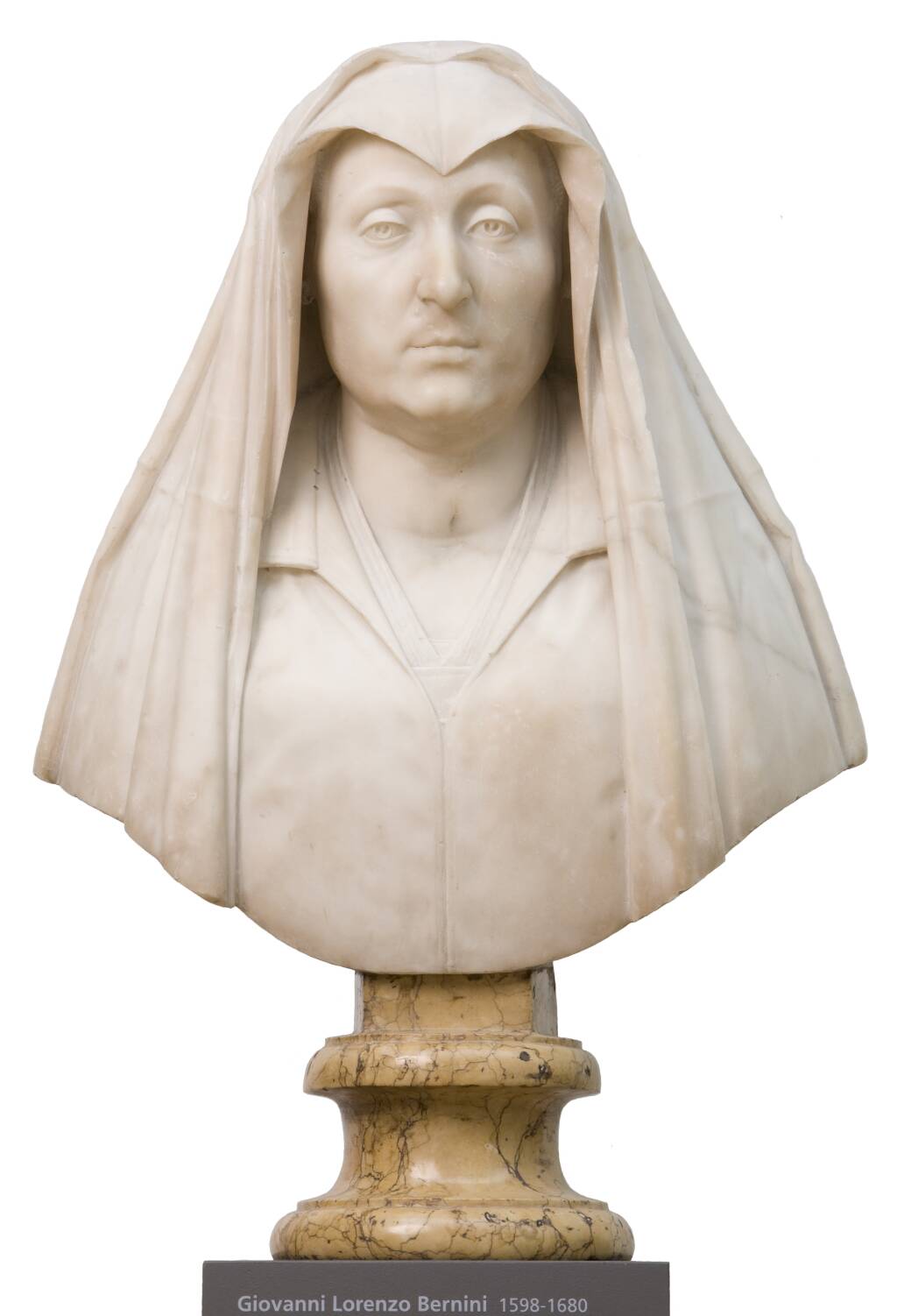
Title: Bust of Camilla Barbadori (dead 1609). Mother of Pope Urban VIII Barberini
Description:
At the tender age of 20, Giovanni Lorenzo Bernini, one of the greatest sculptors of the Baroque, created this bust of the mother of Cardinal Maffeo Barberini (1568-1644), Camilla Barbadori.
A few years later, after the cardinal was appointed Pope and took the name Urban VIII, he became Bernini’s most important patron.
The bust of Camilla Barbadori was to join a companion piece of the cardinal’s father, prince Antonio Barberini (1607-1671), in niches in the family vault at the Sant’ Andrea della Valle in Rome.
The Baroque features
The uniquely Baroque feature of this work is the play of light and shade.
It is evident in the contrast between Camilla Barbadori’s smooth face and the deep shadows created where the cloak meets the neck and throat, as well as in the eyes which appear full of life when seen from a distance.
This is because Bernini carved very deep furrows around the pupils, creating a deep shade that allows spectators to make their own interpretations of what they see.
A framework of a new style
The young artist did not only have a crucial impact on the portrait bust genre; he also laid down the framework of a new style within what many think of as "sculpture proper", i.
e.
sculpture in the round.
Related Results
Saint Catherine of Alexandria
Saint Catherine of Alexandria
Saint Catherine of Alexandria by Caravaggio is one of the works in the Collection whose complete provenance allows its history to be traced almost from the time it was painted to t...
Portrait of Henry VIII of England
Portrait of Henry VIII of England
During the 16th century portraiture was the leading genre in England and almost the only one to which artists could devote themselves following the events of the early 1530s, the c...
Histamenon of Constantine VIII, Constantinople
Histamenon of Constantine VIII, Constantinople
Obv.: Bust of Christ Pantocrator (Type VIII) facing, bearded, with cross nimbus, wearing tunic and himation, r, hand in cloak, l. holding book to breast.
Rev.: Bust of Constantine...
The Mother of God of Trakai
The Mother of God of Trakai
It is one of the oldest easel paintings in Lithuania, closely linked to Vytautas, the Grand Duke of Lithuania (reigning 1401-1430), and early Christianisation in Lithuania. Up unti...
Design for the Prow of a Galley of Pope Urban VIII, with Figures of Victory, Sea Gods, Angels, and the Emblems of the Barberini Family
Design for the Prow of a Galley of Pope Urban VIII, with Figures of Victory, Sea Gods, Angels, and the Emblems of the Barberini Family
Pen and brown ink over leadpoint and partial stylus-incisions...