
Search engine for discovering works of Art, research articles, and books related to Art and Culture


Javascript must be enabled to continue!
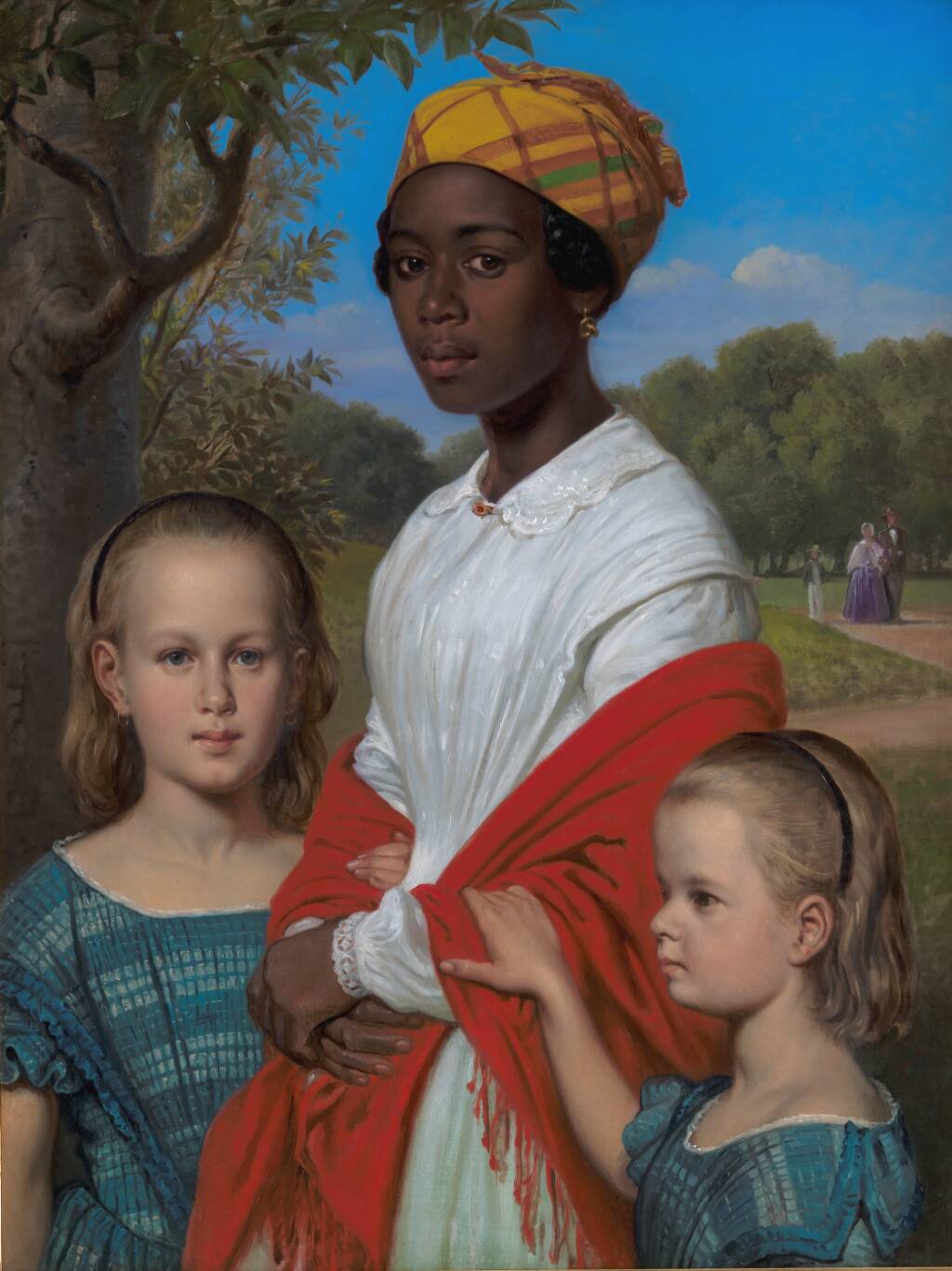
Portrait of Otto Marstrand's two Daughters and their West-Indian Nanny, Justina Antoine, in the Frederiksberg Gardens near Copenhagen
View through National Gallery of Denmark
The Black woman seen here is called Justina Antoine.
Having been enslaved, she was bought by the branch of the
Marstrand family that lived in the West Indies (now the US
Virgin Islands). Justina saw the revolt in 1848 which forced
the island authorities to abandon slavery against the will of
the Danish king.
After the rebellion, the idea of selling the islands was
widely debated in Denmark. The painting has Justina, now
free and working as a nanny, pose as a living Danish flag in red
and white. Perhaps the painting was a partisan contribution
to the public debate? ‘Justina should continue to live under
the Danish flag’. In a referendum held in 1915 – the first in
Denmark where women had the right to vote – the Danes
voted ‘yes’ to the islands being sold. The population on the
islands had no vote.
‘Justina’ means justice. Was there any justice for
Justina? Did she ask to be painted the way we see her here?
Do her eyes offer a glimpse of the many hardships and
violations she endured? The inhabitants of the islands, which
were sold to the United States in 1917, still do not have the
right to vote in American presidential elections (50 Favorites in the SMK Collection).
1857 : 1857
Maleriet blev udført på bestilling af Otto Marstrand, der boede på Skt. Thomas, men var på besøg i Danmark i 1857 sammen med sin hustru, deres børn og familiens sorte barnepige, Justina.
Title: Portrait of Otto Marstrand's two Daughters and their West-Indian Nanny, Justina Antoine, in the Frederiksberg Gardens near Copenhagen
Description:
The Black woman seen here is called Justina Antoine.
Having been enslaved, she was bought by the branch of the
Marstrand family that lived in the West Indies (now the US
Virgin Islands).
Justina saw the revolt in 1848 which forced
the island authorities to abandon slavery against the will of
the Danish king.
After the rebellion, the idea of selling the islands was
widely debated in Denmark.
The painting has Justina, now
free and working as a nanny, pose as a living Danish flag in red
and white.
Perhaps the painting was a partisan contribution
to the public debate? ‘Justina should continue to live under
the Danish flag’.
In a referendum held in 1915 – the first in
Denmark where women had the right to vote – the Danes
voted ‘yes’ to the islands being sold.
The population on the
islands had no vote.
‘Justina’ means justice.
Was there any justice for
Justina? Did she ask to be painted the way we see her here?
Do her eyes offer a glimpse of the many hardships and
violations she endured? The inhabitants of the islands, which
were sold to the United States in 1917, still do not have the
right to vote in American presidential elections (50 Favorites in the SMK Collection).
Related Results
My nanny's brooch
My nanny's brooch
I've brough this brooch, which was my nanny's brooch. I grew up in the United States, in a tight-knit Irish American community in Wilkes-Barre, Pennsylvania. All the branches of my...
[Croquis of the ground floor of the Alcázar of Seville] [Material graphic]
[Croquis of the ground floor of the Alcázar of Seville] [Material graphic]
Handwritten annotation with pen and brown ink on the upper left side: "Explanation/1 Gate of the monteria p.a enter the Palace/2 Employee rooms/3 Cocheras/4 Material storage/5 Step...
Lot and His Daughters
Lot and His Daughters
This incestuous biblical episode is to be found in Genesis. It narrates how Lot and his daughters left the city of Zoar, where they had lived after their departure from Sodom, and ...
Fra en Frederiksbergsk Sporvogn
Fra en Frederiksbergsk Sporvogn
The tramway agreement between Copenhagen and Frederiksberg, which ensures Frederiksberg Municipality Share in the Overview, must be temporarily extended after January 1, as the mun...
Sketchbook
Sketchbook
Sketchbook with blue-and-white marbled cardboard covers. Black fabric tape at spine. Sewn page block; sheets perforated for removal. Pages of off-white wove paper, each 36.7 x 2...
Ten Thousand Years, Ten Thousand Years of Sleep, One Hundred Million Scattered Pieces
Ten Thousand Years, Ten Thousand Years of Sleep, One Hundred Million Scattered Pieces
This triptych comprises a set of three hanging scrolls, each painted in ink on paper. The central scroll is a formal portrait of Mao Zedong (1893–1976); the flanking scrolls repres...