
Search engine for discovering works of Art, research articles, and books related to Art and Culture


Javascript must be enabled to continue!
Oysters, Fruit and a Wineglass on a Stone Table
View through National Gallery of Denmark
How the German still life painter Abraham Mignon (1640-79), demonstrated his talent for giving form to intangible phenomena in nature on the flat canvas is wonderfully exemplified in Oysters, Fruit and a Wineglass on a Stone Table. Here one sees the transitory character of nature in the smoke that rises from the incandescent fire-lighter, and in the food, as a slimy droplet from the oyster shells is heavy and solid in its fall. Mignon has obviously spent time studying these phenomena by careful observation. The painting technique is crystal clear. In the roemer goblet’s edge, one glimpses tiny dots of precisely deposited white paint. Perhaps Mignon wanted to paint the individual particles of water vapor that catch the light. Mignon thinks in an open and a closed version of all foods so as to emphasize the body's density. When one observes what kind of fruits Mignon has chosen, and in particular how he has chosen to paint them, one is suddenly struck by the extent to which the shape is conceived as geometry. Mignon has painted the fruits as if they were echoes of geometric figures or even echoes of Plato's five solids or polyhedrons. The orange has been peeled so that the cut of the knife emphasizes the triangular shape of the individual pieces. The geometry of the prismatic pomegranate cores is painted with accentuated regularity. The orange ‘lanterns’ of the winter cherries also speak to a geometric order of nature. Mignon allows the objects to light up a darkened room, letting the food be a light source in itself, as if they were made of divine material. Still lifes with or without food were much in demand in their own time, and in the eras that followed, artists have continued to gain inspiration from the infinite beauty they represent. Painting food in the 17th century was not just a matter of creating aesthetic wall decorations for the fine parlors of the bourgeoisie. The immense beauty of the paintings would please the audience, moving them by way of visual deception, but perhaps they also instructed about a higher metaphysical order. At a time when the photograph had not yet been invented, the art-loving and art-purchasing clientele was overwhelmed and held spellbound in front of these still lifes, which, despite the flat canvas and the few resources needed to paint them, could look so true to life that one was almost cheated.
Værkdatering: 1671-1679
Påbegyndt: fagligt skøn afsluttet: fagligt skøn
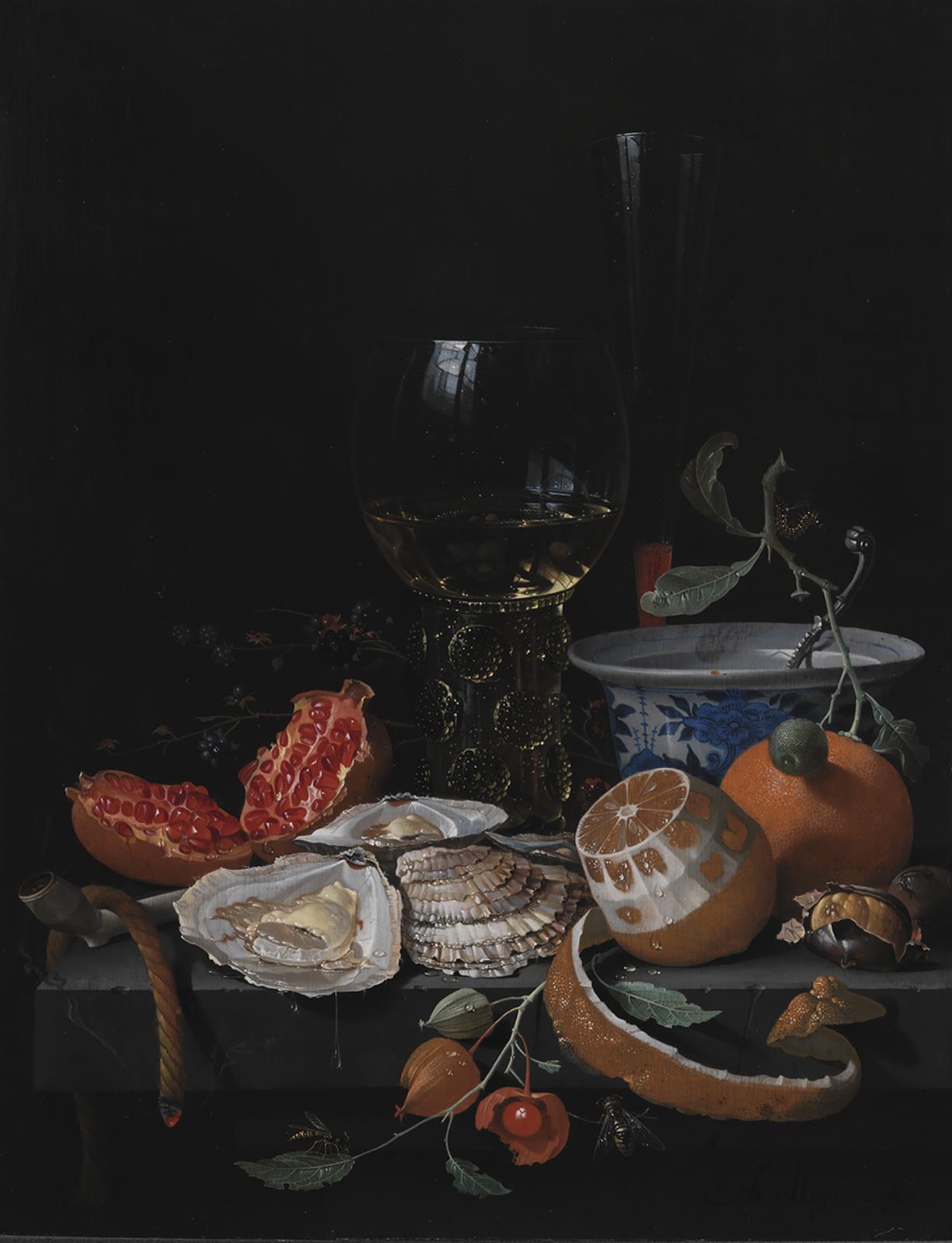
Title: Oysters, Fruit and a Wineglass on a Stone Table
Description:
How the German still life painter Abraham Mignon (1640-79), demonstrated his talent for giving form to intangible phenomena in nature on the flat canvas is wonderfully exemplified in Oysters, Fruit and a Wineglass on a Stone Table.
Here one sees the transitory character of nature in the smoke that rises from the incandescent fire-lighter, and in the food, as a slimy droplet from the oyster shells is heavy and solid in its fall.
Mignon has obviously spent time studying these phenomena by careful observation.
The painting technique is crystal clear.
In the roemer goblet’s edge, one glimpses tiny dots of precisely deposited white paint.
Perhaps Mignon wanted to paint the individual particles of water vapor that catch the light.
Mignon thinks in an open and a closed version of all foods so as to emphasize the body's density.
When one observes what kind of fruits Mignon has chosen, and in particular how he has chosen to paint them, one is suddenly struck by the extent to which the shape is conceived as geometry.
Mignon has painted the fruits as if they were echoes of geometric figures or even echoes of Plato's five solids or polyhedrons.
The orange has been peeled so that the cut of the knife emphasizes the triangular shape of the individual pieces.
The geometry of the prismatic pomegranate cores is painted with accentuated regularity.
The orange ‘lanterns’ of the winter cherries also speak to a geometric order of nature.
Mignon allows the objects to light up a darkened room, letting the food be a light source in itself, as if they were made of divine material.
Still lifes with or without food were much in demand in their own time, and in the eras that followed, artists have continued to gain inspiration from the infinite beauty they represent.
Painting food in the 17th century was not just a matter of creating aesthetic wall decorations for the fine parlors of the bourgeoisie.
The immense beauty of the paintings would please the audience, moving them by way of visual deception, but perhaps they also instructed about a higher metaphysical order.
At a time when the photograph had not yet been invented, the art-loving and art-purchasing clientele was overwhelmed and held spellbound in front of these still lifes, which, despite the flat canvas and the few resources needed to paint them, could look so true to life that one was almost cheated.
Related Results
Tobacco pouch
Tobacco pouch
"362-22" "Two Bears Band, Fort Rice.″Yanktonai pipe bag; wool, glass, porcupine quills; l. 43.5/73 cm., w. 16.5 cm.; ca. 1860s.″Documentation: \Two Bears band, Fort Rice.‖ Purchase...
Tobacco pouch
Tobacco pouch
Tobacco, smoking, ritual, pipes, tobacco bags Tobacco was a stimulant used by the indigenous people in large parts of North, Central and South America as a sedative, medicine again...
Ceremonial tobacco pouch
Ceremonial tobacco pouch
Pipe bag; Lakota; ca. 1870-1880 \nHide, glass beads, porcupine quills, pigments; l. 40 cm. (incl. fringe); w. 13 cm.\nRMV 3158-9; purchased from art dealer Leendert Van Lier, Amste...
Still Life
Still Life
In 1899, Gauguin's mistress, Pahura, gave birth to a son, who gave the artist a new lease on life. After months of inaction due to poverty and ill health, Gauguin began to paint ag...
Still Life with Fruit
Still Life with Fruit
Willem van Aelst trained with his uncle Evert van Aelst in his native city of Delft and opted to specialise in still-life painting. At the age of eighteen he left Holland and settl...
Twelve-pointed pendant for Bektashi Sufis
Twelve-pointed pendant for Bektashi Sufis
Pendant in twelve-pointed form, made of marble (or alabaster?) from the place Haci Bektash. The pendant is worn on a cord around the neck by followers of the Sufi order of the Bekt...
ROMAN SCULPTURE
ROMAN SCULPTURE
A worked stone of the Roman period, dating from the 2nd-3rd centuries.The stone depicts a probably female head in the Romano-British style, with a head on a neck in relief on a rec...