
Search engine for discovering works of Art, research articles, and books related to Art and Culture


Javascript must be enabled to continue!
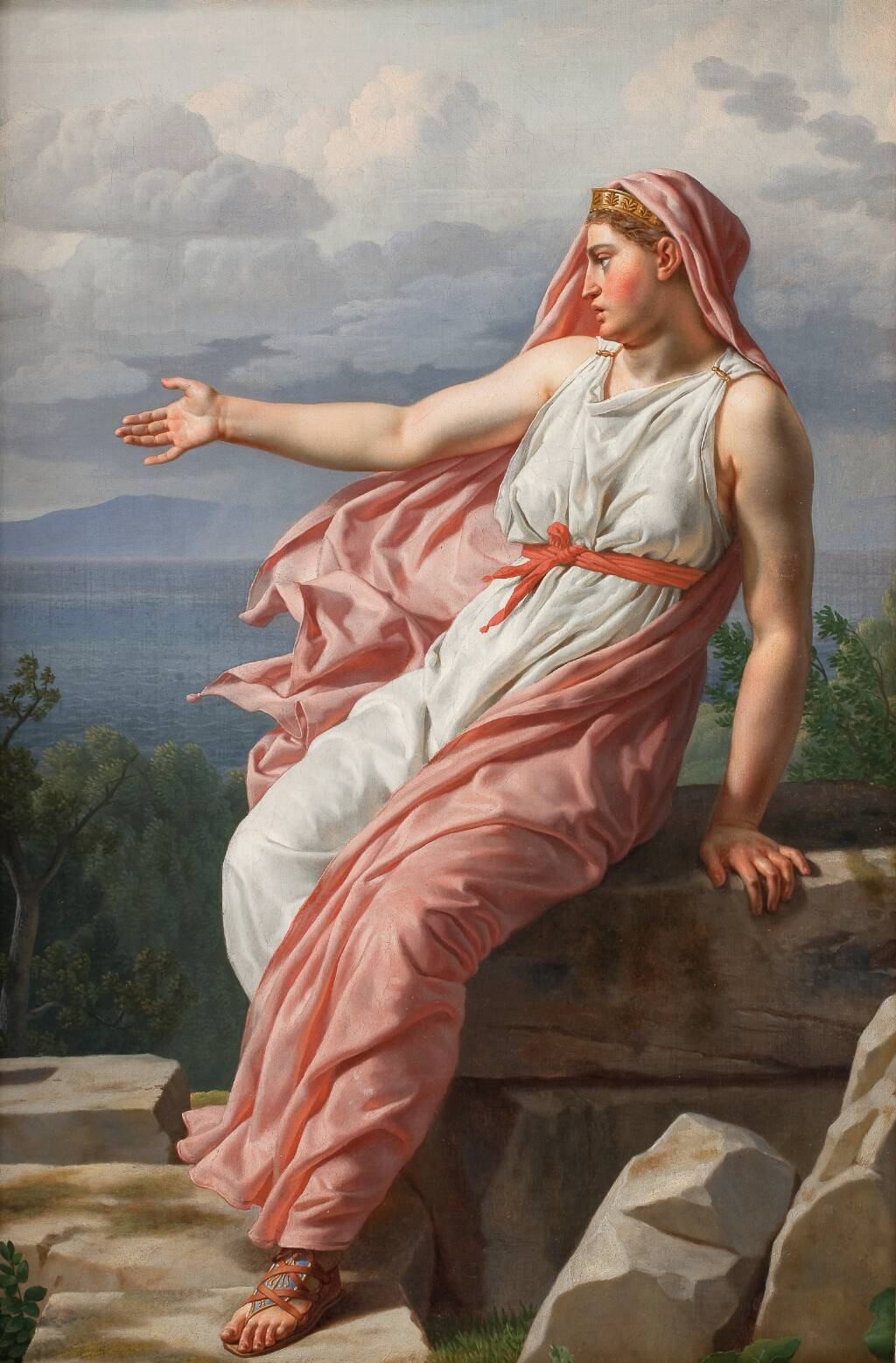
Alcyone's Farewell to her Husband. From Ovid's Metamorphoses, Song XI
View through National Gallery of Denmark
In the autumn of 1813 Eckersberg was in Rome, working on two companion pieces: both were mythological paintings, commissioned by Nathanson, of scenes from the tragic love story of Queen Alcyone and King Ceyx from Ovid’s Metamorphoses. The choice of subject matter was highly unusual, but he may have gotten the idea from the contemporary French art scene, via another Danish artist of Eckersberg’s generation, Kratzenstein Stub (cf. Monrad, 1990, 77–81). The first painting shows Alcyone waving farewell to Ceyx from tall cliffs while a storm is brewing out at sea. This allows Eckersberg to include a depiction of very accurately observed nature in the narrative. The painting has been cropped on three sides and shows only a fragment of the original composition. It is likely that the departing Ceyx was originally seen sailing away to the left (as has been pointed out by Jesper Svenningsen, see page 128). The cropping may have been done because of a lack of coherence between foreground and background.
Værkdatering: (1813)
Ifølge kunstnerens dagbog blev maleriet fuldført den 22. oktober 1813 (Eckersberg i Rom, 1983, p. 14).
Title: Alcyone's Farewell to her Husband. From Ovid's Metamorphoses, Song XI
Description:
In the autumn of 1813 Eckersberg was in Rome, working on two companion pieces: both were mythological paintings, commissioned by Nathanson, of scenes from the tragic love story of Queen Alcyone and King Ceyx from Ovid’s Metamorphoses.
The choice of subject matter was highly unusual, but he may have gotten the idea from the contemporary French art scene, via another Danish artist of Eckersberg’s generation, Kratzenstein Stub (cf.
Monrad, 1990, 77–81).
The first painting shows Alcyone waving farewell to Ceyx from tall cliffs while a storm is brewing out at sea.
This allows Eckersberg to include a depiction of very accurately observed nature in the narrative.
The painting has been cropped on three sides and shows only a fragment of the original composition.
It is likely that the departing Ceyx was originally seen sailing away to the left (as has been pointed out by Jesper Svenningsen, see page 128).
The cropping may have been done because of a lack of coherence between foreground and background.
Related Results
Arthur (James) Lewis (1824-1901), husband of Kate Terry, and grandfather of John Gielgud. It appears he was also a painter and a musician, with a connection to J M Whistler.
Arthur James Lewis was a London landscape and portrait painter, and illustrator.
Arthur (James) Lewis (1824-1901), husband of Kate Terry, and grandfather of John Gielgud. It appears he was also a painter and a musician, with a connection to J M Whistler.
Arthur James Lewis was a London landscape and portrait painter, and illustrator.
Arthur (James) Lewis (1824-1901), husband of Kate Terry, and grandfather of John Gielgud. It appears he was also a painter and a musician, with a connection to J M Whistler.
Arthur...
The Parthenon Frieze. Block E V
The Parthenon Frieze. Block E V
The portrayal of the gods continues on this block, with Hera (29) and Zeus (30) and a small youthful figure (28) identified either as Nike or more likely as Iris, the wingèd messen...
The Parthenon Frieze. Block E V
The Parthenon Frieze. Block E V
The portrayal of the gods continues on this block, with Hera (29) and Zeus (30) and a small youthful figure (28) identified either as Nike or more likely as Iris, the wingèd messen...
Werbefilme der Insel-Film GmbH: Musterrolle 69/1
Werbefilme der Insel-Film GmbH: Musterrolle 69/1
Spot Nr. 1 (00:34): POLAR Rum 68/1: A person dressed in fur jacket in snow flurry. „Winter time, polar time, grog time - time for Polar.“ The person is serving grog with Polar Rum....
Anthropomorphic female figurine
Anthropomorphic female figurine
This handmade terracotta figurine depicts a anthropomorphic female figure. She is naked except for a necklace or collar around her neck and a belt or sash around her waist. Four ro...
Portrait of a Lady spinning
Portrait of a Lady spinning
During the 16th century, painting in the Netherlands underwent a transformation, abandoning the intimate, religious compositions used by the early Flemish artists that has so brill...
Pan and Syrinx
Pan and Syrinx
Both panels were acquired for the Collection in 1929 from Lucerne Fine Art, Switzerland. One month later, Georg Gronau wrote a report in which he praised the quality and artistic m...
Ladon and Syrinx
Ladon and Syrinx
Both panels were acquired for the Collection in 1929 from Lucerne Fine Art, Switzerland. One month later, Georg Gronau wrote a report in which he praised the quality and artistic m...