
Search engine for discovering works of Art, research articles, and books related to Art and Culture


Javascript must be enabled to continue!
Marble capital and finial in the form of a sphinx
View through The Met
Marble Parian, Archaic, Greek Attic
Rights: Public Domain
Greek and Roman Art, Metropolitan Museum of Art New York NY, Munsey Fund 1936 1938
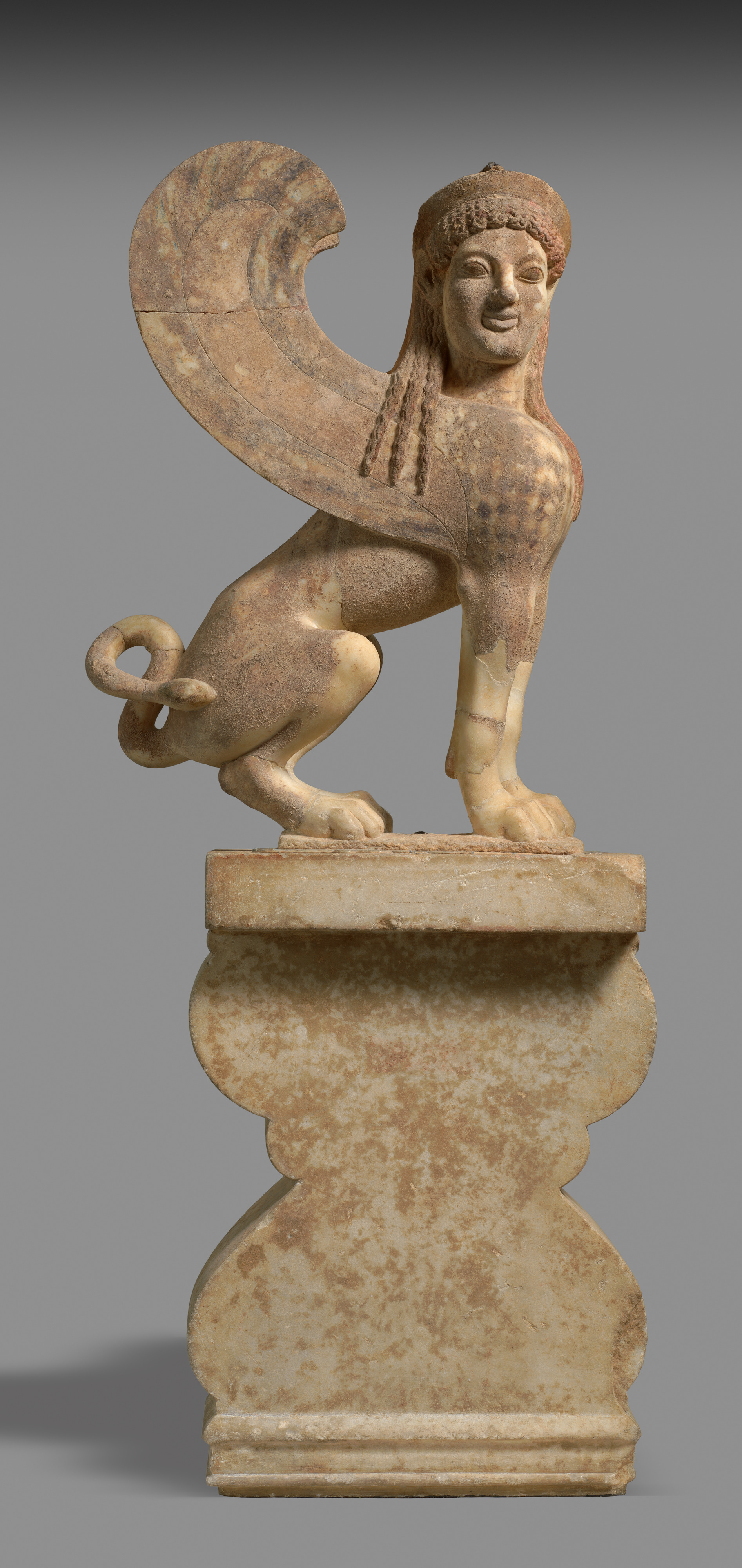
Title: Marble capital and finial in the form of a sphinx
Description:
Marble Parian, Archaic, Greek Attic.
Related Results
Column Krater (mixing bowl for wine and water): Four-Horse Chariot and Charioteer; Sphinx and Lions
Column Krater (mixing bowl for wine and water): Four-Horse Chariot and Charioteer; Sphinx and Lions
The vase is broken and repaired with numerous rivet holes on the body from ancient repairs. In shape, the vessel has a wide body, short neck, and echinus foot. On each side is a fi...
Finial Support with Four Faces
Finial Support with Four Faces
This bulbous finial support is decorated with four faces. The faces have two variations, and each face shares elements with the neighboring faces. Each face is composed of two larg...
Shallow Bowl with Tall Foot and Knobbed Lid
Shallow Bowl with Tall Foot and Knobbed Lid
Interior: in the center a whirl pattern in black bounded by a checker border between two stripes of applied purple. Around an animal zone, panther, goose, panther, goose, lion, ibe...
White Statuary Chimney-piece
White Statuary Chimney-piece
Ink and watercolour drawing of a white statuary chimney-piece. The centre tablet is carved with an urn on foliate foot with griffin handles which hold a festoon suspended from ribb...
Finial with Two Confronted Ibex
Finial with Two Confronted Ibex
This finial is comprised of two rampant, confronted ibexes, joined at the forelimbs and hindlimbs around rings that would have once held the pin of the finial. The ibexes are very ...
Marble sphinx on a cavetto capital
Marble sphinx on a cavetto capital
Marble, Archaic, Greek Attic...