
Search engine for discovering works of Art, research articles, and books related to Art and Culture


Javascript must be enabled to continue!
Venus Bewailing the Slain Adonis
View through National Gallery of Denmark
This painting is on a panel of oak. In the 1600s oak was in short supply, so to control the trade and production of panels the carpenters’ guild in Antwerp (which included frame and panel makers) ruled that from 1617 all panels were to be stamped with the personal monogram of the carpenter. Once this had been done, an inspector from the Guild of Saint Luke came to the carpenter’s workshop to check the quality of the panels. Approved panels were then branded with Antwerp’s city arms: three towers surmounted by two hands. This is the brand that can be seen on the back of Frans Wouter’s painting. The design here was in use from 1637-1650, so the painting was probably made during this period. It is, however, strange that there is no carpenter’s stamp on this approved and branded panel. We do not know why. Such a monogram would have given us more information about when the panel was made
Værkdatering: 1650'erne
Dateringen er baseret på et fagligt skøn
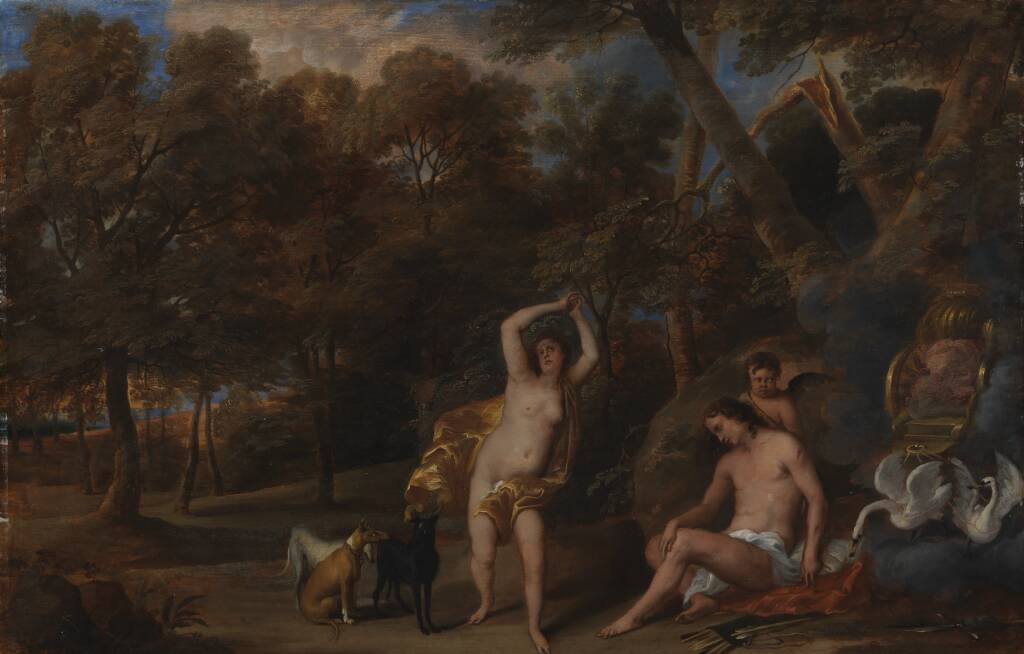
Title: Venus Bewailing the Slain Adonis
Description:
This painting is on a panel of oak.
In the 1600s oak was in short supply, so to control the trade and production of panels the carpenters’ guild in Antwerp (which included frame and panel makers) ruled that from 1617 all panels were to be stamped with the personal monogram of the carpenter.
Once this had been done, an inspector from the Guild of Saint Luke came to the carpenter’s workshop to check the quality of the panels.
Approved panels were then branded with Antwerp’s city arms: three towers surmounted by two hands.
This is the brand that can be seen on the back of Frans Wouter’s painting.
The design here was in use from 1637-1650, so the painting was probably made during this period.
It is, however, strange that there is no carpenter’s stamp on this approved and branded panel.
We do not know why.
Such a monogram would have given us more information about when the panel was made.
Related Results
Plate 1: The Toilette of Venus; Venus reclining at center, gazing into a mirror held by Cupid, attendants fix her hair while a putto ties her sandal, above her chariot appears on a cloud; from "The Loves of Venus and Adonis"
Plate 1: The Toilette of Venus; Venus reclining at center, gazing into a mirror held by Cupid, attendants fix her hair while a putto ties her sandal, above her chariot appears on a cloud; from "The Loves of Venus and Adonis"
Engraving and etching [possibly a later printing], The Loves of Venus and Adonis...
Venus and Adonis, from "The Story of Adonis"
Venus and Adonis, from "The Story of Adonis"
Engraving; second state of two, The Story of Adonis...
Venus and Cupid
Venus and Cupid
In his Arte de la Pintura, Pacheco left a significant account of Rubens’ second trip to Spain of 1628–29 (following his first trip of 1603). Pacheco mentions some of Rubens’ activi...
painting (oil): ["Venus and Cupid"]
painting (oil): ["Venus and Cupid"]
"Signed bottom right just above the corner "Chev. V. Werff fec. 1709" - in black and slightly flourished italics." [Letter from Isherwood Kay in Registry] A small painting with a f...
Vignette page 232 depicting Venus rushing from her Chariot, hands raised towards the heaven in despair, as Adonis dies in the arms of his hunting companions, from Les Amours de Psyché et de Cupidon Avec la Poème d'Adonis
Vignette page 232 depicting Venus rushing from her Chariot, hands raised towards the heaven in despair, as Adonis dies in the arms of his hunting companions, from Les Amours de Psyché et de Cupidon Avec la Poème d'Adonis
Etching and engraving; fourth state of five (Bocher), Les Amours de Psyché et de Cupidon Avec la Poème d'Adonis...
Vignette page 232 depicting Venus rushing from her Chariot, hands raised towards the heaven in despair, as Adonis dies in the arms of his hunting companions, from Les Amours de Psyché et de Cupidon Avec la Poème d'Adonis
Vignette page 232 depicting Venus rushing from her Chariot, hands raised towards the heaven in despair, as Adonis dies in the arms of his hunting companions, from Les Amours de Psyché et de Cupidon Avec la Poème d'Adonis
Etching; first state of five (Bocher), Les Amours de Psyché et de Cupidon Avec la Poème d'Adonis...
Vignette page 215 Venus surrounded by putti with Adonis laying in the grass with his dogs after him, from Les Amours de Psyché et de Cupidon Avec la Poème d'Adonis
Vignette page 215 Venus surrounded by putti with Adonis laying in the grass with his dogs after him, from Les Amours de Psyché et de Cupidon Avec la Poème d'Adonis
Etching and engraving; third state of four (Bocher), Les Amours de Psyché et de Cupidon Avec la Poème d'Adonis...