
Search engine for discovering works of Art, research articles, and books related to Art and Culture


Javascript must be enabled to continue!
Henri Matisse: Paper Cut-Outs
View through Artsy
Blue nudes, red hearts, and multicolored flowers fill [Henri Matisse](/artist/henri-matisse)’s paper cut-outs—the technique that fascinated the artist for the final decade of his career. With paper cut-outs, Matisse was able to draw with scissors, creating striking compositions (some as large as 25 feet long) from his bed or wheelchair, after a 1941 surgery left the artist largely disabled. While some dismissed Matisse’s experimentation with paper cut-outs as his second childhood, others quickly recognized the medium as cutting-edge—a swift way of capturing the modern essentials of line, form, and color. “It was pure joy to be able in 10 minutes to do something that was of now, now, now,” [remembers](https://www.theguardian.com/artanddesign/2014/mar/29/henri-matisse-cutouts-tate-modern-drawing-scissors) artist [Françoise Gilot](/artist/francoise-gilot), who often visited Matisse’s studio with her boyfriend [Pablo Picasso](/artist/pablo-picasso). In 2014, an exhibition of Matisse’s cut-outs traveled from the Tate Modern in London to the Museum of Modern Art in New York, drawing record crowds to both institutions. From stained glass windows to [limited edition books](/artist-series/henri-matisse-jazz), the show brought together more than 100 of Matisse’s visionary paper cut-outs, presenting the series as an essential moment in the story of art history.
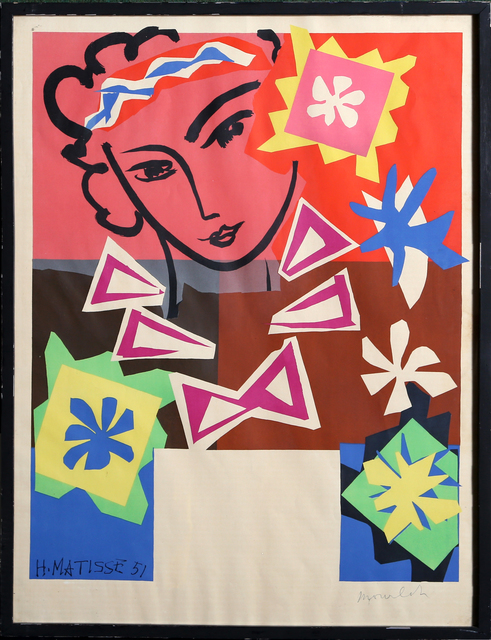
Title: Henri Matisse: Paper Cut-Outs
Description:
Blue nudes, red hearts, and multicolored flowers fill [Henri Matisse](/artist/henri-matisse)’s paper cut-outs—the technique that fascinated the artist for the final decade of his career.
With paper cut-outs, Matisse was able to draw with scissors, creating striking compositions (some as large as 25 feet long) from his bed or wheelchair, after a 1941 surgery left the artist largely disabled.
While some dismissed Matisse’s experimentation with paper cut-outs as his second childhood, others quickly recognized the medium as cutting-edge—a swift way of capturing the modern essentials of line, form, and color.
“It was pure joy to be able in 10 minutes to do something that was of now, now, now,” [remembers](https://www.
theguardian.
com/artanddesign/2014/mar/29/henri-matisse-cutouts-tate-modern-drawing-scissors) artist [Françoise Gilot](/artist/francoise-gilot), who often visited Matisse’s studio with her boyfriend [Pablo Picasso](/artist/pablo-picasso).
In 2014, an exhibition of Matisse’s cut-outs traveled from the Tate Modern in London to the Museum of Modern Art in New York, drawing record crowds to both institutions.
From stained glass windows to [limited edition books](/artist-series/henri-matisse-jazz), the show brought together more than 100 of Matisse’s visionary paper cut-outs, presenting the series as an essential moment in the story of art history.
Related Results
Brisé fan of paste board covered with silk, decorated with straw appliqué work, probably made in Florence, 1620s. Brisé fan of seven sticks, each one shaped to represent a curled feather. Cut straw, applied to silk covered cardboard. The sticks are made o
Brisé fan of paste board covered with silk, decorated with straw appliqué work, probably made in Florence, 1620s. Brisé fan of seven sticks, each one shaped to represent a curled feather. Cut straw, applied to silk covered cardboard. The sticks are made o
Brisé fan of paste board covered with silk, decorated with straw appliqué work, probably made in Florence, 1620s. Brisé fan of seven sticks, each one shaped to represent a curled f...
Gold watch and chatelaine set with topazes and table-cut and brilliant-cut diamonds, signed 'Julien le Roy A Paris', France, ca.1760. Gold watch and chatelaine set with topazes and table-cut and brilliant-cut diamonds, signed 'Julien le Roy A Paris'. Gol
Gold watch and chatelaine set with topazes and table-cut and brilliant-cut diamonds, signed 'Julien le Roy A Paris', France, ca.1760. Gold watch and chatelaine set with topazes and table-cut and brilliant-cut diamonds, signed 'Julien le Roy A Paris'. Gol
Gold watch and chatelaine set with topazes and table-cut and brilliant-cut diamonds, signed 'Julien le Roy A Paris', France, ca.1760. Gold watch and chatelaine set with topazes and...
Gold slide and pendant set with table-cut and rose-cut diamonds, made in Spain, probably Cordoba, about 1750. Slide and pendant ornamented with table-cut and rose-cut diamonds set in gold openwork. The slide in the form of a bow with two foliated units be
Gold slide and pendant set with table-cut and rose-cut diamonds, made in Spain, probably Cordoba, about 1750. Slide and pendant ornamented with table-cut and rose-cut diamonds set in gold openwork. The slide in the form of a bow with two foliated units be
Gold slide and pendant set with table-cut and rose-cut diamonds, made in Spain, probably Cordoba, about 1750. Slide and pendant ornamented with table-cut and rose-cut diamonds set ...
Enamelled gold commemorative ring, set with a rose-cut diamond cipher of King Louis Philippe of France, with a brilliant-cut diamond border, French warranty mark from 1838, France, ca. 1840. Enamelled gold commemorative ring, set with diamonds. The oval b
Enamelled gold commemorative ring, set with a rose-cut diamond cipher of King Louis Philippe of France, with a brilliant-cut diamond border, French warranty mark from 1838, France, ca. 1840. Enamelled gold commemorative ring, set with diamonds. The oval b
Enamelled gold commemorative ring, set with a rose-cut diamond cipher of King Louis Philippe of France, with a brilliant-cut diamond border, French warranty mark from 1838, France,...
Clearing in Provence (study for The Clearing)
Clearing in Provence (study for The Clearing)
Henri-Edmond Cross was born on May 20, 1856 in Douai, a small town close to the Belgian border in northern France. He spent his youth in Lille and there, at the age of ten, took dr...
Henri Matisse: Jazz
Henri Matisse: Jazz
In addition to his bold innovations in painting and sculpture, Henri Matisse (1869 – 1954) recognised the expressive potential of printmaking, and over the course of his career, he...