
Search engine for discovering works of Art, research articles, and books related to Art and Culture


Javascript must be enabled to continue!
Navajo Brave and his Mother. The Navajo's were formerly a warlike tribe until subdued by U.S. Troops, in 1859-60.
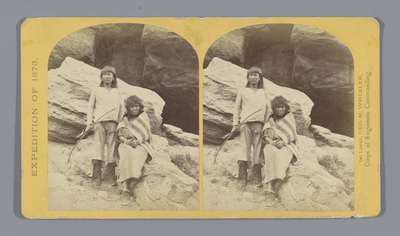
Title: Navajo Brave and his Mother. The Navajo's were formerly a warlike tribe until subdued by U.S. Troops, in 1859-60.
Description not available.
Related Results
Gospel of the Lots of Mary
Gospel of the Lots of Mary
A miniature codex that contains 37 oracles, entitled The Gospel of the Lots of Mary according to its incipit. These oracles would be chosen via lot divination so as to provide the ...
Mother and Child
Mother and Child
Renoir once quipped that had God not created the female breast, he might never have become an artist. Indeed, the full, womanly bosom figures prominently in Renoir's loving portray...
Maudit propriétaire..., tu seras donc cause de tous mes maux..., from L'Exposition de 1859, published in Le Charivari, April 26, 1859
Maudit propriétaire..., tu seras donc cause de tous mes maux..., from L'Exposition de 1859, published in Le Charivari, April 26, 1859
Lithograph; second state (Delteil), L'Exposition de 1859...
Je suis reçu!!..., from L'Exposition de 1859, published in Le Charivari, April 22, 1859
Je suis reçu!!..., from L'Exposition de 1859, published in Le Charivari, April 22, 1859
Lithograph; second state (Delteil), L'Exposition de 1859...
The Naughty Drummer
The Naughty Drummer
Nicolaes Maes initiated his artistic studies in his native city and completed his training in Rembrandt’s studio where he worked from the late 1640s until 1653. From his early year...
Vas. Chongzhen, late Mingdynasty.
Vas. Chongzhen, late Mingdynasty.
VAS, with a cuppy secondary screw cap and silver coining. Curbite, on the edge of the foot, the lower part spherical, the upper pear shaped and drawn out in a narrow neck with slig...
Tirthankara Suparsvanatha in Kayotsarga, or Standing Meditation, Posture and Protected by a Five-Headed Naga
Tirthankara Suparsvanatha in Kayotsarga, or Standing Meditation, Posture and Protected by a Five-Headed Naga
Formerly thought to represent Parsvanatha, Jainism’s twenty-third Tirthankara, this sculpture has now been identified as Suparsvanatha, Jainism’s seventh Tirthankara. According to ...