
Search engine for discovering works of Art, research articles, and books related to Art and Culture


Javascript must be enabled to continue!
mask
View through Europeana Collections
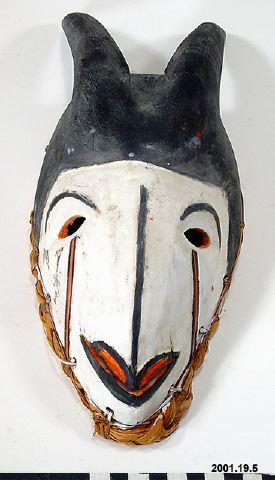
Mask in clear colors, red-white-black. Djuranskikte, a goat. The upper is black painted and has two horns. The eye holes on the sides of the mask are red colored. Under the eyes, oblique to the edge of the mask runs a red-colored dash surrounded by two black dashes. These are cut out of the mask and not just painted. Also the mouth has black and red marking.
The mask rests on a base of bast.
In the television film “To Be Converted,” Part 4, Birgit Åkesson says of this mask that the goat is a victim given to the earth, that the tattoos on the face excel the igbo and that the mask is worn in front of the face.
The mask comes from Afikpo Igbo in southeastern Nigeria and is of Mkpe type (see picture Ottenberg p. 33 also color picture Plate VII). Mkpe means horn. The horns are typical of this type of mask. The main form is a goat. Simon Ottenberg writes in his book: Masked Rituals of Afikpo: The Simon of an African art. It can be used by musicians during the Okumkpa masquerade or by an adult dressed an ori costume, however, can not be worn by younger boys. Despite the design of the mask, it is not common for the wearer to assume the role of a horned animal, to play goat. According to Ottenberg, there are four variations on this type of mask.
Simon Ottenberg writes in an email to Wilhelm Östberg 050525 concerning Afikpo’s masks:
Afikpo-style masks Aby Afikpo carvers at museum and elsewhere in Nigeria and have Ain European and American African art galleries so that she (Birgit Åkesson) Ahave have AAA
There are carvers at Afikpo There sell them to expatriates There come to visit Afikpo as well. They have been used for the needs of the local performance.
While I say that they mask is not a love good one that does not mean that it must not be enough.
Title: mask
Description:
Mask in clear colors, red-white-black.
Djuranskikte, a goat.
The upper is black painted and has two horns.
The eye holes on the sides of the mask are red colored.
Under the eyes, oblique to the edge of the mask runs a red-colored dash surrounded by two black dashes.
These are cut out of the mask and not just painted.
Also the mouth has black and red marking.
The mask rests on a base of bast.
In the television film “To Be Converted,” Part 4, Birgit Åkesson says of this mask that the goat is a victim given to the earth, that the tattoos on the face excel the igbo and that the mask is worn in front of the face.
The mask comes from Afikpo Igbo in southeastern Nigeria and is of Mkpe type (see picture Ottenberg p.
33 also color picture Plate VII).
Mkpe means horn.
The horns are typical of this type of mask.
The main form is a goat.
Simon Ottenberg writes in his book: Masked Rituals of Afikpo: The Simon of an African art.
It can be used by musicians during the Okumkpa masquerade or by an adult dressed an ori costume, however, can not be worn by younger boys.
Despite the design of the mask, it is not common for the wearer to assume the role of a horned animal, to play goat.
According to Ottenberg, there are four variations on this type of mask.
Simon Ottenberg writes in an email to Wilhelm Östberg 050525 concerning Afikpo’s masks:
Afikpo-style masks Aby Afikpo carvers at museum and elsewhere in Nigeria and have Ain European and American African art galleries so that she (Birgit Åkesson) Ahave have AAA
There are carvers at Afikpo There sell them to expatriates There come to visit Afikpo as well.
They have been used for the needs of the local performance.
While I say that they mask is not a love good one that does not mean that it must not be enough.
Related Results
Ivory pendant in the shape of a miniature mask
Ivory pendant in the shape of a miniature mask
There are various interpretations of its function in the literature. One emphasizes the protective and healing influence of the pendant on the wearer. The other states that the pen...
mask, kiwoyo
mask, kiwoyo
The Georg von Békesy Collection, page 182-183.
Wooden dance mask
The Eastern Bapende live in a large L-shaped area on the Loange and Kasai rivers, in the middle of wich lies the ...
ansiktsmask, mask, topeng
ansiktsmask, mask, topeng
Mask of painted wood, yellow with long pointed nose.
The mask is a dance mask that is part of the prop of a trancedans- set called kuda kepang (Indonesian, kuda: horse, kepang: b...