
Search engine for discovering works of Art, research articles, and books related to Art and Culture


Javascript must be enabled to continue!
Nuptual Chest (Storage Chest). So-called "Cassone" or "Forziere"
View through National Gallery of Denmark
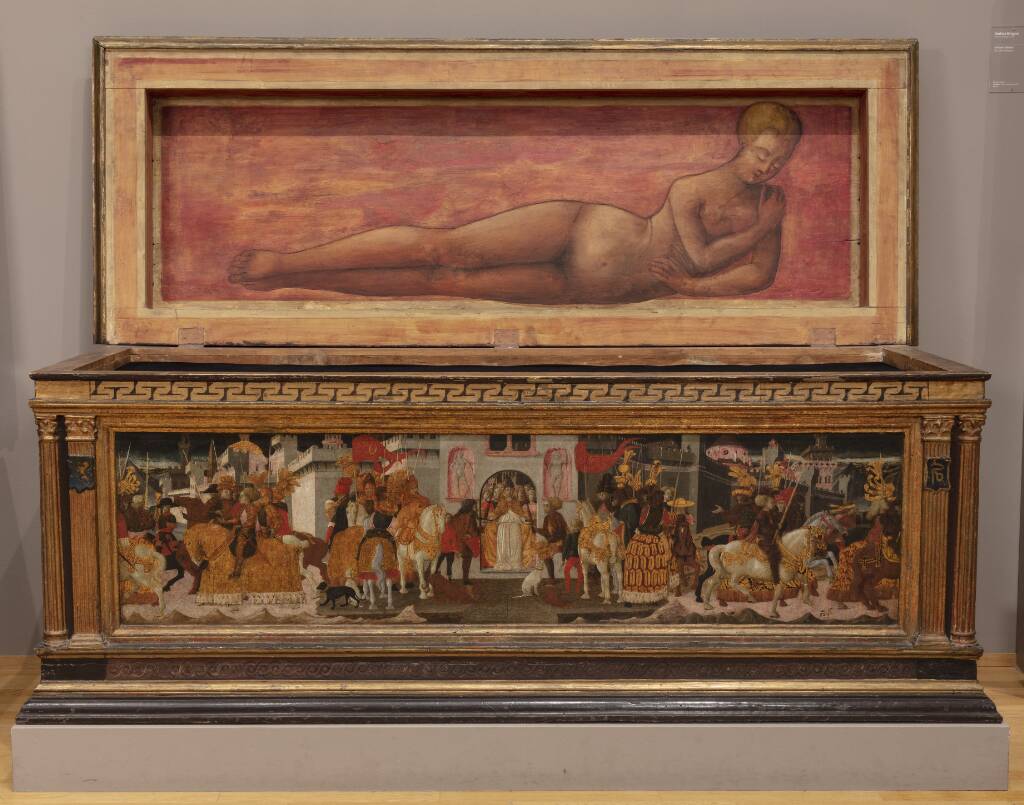
In fifteenth-century Florence all affluent couples owned beautifully painted chests for clothes and accessories. On the day of their wedding, these nuptial chests were carried by a procession of people, moving them from the bride’s parents’ house to her new home, where they were placed in the sleeping quarters. The front of such chests were usually decorated by non-religious motifs. This example depicts a story from the early days of Rome. The Romans had abducted the women of a neighbouring tribe, the Sabines, because they needed wives, but the Sabines sought to reclaim their women. The front of this chest shows the Sabine women standing in the gates of Rome, led by Hersilia, who is holding two swords while her father, Tatius, king of the Sabines, and her husband Romulus, first king of Rome, both kneel down as they make peace.
Værkdatering: Ca. 1450-75
Title: Nuptual Chest (Storage Chest). So-called "Cassone" or "Forziere"
Description:
In fifteenth-century Florence all affluent couples owned beautifully painted chests for clothes and accessories.
On the day of their wedding, these nuptial chests were carried by a procession of people, moving them from the bride’s parents’ house to her new home, where they were placed in the sleeping quarters.
The front of such chests were usually decorated by non-religious motifs.
This example depicts a story from the early days of Rome.
The Romans had abducted the women of a neighbouring tribe, the Sabines, because they needed wives, but the Sabines sought to reclaim their women.
The front of this chest shows the Sabine women standing in the gates of Rome, led by Hersilia, who is holding two swords while her father, Tatius, king of the Sabines, and her husband Romulus, first king of Rome, both kneel down as they make peace.
Related Results
The Argonauts Leaving Colchis
The Argonauts Leaving Colchis
This small panel was part of the decoration of a cassone or wedding chest. According to an old description, the chest had three scenes on the front divided by small columns. This i...
X-radiograph(s) of "Solomon and Sheba (cassone pannel)"
X-radiograph(s) of "Solomon and Sheba (cassone pannel)"
X-Radiograph Description: X-Radiograph; Negative; Detail : female figures, behind Sheba
Burroughs Number: 1120
X-Radiograph(s) of:
Artist: Italian School
Artist: Also att....
X-radiograph(s) of "Dido (cassone pannel)"
X-radiograph(s) of "Dido (cassone pannel)"
X-Radiograph Description: X-Radiograph; Detail : horse (right); Little shows
Burroughs Number: 1121
X-Radiograph(s) of:
Artist: Italian School
Artist: Also att. to Giovann...
X-radiograph(s) of "Cassone (test on wood structure)"
X-radiograph(s) of "Cassone (test on wood structure)"
X-Radiograph Description: Negative
Burroughs Number: 770
X-Radiograph(s) of:
Artist: Francesco di Giorgio Martini, Sienese, 1439-1501
Title: Cassone (test on wood structur...
X-radiograph(s) of "Nativity of the Virgin (cassone panel)"
X-radiograph(s) of "Nativity of the Virgin (cassone panel)"
Burroughs Number: 1071
X-Radiograph(s) of:
Artist: Italian School
Title: Nativity of the Virgin (cassone pannel)
Date: ca. 1410
Description: Tempera on wood panel
Owner: H...