
Search engine for discovering works of Art, research articles, and books related to Art and Culture


Javascript must be enabled to continue!
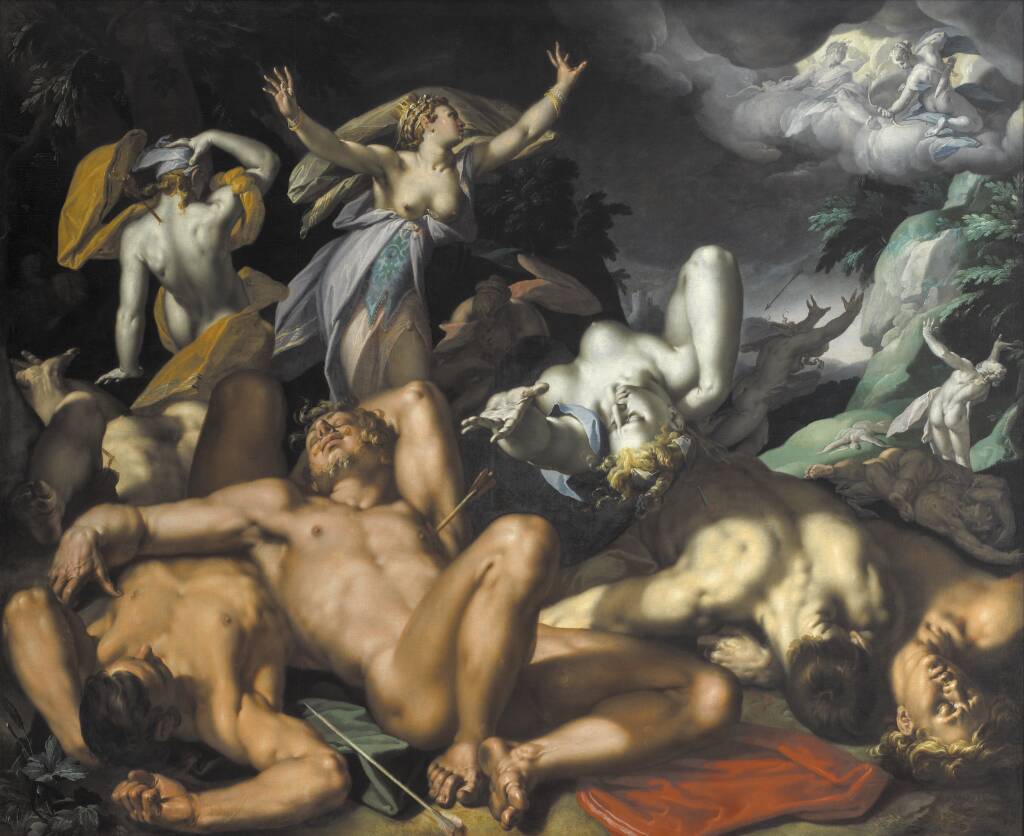
Apollo and Diana Punishing Niobe by Killing her Children
View through National Gallery of Denmark
The story of Niobe is related in Ovid’s Metamorphoses (Canto 6, 146-312):
Niobe was the daughter of the proud King Tantalus of Phrygia. She married Amphion, the king of Thebes, and bore him seven sons and seven daughters. She bragged of her many children and chided the goddess Latona, mother of the twins Apollo and Diana, for having only two. In vengeance, Apollo and Diana carried out a massacre. They are shown in the clouds showering arrows down onto Niobe’s children.
Style of painting and the drama of the tale
Abraham Bloemaert’s style of painting suits the drama of the tale, full of contrasting shifts between colours, light, and shade as well as complicated poses with bodies viewed from extreme angles.
The great role model: Cornelis Cornelisz van Haarlem
Only 24 years old at the time, the painting sees Bloemaert closely approximating his great role model Cornelis Cornelisz van Haarlem (1562-1638), who in the 1580s joined his friends Karel van Mander (1548-1606) and Hendrick Goltzius (1558-1617) to make his native town of Haarlem the centre of the special Haarlem Mannerist style.
In his famous Schilder Boeck from 1604 Karel van Mander relates how the painting was originally intended for Rudolph 2. (1552-1612) in Prague, a patron of many Mannerist artists.
Title: Apollo and Diana Punishing Niobe by Killing her Children
Description:
The story of Niobe is related in Ovid’s Metamorphoses (Canto 6, 146-312):
Niobe was the daughter of the proud King Tantalus of Phrygia.
She married Amphion, the king of Thebes, and bore him seven sons and seven daughters.
She bragged of her many children and chided the goddess Latona, mother of the twins Apollo and Diana, for having only two.
In vengeance, Apollo and Diana carried out a massacre.
They are shown in the clouds showering arrows down onto Niobe’s children.
Style of painting and the drama of the tale
Abraham Bloemaert’s style of painting suits the drama of the tale, full of contrasting shifts between colours, light, and shade as well as complicated poses with bodies viewed from extreme angles.
The great role model: Cornelis Cornelisz van Haarlem
Only 24 years old at the time, the painting sees Bloemaert closely approximating his great role model Cornelis Cornelisz van Haarlem (1562-1638), who in the 1580s joined his friends Karel van Mander (1548-1606) and Hendrick Goltzius (1558-1617) to make his native town of Haarlem the centre of the special Haarlem Mannerist style.
In his famous Schilder Boeck from 1604 Karel van Mander relates how the painting was originally intended for Rudolph 2.
(1552-1612) in Prague, a patron of many Mannerist artists.
Related Results
The Parthenon Frieze. Block E V
The Parthenon Frieze. Block E V
The portrayal of the gods continues on this block, with Hera (29) and Zeus (30) and a small youthful figure (28) identified either as Nike or more likely as Iris, the wingèd messen...
The Parthenon Frieze. Block E V
The Parthenon Frieze. Block E V
The portrayal of the gods continues on this block, with Hera (29) and Zeus (30) and a small youthful figure (28) identified either as Nike or more likely as Iris, the wingèd messen...
Werbefilme der Insel-Film GmbH: Musterrolle 69/1
Werbefilme der Insel-Film GmbH: Musterrolle 69/1
Spot Nr. 1 (00:34): POLAR Rum 68/1: A person dressed in fur jacket in snow flurry. „Winter time, polar time, grog time - time for Polar.“ The person is serving grog with Polar Rum....
Anthropomorphic female figurine
Anthropomorphic female figurine
This handmade terracotta figurine depicts a anthropomorphic female figure. She is naked except for a necklace or collar around her neck and a belt or sash around her waist. Four ro...
Arthur (James) Lewis (1824-1901), husband of Kate Terry, and grandfather of John Gielgud. It appears he was also a painter and a musician, with a connection to J M Whistler.
Arthur James Lewis was a London landscape and portrait painter, and illustrator.
Arthur (James) Lewis (1824-1901), husband of Kate Terry, and grandfather of John Gielgud. It appears he was also a painter and a musician, with a connection to J M Whistler.
Arthur James Lewis was a London landscape and portrait painter, and illustrator.
Arthur (James) Lewis (1824-1901), husband of Kate Terry, and grandfather of John Gielgud. It appears he was also a painter and a musician, with a connection to J M Whistler.
Arthur...
Neck Amphora (storage jar): Medea Boiling a Ram
Neck Amphora (storage jar): Medea Boiling a Ram
Both sides of this vase depict an episode from the story of Medea, the daughter of Aeetes, king of Colchis (in modern-day Georgia). When the Greek hero Jason came with the Argonaut...
The Punishment of the Arrogant Niobe by Diana and Apollo
The Punishment of the Arrogant Niobe by Diana and Apollo
Oil paint on canvas mounted on board...