
Search engine for discovering works of Art, research articles, and books related to Art and Culture


Javascript must be enabled to continue!
Vision. Painting for Arthur Rimbaud
View through National Gallery of Denmark
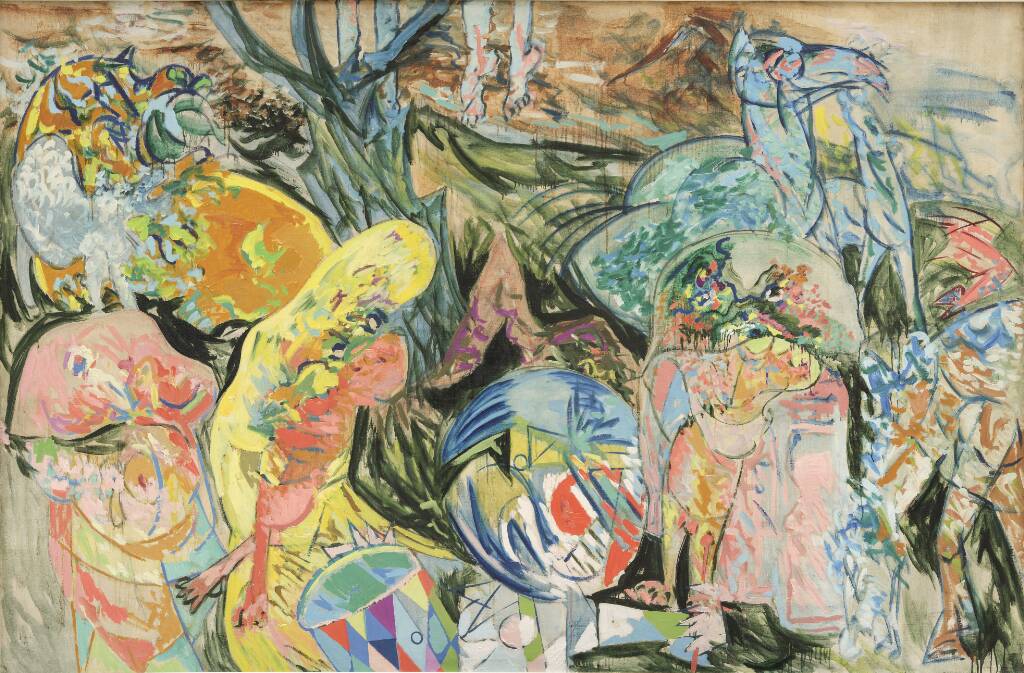
According to the artist himself, this major 1940s work by Richard Mortensen was intended as a protest against the war. The picture was inspired by Pablo Picasso’s (1881-1973) Guernica from 1937 and by the French poet Arthur Rimbaud’s (1854-1891) prose poems Illuminations. An allegory of the consequences of war Viewed in this context, the picture is an allegory of the consequences of war: Dead men are hanging from a dead tree in the middle of the picture. Around it we find Mortensen’s main motif from the 1940s: the mother-and-child unity, appearing here in both human and animal incarnations. Despite all suffering and pain, the mother-child motif is an affirmation of how life goes on. An allegory of the battle of the sexes Apart from the obvious war-related aspects of the scene, the picture can also be read in the context of Richard Mortensen’s works from the 1930s and their inspiration from French Surrealism. Within this interpretation, the picture is an allegory of the battle of the sexes: The strains imposed on male sexuality in a world peopled by women (clinging, all-devouring mothers). Man is only present as a victim (the hanged men in the tree) or as a fool – Harlequin in the foreground, enticing audiences in with his drum. He is the artist’s alter ego, the outsider who shows the true state of affairs. The tragic clown, crying behind his mask.
Værkdatering: 1944
Sandsynligvis december 1944, jf. Würtz Frandsen, Richard Mortensen, Afklaringens år 1940-1958, København 1992, pp. 158, 190-191.
Title: Vision. Painting for Arthur Rimbaud
Description:
According to the artist himself, this major 1940s work by Richard Mortensen was intended as a protest against the war.
The picture was inspired by Pablo Picasso’s (1881-1973) Guernica from 1937 and by the French poet Arthur Rimbaud’s (1854-1891) prose poems Illuminations.
An allegory of the consequences of war Viewed in this context, the picture is an allegory of the consequences of war: Dead men are hanging from a dead tree in the middle of the picture.
Around it we find Mortensen’s main motif from the 1940s: the mother-and-child unity, appearing here in both human and animal incarnations.
Despite all suffering and pain, the mother-child motif is an affirmation of how life goes on.
An allegory of the battle of the sexes Apart from the obvious war-related aspects of the scene, the picture can also be read in the context of Richard Mortensen’s works from the 1930s and their inspiration from French Surrealism.
Within this interpretation, the picture is an allegory of the battle of the sexes: The strains imposed on male sexuality in a world peopled by women (clinging, all-devouring mothers).
Man is only present as a victim (the hanged men in the tree) or as a fool – Harlequin in the foreground, enticing audiences in with his drum.
He is the artist’s alter ego, the outsider who shows the true state of affairs.
The tragic clown, crying behind his mask.
Related Results
painting, painting, painting, painting, painting, painting, painting, painting, painting, painting, painting, painting, painting, painting, painting, painting, painting, painting, painting, painting, painting, painting, painting, painting, painting, paint
painting, painting, painting, painting, painting, painting, painting, painting, painting, painting, painting, painting, painting, painting, painting, painting, painting, painting, painting, painting, painting, painting, painting, painting, painting, paint
"Here is portrayed three Moods of the Sky and the effects on the Fish and Animals. Sharks and Turtles come to the Surface when it is Raining. Wallabies and Kangaroos are out feedin...
Midvinterblot
Midvinterblot
The painting shows a naked man with his head held high standing on a gilded sleigh drawn by four strong men, two pulling and two pushing. A one-eyed priest is shown in the centre o...
Luminescence
Luminescence
In 1925, at the first exhibition of the OST, the painter I. Kudriashov presented two series of paintings: the Construction of Straight Line Movement and the Construction of Curvili...
Pierrot Content
Pierrot Content
Pierrot content is one of a group of early works by Watteau in which the artist developed the theme of the fête galante that would be so highly appreciated during the 18th century....
Heimdal överlämnar Brisingasmycket till Freja
Heimdal överlämnar Brisingasmycket till Freja
New acquisition, September 2013: Competition entry by Nils Andersson Nils Andersson's painting Heimdal Returns Brisingamen to Freya is an evocative example of the images of ancient...
The Mother of God of Trakai
The Mother of God of Trakai
It is one of the oldest easel paintings in Lithuania, closely linked to Vytautas, the Grand Duke of Lithuania (reigning 1401-1430), and early Christianisation in Lithuania. Up unti...
Colors of Mount Emei (Emeishan se)
Colors of Mount Emei (Emeishan se)
Dong Shouping (1904-1997) painted this short hanging scroll in ink and colors on paper. It depicts Mt. Emei's famous and very colorful sunrise. A mass of rocks--presumably the moun...