
Search engine for discovering works of Art, research articles, and books related to Art and Culture


Javascript must be enabled to continue!
The Virgin Swooning and the Three Maries at the Tomb of Christ
View through National Gallery of Denmark
This landscape looks more like a set piece from a theatre than a natural landscape. The sky has been replaced by a gold background. Around 1350 we see an emerging interest in the physiognomy of the human body and in nature. However, artists are not yet preoccupied with depicting landscapes in full detail as they might look in real life. That particular trend does not have its breakthrough in art until around 1600. In this work nature primarily serves a symbolic function. We can read the trees and flowers as symbols of the resurrection of Christ and of how life continues after death. These trees do, in fact, reach all the way up to the sky. Nature tells us more than the grieving figures in the painting can take in at the moment, but Christian observers of the depiction will know that something else will follow grief. Christ will be resurrected, and there will be a life after death in the golden Paradise.
Værkdatering: Ca. 1350
afsluttet: fagligt skøn
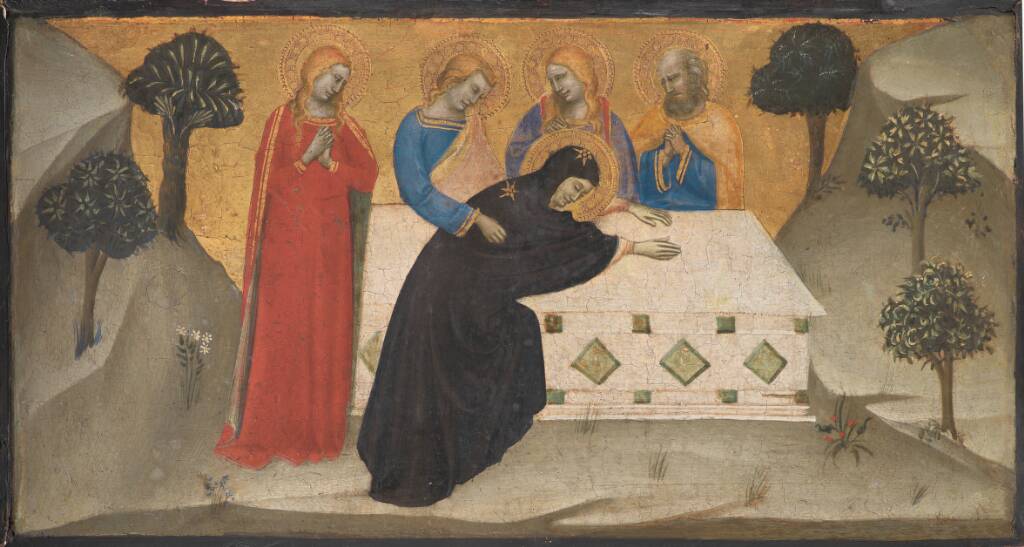
Title: The Virgin Swooning and the Three Maries at the Tomb of Christ
Description:
This landscape looks more like a set piece from a theatre than a natural landscape.
The sky has been replaced by a gold background.
Around 1350 we see an emerging interest in the physiognomy of the human body and in nature.
However, artists are not yet preoccupied with depicting landscapes in full detail as they might look in real life.
That particular trend does not have its breakthrough in art until around 1600.
In this work nature primarily serves a symbolic function.
We can read the trees and flowers as symbols of the resurrection of Christ and of how life continues after death.
These trees do, in fact, reach all the way up to the sky.
Nature tells us more than the grieving figures in the painting can take in at the moment, but Christian observers of the depiction will know that something else will follow grief.
Christ will be resurrected, and there will be a life after death in the golden Paradise.
Related Results
The Virgin and Child enthroned
The Virgin and Child enthroned
This small panel of the Virgin and Child belonged to Frederick II of Prussia. It was in the Rohoncz collection by 1930, the date when it was included in the exhibition held at the ...
Diptych with symbols of the Virgin and Redeeming Christ: Virgin and Child in the Hortus Conclusus (Left wing)
Diptych with symbols of the Virgin and Redeeming Christ: Virgin and Child in the Hortus Conclusus (Left wing)
This pair of panels formed part of a large ensemble of which the other subjects are now unknown. Within the Museum’s collection they are among the most iconographically interesting...
Diptych with symbols of the Virgin and Redeeming Christ: Christ with the Cross as Redemptor Mundi (Right wing)
Diptych with symbols of the Virgin and Redeeming Christ: Christ with the Cross as Redemptor Mundi (Right wing)
This pair of panels formed part of a large ensemble of which the other subjects are now unknown. Within the Museum’s collection they are among the most iconographically interesting...
The Virgin and Child
The Virgin and Child
The collection of Early Italian paintings in the Museo Thyssen-Bornemisza has two works by Bernardo Daddi: the present Virgin and Child and a Crucifixion. From their dimensions it ...
The Risen Christ
The Risen Christ
This panel depicting The Risen Christ was formerly in the collection of the Pusterla della Porta family in Milan, where it is recorded from 1590 until the first quarter of the 20th...
The Virgin, standing, with the Christ Child at her Breast
The Virgin, standing, with the Christ Child at her Breast
This Virgin and Child entered the Thyssen-Bornemisza collection in 1975. The painting was acquired as a work by Bernaert van Orley from the Cramer gallery in The Hague where it was...
The Syon Cope
The Syon Cope
'The Syon Cope', scenes from the Life of Christ and the Virgin, linen embroidered with silk, silver-gilt and silver thread, England, 1300-1320. Linen embroidered with silk, silver-...
The Assumption of the Virgin
The Assumption of the Virgin
During the 15th century Johann Koerbecke was the most important artist in the Westphalian city of Munster. He trained in the workshop of his father, Hermann Koerbecke, and took ove...