
Search engine for discovering works of Art, research articles, and books related to Art and Culture


Javascript must be enabled to continue!
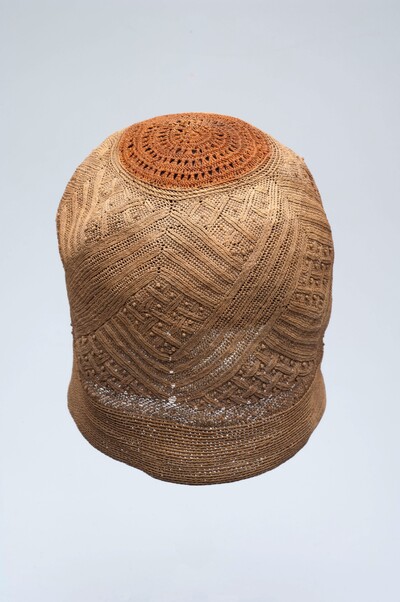
Knotted raffia ministerial hat, dignity badge
View through Europeana Collections
The (state) cap was used by the Vili and Yombe from Congo. The acceptance of a certain office also meant that one received a hat (mpu), the symbol of the office. \The heads of provinces, districts, etc., were appointed by the king himself and received from his hands the hat belonging to the office. The bonnets are not only worn as symbols of high status, but are in themselves objects to which reverence is paid, as they are powerful religious objects. The direct function of the bonnets is to indicate the distinction between the people and their rulers in a hierarchical society. The basis of the obedience shown by the people to the higher positions is based on the fact that the bonnets are generally believed to be sacred or magical objects. This makes those who wear bonnets leaders, empowered by supernatural powers.‖ The king was chosen by an assembly of elders or 'electors', from the nobility or from the sons of the deceased king. Supernatural powers were attributed to the king, on which the prosperity of the kingdom depended. Kings are of divine origin, i.e. they rule in accordance with a divine right. They are not divine as persons, but the office is. And this fact is expressed by the honor paid to the royal dignity signs, such as the hat. The hat is also worn as a protection against evil forces and spirits, among others at the Sundi while drinking palm wine.The hat, as a sign of dignity, passed from its possessor to his successor after death. When a chief died, a statuette was made of him complete with cap. The hat was only handed over to his successor after the memorial ceremony, about one year after his death (Gibson and McGurk, 1977).Ó The hat bears a great resemblance to the hat 'ngola' mentioned by Zdenka Volavka (1981). The ministers of the Kongo kings were appointed and deposed by the central authority, that is, the king. The NAM data also describe the hat as a minister's hat. Thus, this type of hat is worn by authority figures and senior members of the central authority.‖ The artistic skill of raffia weaving was recognized by the Portuguese as early as the early 16th century. Such textile products soon became commodities and gained a place in the European cabinets of curiosities of the 17th century. Hats such as these were made by special milliners and were only worn by members of the royal court. On pain of death, the weavers were forbidden to sell the hats to others (Clarke, 1998:27). The woven items were not only used as clothing, pillows and bags but were an important part of grave goods for important people.‖ The hat was made from raffia, which are fibres from the leaves of the pineapple plant. Gibson and McGurk (1977) mention these leaves, those of the banana tree, cotton, grass and baobab bark as the materials used in the manufacture of bonnets by the Kongo and Mbundu. The outer surface of the leaves is removed by passing them under a knife held against a board.The preparation of the raffia fibres is probably done in the following way:One makes an incision at the base of the petiole, the outer surface is then pulled off the leaf into one large sheet, which is light green in colour and translucent when fresh. Dried in the sun, the sheet takes on a brown opaque color. The sheet is then split. This can be done with the aid of a comb, whose teeth consist of strips cut from the veins of the raffia leaf.‖ Before knotting, the fibers were probably twisted together.‖ The hat is put on in a spiral shape, working from the center to the edge. Most bonnets of this type were made using a single thread, to which new threads were undoubtedly attached as the work progressed. \After starting with a narrow, central ring as a starting point, the free part of the thread is passed through part of the previously made row. The stitch used at each stage varies from hat to hat, often even within the same hat. All caps are made by means of loops or knots. The two most common stitches used in the saturation of the large sections of bonnets are the 'half twist looping' and the 'one-and-a-half twist looping' (Gibson and McGurk, 1977: 82). Another type of stitch, particularly common at the edges, is the 'lateral looping'.ith regard to a hat of the same type as this object, the literature also mentions the use of the 'slip-knot' and a variation of this with narrow open spaces; the vertical loops are gathered into bundles in groups of two or three and tied together with two or three overhand knots.Ó The application of patterns is done by means of a number of different techniques. In a number of Kongo bonnets geometric motifs can be found, consisting of raised knots or diagonal lines. This motif is also present on this hat. The diagonal lines are made with simple looping, while another stitch forms the background. The diagonal line is high or low depending on whether the twist of the loops (S or Z) that form the line corresponds to or opposes the direction of the diagonal. The 'raised knots' are variations of 'simple looping'.This hat has a pattern of loose and interwoven zigzag lines. The sphere of the hat consists of ajour motif that is spiral-shaped from the centre.
National Museum of World Cultures Foundation
Title: Knotted raffia ministerial hat, dignity badge
Description:
The (state) cap was used by the Vili and Yombe from Congo.
The acceptance of a certain office also meant that one received a hat (mpu), the symbol of the office.
\The heads of provinces, districts, etc.
, were appointed by the king himself and received from his hands the hat belonging to the office.
The bonnets are not only worn as symbols of high status, but are in themselves objects to which reverence is paid, as they are powerful religious objects.
The direct function of the bonnets is to indicate the distinction between the people and their rulers in a hierarchical society.
The basis of the obedience shown by the people to the higher positions is based on the fact that the bonnets are generally believed to be sacred or magical objects.
This makes those who wear bonnets leaders, empowered by supernatural powers.
‖ The king was chosen by an assembly of elders or 'electors', from the nobility or from the sons of the deceased king.
Supernatural powers were attributed to the king, on which the prosperity of the kingdom depended.
Kings are of divine origin, i.
e.
they rule in accordance with a divine right.
They are not divine as persons, but the office is.
And this fact is expressed by the honor paid to the royal dignity signs, such as the hat.
The hat is also worn as a protection against evil forces and spirits, among others at the Sundi while drinking palm wine.
The hat, as a sign of dignity, passed from its possessor to his successor after death.
When a chief died, a statuette was made of him complete with cap.
The hat was only handed over to his successor after the memorial ceremony, about one year after his death (Gibson and McGurk, 1977).
Ó The hat bears a great resemblance to the hat 'ngola' mentioned by Zdenka Volavka (1981).
The ministers of the Kongo kings were appointed and deposed by the central authority, that is, the king.
The NAM data also describe the hat as a minister's hat.
Thus, this type of hat is worn by authority figures and senior members of the central authority.
‖ The artistic skill of raffia weaving was recognized by the Portuguese as early as the early 16th century.
Such textile products soon became commodities and gained a place in the European cabinets of curiosities of the 17th century.
Hats such as these were made by special milliners and were only worn by members of the royal court.
On pain of death, the weavers were forbidden to sell the hats to others (Clarke, 1998:27).
The woven items were not only used as clothing, pillows and bags but were an important part of grave goods for important people.
‖ The hat was made from raffia, which are fibres from the leaves of the pineapple plant.
Gibson and McGurk (1977) mention these leaves, those of the banana tree, cotton, grass and baobab bark as the materials used in the manufacture of bonnets by the Kongo and Mbundu.
The outer surface of the leaves is removed by passing them under a knife held against a board.
The preparation of the raffia fibres is probably done in the following way:One makes an incision at the base of the petiole, the outer surface is then pulled off the leaf into one large sheet, which is light green in colour and translucent when fresh.
Dried in the sun, the sheet takes on a brown opaque color.
The sheet is then split.
This can be done with the aid of a comb, whose teeth consist of strips cut from the veins of the raffia leaf.
‖ Before knotting, the fibers were probably twisted together.
‖ The hat is put on in a spiral shape, working from the center to the edge.
Most bonnets of this type were made using a single thread, to which new threads were undoubtedly attached as the work progressed.
\After starting with a narrow, central ring as a starting point, the free part of the thread is passed through part of the previously made row.
The stitch used at each stage varies from hat to hat, often even within the same hat.
All caps are made by means of loops or knots.
The two most common stitches used in the saturation of the large sections of bonnets are the 'half twist looping' and the 'one-and-a-half twist looping' (Gibson and McGurk, 1977: 82).
Another type of stitch, particularly common at the edges, is the 'lateral looping'.
ith regard to a hat of the same type as this object, the literature also mentions the use of the 'slip-knot' and a variation of this with narrow open spaces; the vertical loops are gathered into bundles in groups of two or three and tied together with two or three overhand knots.
Ó The application of patterns is done by means of a number of different techniques.
In a number of Kongo bonnets geometric motifs can be found, consisting of raised knots or diagonal lines.
This motif is also present on this hat.
The diagonal lines are made with simple looping, while another stitch forms the background.
The diagonal line is high or low depending on whether the twist of the loops (S or Z) that form the line corresponds to or opposes the direction of the diagonal.
The 'raised knots' are variations of 'simple looping'.
This hat has a pattern of loose and interwoven zigzag lines.
The sphere of the hat consists of ajour motif that is spiral-shaped from the centre.
Related Results
Cap of a courtier
Cap of a courtier
According to the collector's information, the hat is a 'prince's hat' and was worn as a badge of honour in the Lower Congo. According to the information on the N.A.M. map, the hat ...
Knotted raffia ministerial hat, dignity badge
Knotted raffia ministerial hat, dignity badge
The (state) cap was used by the Vili and Yombe from Congo. The acceptance of a certain office also meant that one received a hat (mpu), the symbol of the office. \The heads of prov...
Knotted raffia hat, dignity sign
Knotted raffia hat, dignity sign
The hat was worn as a badge of dignity by a mfumu.The mfumu, the traditionally installed head, usually owns a set of hats, made from plant material. The Ngunda (also called Ngundu/...
Ceremonial wraparound skirt for women
Ceremonial wraparound skirt for women
The cloth is worn as a wraparound skirt by important Bushoong women during rituals and ceremonies. Often the cloth is wrapped with a band or belt around the top, over which the clo...
Knotted raffia hat, dignity sign
Knotted raffia hat, dignity sign
The hat was worn as a badge of dignity by a mfumu.The mfumu, the traditionally installed head, usually owns a set of hats, made from plant material. The Ngunda (also called Ngundu/...
Knotted raffia hat, dignity sign
Knotted raffia hat, dignity sign
The hat was worn as a badge of dignity by a mfumu.The mfumu, the traditionally installed head, usually owns a set of hats, made from plant material. The Ngunda (also called Ngundu/...
Ensemble of dress, knickerbockers, belt and hat, designed by Mary Quant, London, 1958. Knickerbockers, part of an ensemble with grey flannel dress and hat. The knickerbockers are knee length with a flat pleated frill and white metal button at the knee. Th
Ensemble of dress, knickerbockers, belt and hat, designed by Mary Quant, London, 1958. Knickerbockers, part of an ensemble with grey flannel dress and hat. The knickerbockers are knee length with a flat pleated frill and white metal button at the knee. Th
Ensemble of dress, knickerbockers, belt and hat, designed by Mary Quant, London, 1958. Knickerbockers, part of an ensemble with grey flannel dress and hat. The knickerbockers are k...
Emperor Leopold I elevates Mark Putz von Adlersthurn, court chamber council and secret secretary, to the old knight’s state, improves his coat of arms and improves his predicate on von Putz zu Adlerßthurn and grants him a new predicate Edler von Schrotten
Emperor Leopold I elevates Mark Putz von Adlersthurn, court chamber council and secret secretary, to the old knight’s state, improves his coat of arms and improves his predicate on von Putz zu Adlerßthurn and grants him a new predicate Edler von Schrotten
Character: description on folk. 5b and 6a, miniature on folk. 5a, 166 x 151 mm.
Quarter shield with crowned heart plate. It is red with a silver crossbar, above the crossbar is the...