
Search engine for discovering works of Art, research articles, and books related to Art and Culture


Javascript must be enabled to continue!
Carl Th. Dreyer Robot
View through National Gallery of Denmark
The four robot sculptures were created by Nam June Paik for the SMK in 1996. They depict four major figures from Danish history: Physicist Niels Bohr, philosopher Søren Kierkegaard, film director Carl. Th. Dreyer and writer Hans Christian Andersen. The robots combine technology, in the form of television cabinets and screens, with everyday objects such as toys, books and an umbrella. The videos screened and the objects themselves are linked to the lives and works of the persons portrayed. Paik was greatly interested in the evolution of new mass media and information technologies. He was a pioneering figure within video art, and began incorporating TV objects in interactive installations back in the early 1960s. To Paik, new technology held social as well as aesthetic potential, and his experiments have helped push media art in new directions. Despite the humorous undercurrents often seen in Paik’s work, the main objective was not to create “scientific toys”, but rather to “humanise technology”. The four friendly robot portraits reflect this position. They also point to how science, literature and philosophy can enter into and be presented in new settings, carried aloft by technology and entertainment.
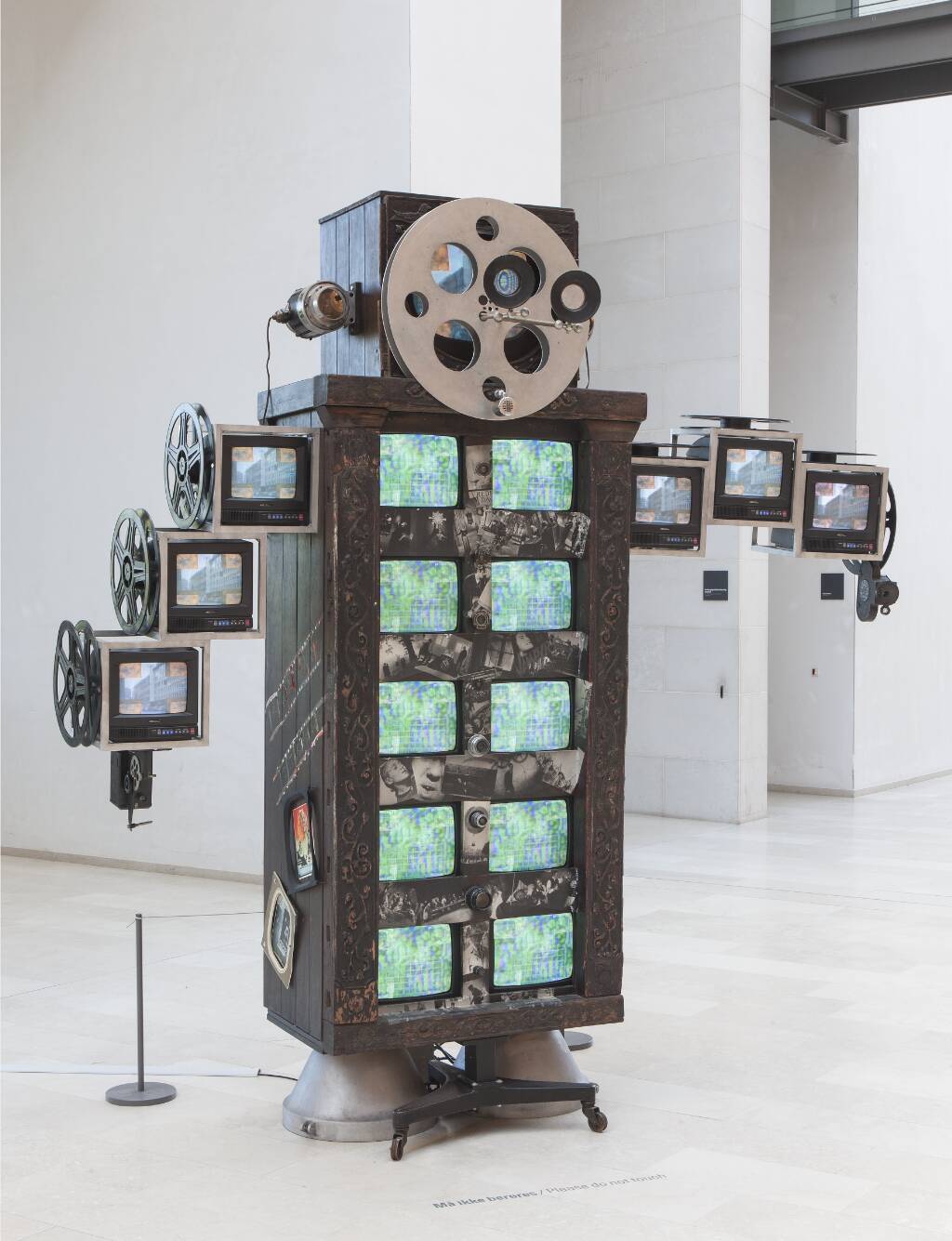
Title: Carl Th. Dreyer Robot
Description:
The four robot sculptures were created by Nam June Paik for the SMK in 1996.
They depict four major figures from Danish history: Physicist Niels Bohr, philosopher Søren Kierkegaard, film director Carl.
Th.
Dreyer and writer Hans Christian Andersen.
The robots combine technology, in the form of television cabinets and screens, with everyday objects such as toys, books and an umbrella.
The videos screened and the objects themselves are linked to the lives and works of the persons portrayed.
Paik was greatly interested in the evolution of new mass media and information technologies.
He was a pioneering figure within video art, and began incorporating TV objects in interactive installations back in the early 1960s.
To Paik, new technology held social as well as aesthetic potential, and his experiments have helped push media art in new directions.
Despite the humorous undercurrents often seen in Paik’s work, the main objective was not to create “scientific toys”, but rather to “humanise technology”.
The four friendly robot portraits reflect this position.
They also point to how science, literature and philosophy can enter into and be presented in new settings, carried aloft by technology and entertainment.
Related Results
Burning Pyre model for Jeanne D' Arc
Burning Pyre model for Jeanne D' Arc
Dating back to Dreyer’s debut film The President, it’s obvious how much importance the director gave to the sets and how meticulous he was about design, tone and style. Dreyer pres...
Prison model for Jeanne D'Arc
Prison model for Jeanne D'Arc
Dating back to Dreyer’s debut film The President, it’s obvious how much importance the director gave to the sets and how meticulous he was about design, tone and style. Dreyer pres...
Galjonsbild
Galjonsbild
The subject is shown in the base exhibition Kustland, Bohusläns museum, Uddevalla.
The figure of Galjons from the mid-18th century depicting a female figure was wearing a loosely ...
Midvinterblot
Midvinterblot
The painting shows a naked man with his head held high standing on a gilded sleigh drawn by four strong men, two pulling and two pushing. A one-eyed priest is shown in the centre o...
Getting Ready for a Game
Getting Ready for a Game
"It's really terrible outdoors. The wind is whistling through the joints of the house and the snow is not snow but sharp needles that get into the corners of one's eyes… Just the r...
Bildliche Darstellung der Sturmflut 1825 in der Herrschaft Jever, 1:58 000, Lithographie, 1826
Bildliche Darstellung der Sturmflut 1825 in der Herrschaft Jever, 1:58 000, Lithographie, 1826
Overview of the destruction caused by the floods of 3-4 February 1825 to the dykes of Jever’s rule: collected on the spot in February 1825/Designed and edited by F. B. Dunker & Soh...
Bildliche Darstellung der Sturmflut 1825 in der Herrschaft Jever, 1:58 000, Lithographie, 1826
Bildliche Darstellung der Sturmflut 1825 in der Herrschaft Jever, 1:58 000, Lithographie, 1826
Overview of the destruction caused by the floods of 3-4 February 1825 to the dykes of Jever’s rule: collected on the spot in February 1825/Designed and edited by F. B. Dunker & Soh...