
Search engine for discovering works of Art, research articles, and books related to Art and Culture


Javascript must be enabled to continue!
Family Portrait
View through National Gallery of Denmark
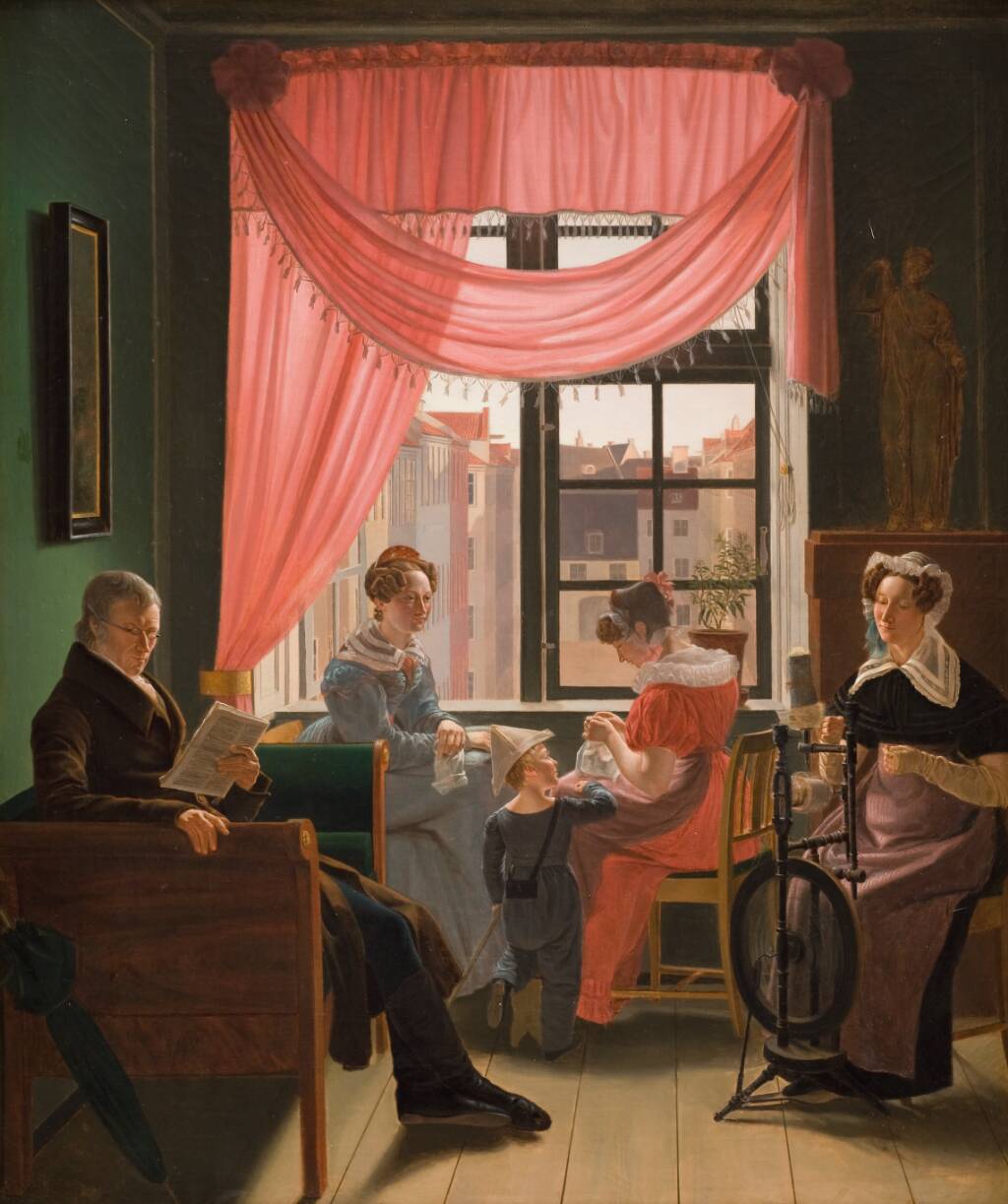
Family was a cornerstone of Danish society during the first decades of the 19th century. The Danish people made a virtue of necessity and found much to recommend a quiet life at home with the family. Thus, family portraits became a very popular genre in the late 1820s. The painter Emilius Bærentzen seems to have been the artist who defined how the subject would be depicted. He shows a family - possibly his parents and sisters - gathered during a quiet moment of the day in their Copenhagen flat. The artist has used the open window to create an excellent depiction of light falling into the living room. His rendition is made particularly sophisticated by the inclusion of the semi-transparent red curtain. The painting clearly reflects the gender roles prevalent at the time. Only the head of the family is comfortably seated as he reads his newspaper. By contrast, the women are all engaged in various useful pursuits.
Værkdatering: (1828)
Datering baseret på udstilling på Charlottenborg
Title: Family Portrait
Description:
Family was a cornerstone of Danish society during the first decades of the 19th century.
The Danish people made a virtue of necessity and found much to recommend a quiet life at home with the family.
Thus, family portraits became a very popular genre in the late 1820s.
The painter Emilius Bærentzen seems to have been the artist who defined how the subject would be depicted.
He shows a family - possibly his parents and sisters - gathered during a quiet moment of the day in their Copenhagen flat.
The artist has used the open window to create an excellent depiction of light falling into the living room.
His rendition is made particularly sophisticated by the inclusion of the semi-transparent red curtain.
The painting clearly reflects the gender roles prevalent at the time.
Only the head of the family is comfortably seated as he reads his newspaper.
By contrast, the women are all engaged in various useful pursuits.
Related Results
Sketchbook
Sketchbook
Sketchbook with blue- and black-fabric-covered cardboard covers. Sewn page block; pages of off-white wove paper, each 27.6 x 21.6 cm. Each sheet numbered on verso at l.l. Drawin...
The Artist and his Wife Marie Suzanne Giroust painting the Portrait of Henrik Wilhelm Peill
The Artist and his Wife Marie Suzanne Giroust painting the Portrait of Henrik Wilhelm Peill
Roslin was active in Paris and came to hold a unique position on the international art scene of the 18th century. It was in the French capital that he met his future wife, the port...
Ten Thousand Years, Ten Thousand Years of Sleep, One Hundred Million Scattered Pieces
Ten Thousand Years, Ten Thousand Years of Sleep, One Hundred Million Scattered Pieces
This triptych comprises a set of three hanging scrolls, each painted in ink on paper. The central scroll is a formal portrait of Mao Zedong (1893–1976); the flanking scrolls repres...
Ten Thousand Years, Ten Thousand Years of Sleep, One Hundred Million Scattered Pieces
Ten Thousand Years, Ten Thousand Years of Sleep, One Hundred Million Scattered Pieces
This triptych comprises a set of three hanging scrolls, each painted in ink on paper. The central scroll is a formal portrait of Mao Zedong (1893–1976); the flanking scrolls repres...
Sketchbook
Sketchbook
Sketchbook with blue-and-white marbled cardboard covers. Black fabric tape at spine. Sewn page block; sheets perforated for removal. Pages of off-white wove paper, each 36.7 x 2...
Sketchbook
Sketchbook
Sketchbook with black-leather-covered cardboard covers. Sewn page block. Pages of white wove paper, each 34.7 x 27.1 cm. Pages numbered at l.l. of verso in graphite. Drawings i...