
Search engine for discovering works of Art, research articles, and books related to Art and Culture


Javascript must be enabled to continue!
sculpture, wood sculpture, wood
View through Europeana Collections
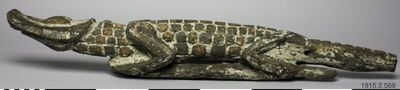
Wooden sculpture in the form of a crocodile painted with white and red color. Collected some time during the period 1913-14.Perhaps it is a totem animal.
In the Sepik region, crocodiles are present in objects, myths and metaphors, all of which speak of people’s relationship to the animal. A common example are the male initiation rites in which the body is cut in a way that results in scars symbolizing crocodile teeth.
The ritual is a learning process involving a complex history of the crocodile’s power and authority, but also incorporating ideas about gender. By performing the ritual, men gain an intimate connection to the abilities and skills of the crocodile.
In some places, the initiation rite has been turned into a kind of tourist spectacle and adapted to the expectations of the tourists. However, the ritual retains its significance for many, and is a way of preserving historical ties to the original creator.
Title: sculpture, wood sculpture, wood
Description:
Wooden sculpture in the form of a crocodile painted with white and red color.
Collected some time during the period 1913-14.
Perhaps it is a totem animal.
In the Sepik region, crocodiles are present in objects, myths and metaphors, all of which speak of people’s relationship to the animal.
A common example are the male initiation rites in which the body is cut in a way that results in scars symbolizing crocodile teeth.
The ritual is a learning process involving a complex history of the crocodile’s power and authority, but also incorporating ideas about gender.
By performing the ritual, men gain an intimate connection to the abilities and skills of the crocodile.
In some places, the initiation rite has been turned into a kind of tourist spectacle and adapted to the expectations of the tourists.
However, the ritual retains its significance for many, and is a way of preserving historical ties to the original creator.
Related Results
Standing Buddha Shakyamuni in Varada-mudra
Standing Buddha Shakyamuni in Varada-mudra
This sculpture depicts a Buddha gracefully standing on a shallow lotus pedestal, the Buddha likely the Buddha Sakyamuni (the Historical Buddha) though possibly the Buddha Dipankara...
Head of Buddha, probably the Buddha Sakyamuni
Head of Buddha, probably the Buddha Sakyamuni
Carved in gray limestone in Thailand in the seventh or early eighth century, this stone sculpture depicts the head of a Buddha, probably the Buddha Sakyamuni, the Historical Buddha...
Pair of leather shoes with linen shoe bag and pair of metal and wood shoe trees, designed by Hook, Knowles & Co, London, ca. 1900. Pair of women's leather shoes with a natural linen bag and a pair of metal and wood shoe trees.Bright red leather lace up sh
Pair of leather shoes with linen shoe bag and pair of metal and wood shoe trees, designed by Hook, Knowles & Co, London, ca. 1900. Pair of women's leather shoes with a natural linen bag and a pair of metal and wood shoe trees.Bright red leather lace up sh
Pair of leather shoes with linen shoe bag and pair of metal and wood shoe trees, designed by Hook, Knowles & Co, London, ca. 1900. Pair of women's leather shoes with a natural line...
Mother and Child
Mother and Child
Renoir once quipped that had God not created the female breast, he might never have become an artist. Indeed, the full, womanly bosom figures prominently in Renoir's loving portray...
The Man with the Broken Nose
The Man with the Broken Nose
The most renowned sculptor of the nineteenth century, Auguste Rodin was revolutionary in his exploration of the human form’s expressive potential. His dynamic compositions, free ha...
Pair of Four-Barreled Turnover Percussion Pistols of Henry Pelham Fiennes Pelham-Clinton, 4th Duke of Newcastle-under-Lyne (1785–1851), with Pair of Box-Lock Turn-Off Pocket Pistols, Case, and Accessories
Pair of Four-Barreled Turnover Percussion Pistols of Henry Pelham Fiennes Pelham-Clinton, 4th Duke of Newcastle-under-Lyne (1785–1851), with Pair of Box-Lock Turn-Off Pocket Pistols, Case, and Accessories
Turnover pistols: steel wood (walnut) gold silver; pocket pistols: steel wood (walnut); mallet: wood (walnut rosewood ebony) leather; ramrod: wood (ebony) brass; cleaning r...
figur, skulptur, sculpture
figur, skulptur, sculpture
God image. Temple figure of cut and painted wood. The sculpture depicts the dreaded, bare-looking witch Rangda with a bare torso, demon head, long hair and extended tongue.
Accord...