
Search engine for discovering works of Art, research articles, and books related to Art and Culture


Javascript must be enabled to continue!
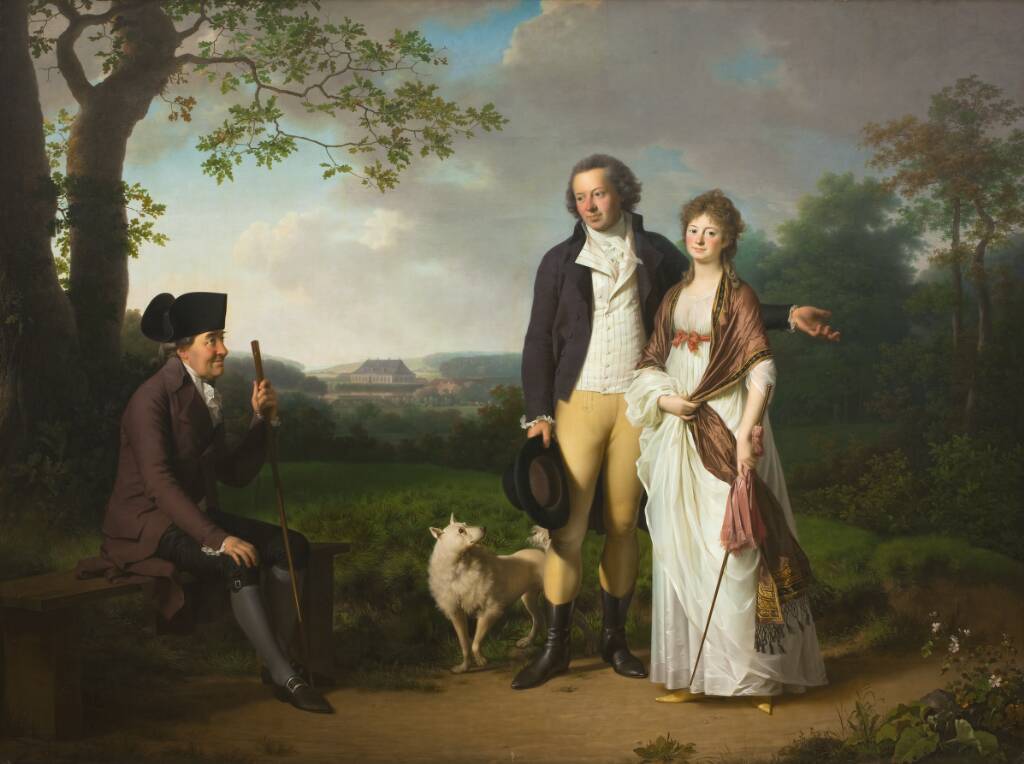
Niels Ryberg with his Son Johan Christian and his Daughter-in-Law Engelke, née Falbe
View through National Gallery of Denmark
The affluent merchant Niels Ryberg is seen sitting under a
tree at his most recently acquired manor house. Next to him
is his immediate family. The idyllic depiction of nature and
the bourgeois family is typical of paintings from the so-called
Danish Golden Age of art (c. 1800–1850). The art of the period
is also characterised by deliberate omissions: there are no
signs of the incipient industrialisation and urbanisation, social
crises, lost wars, and the fact that the Danish economy was to
some extent dependent on the triangular trade and slavery.
The work does not show that Niels Ryberg meddled
in the transportation of enslaved people. One of his slave
ships was named after his daughter-in-law, seen on the far
right. In 1802, the brig Engelcke was loaded with 221 enslaved
people on an African coast and sent in the direction of Cuba.
Along the way, 50 of them were thrown into the sea. All, the
dead and the living, were among the thousands of nameless
victims of the era’s industrious trade.
Was it just a different time? It is estimated that approximately
50 million people live in slave-like conditions today (50 Favorites in the SMK Collection).
Værkdatering: (1797)
Maleriets tilblivelse omtales i et brev fra Johan Christian Ryberg til Rasmus Nyerup, dateret 14. november 1797 (citeret hos Poulsen 1991)
Title: Niels Ryberg with his Son Johan Christian and his Daughter-in-Law Engelke, née Falbe
Description:
The affluent merchant Niels Ryberg is seen sitting under a
tree at his most recently acquired manor house.
Next to him
is his immediate family.
The idyllic depiction of nature and
the bourgeois family is typical of paintings from the so-called
Danish Golden Age of art (c.
1800–1850).
The art of the period
is also characterised by deliberate omissions: there are no
signs of the incipient industrialisation and urbanisation, social
crises, lost wars, and the fact that the Danish economy was to
some extent dependent on the triangular trade and slavery.
The work does not show that Niels Ryberg meddled
in the transportation of enslaved people.
One of his slave
ships was named after his daughter-in-law, seen on the far
right.
In 1802, the brig Engelcke was loaded with 221 enslaved
people on an African coast and sent in the direction of Cuba.
Along the way, 50 of them were thrown into the sea.
All, the
dead and the living, were among the thousands of nameless
victims of the era’s industrious trade.
Was it just a different time? It is estimated that approximately
50 million people live in slave-like conditions today (50 Favorites in the SMK Collection).
Related Results
Silhouette
Silhouette
The subject is shown in the base exhibition Uddevalla of all time, Bohusläns museum, Uddevalla.
From the Handwritten Catalogue 1957-1958:
Three photos. four designs
4 photos with ...
The whole of Protestant Christianity
The whole of Protestant Christianity
Probably : On the left, next to the man with turban: "The three faithful servant at the time of persecution. The devil hopes to be the machomet. Alcorom. / Calvinists and Arian for...