
Search engine for discovering works of Art, research articles, and books related to Art and Culture


Javascript must be enabled to continue!
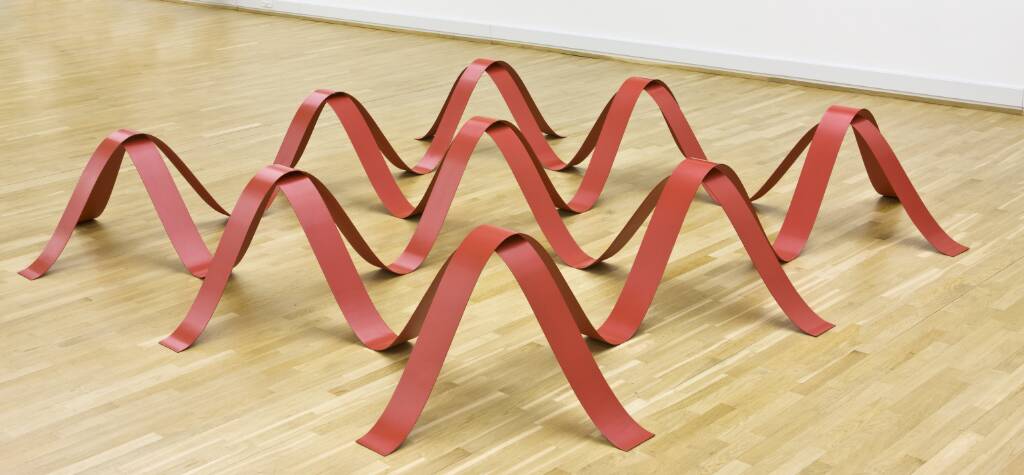
Red Sine Curve
View through National Gallery of Denmark
In Heinsen’s Red Sine Curve, rows of red-painted metal bands cross each other, their bends echoing the mathematical-geometric strictness of the sine curve. By using an industrially manufactured material, subsequently spray-painted, and letting the shape be determined by a scientifically defined curve, Heinsen directs our attention away from the artist as a creator in the traditional sense. The result is the appearance that outer factors determine what the work looks like, not the artist’s subjectivity or psyche. A sculpture with no content The sculpture hides nothing; it is what it is. It places its inside and outside in plain view; nothing is encapsulated, neither its mass, content, or meaning. Whereas traditional sculpture has a finite outline and body and refers to something outside of itself, a context or meaning, Heinsen’s sculpture has no content. It could, in principle, continue indefinitely. The development of Danish sculpture The open, unfinished quality is precisely what interested Hein Heinsen. A significant shift in outlook took place within Danish sculpture in the late 1960s and the early 1970s. In the decade leading up to this change, artists looked to the aesthetics of French art, but gradually younger sculptors such as Hein Heinsen turned their attention to contemporary American minimalism.
Title: Red Sine Curve
Description:
In Heinsen’s Red Sine Curve, rows of red-painted metal bands cross each other, their bends echoing the mathematical-geometric strictness of the sine curve.
By using an industrially manufactured material, subsequently spray-painted, and letting the shape be determined by a scientifically defined curve, Heinsen directs our attention away from the artist as a creator in the traditional sense.
The result is the appearance that outer factors determine what the work looks like, not the artist’s subjectivity or psyche.
A sculpture with no content The sculpture hides nothing; it is what it is.
It places its inside and outside in plain view; nothing is encapsulated, neither its mass, content, or meaning.
Whereas traditional sculpture has a finite outline and body and refers to something outside of itself, a context or meaning, Heinsen’s sculpture has no content.
It could, in principle, continue indefinitely.
The development of Danish sculpture The open, unfinished quality is precisely what interested Hein Heinsen.
A significant shift in outlook took place within Danish sculpture in the late 1960s and the early 1970s.
In the decade leading up to this change, artists looked to the aesthetics of French art, but gradually younger sculptors such as Hein Heinsen turned their attention to contemporary American minimalism.
Related Results
Image frieze over Queen Victoria’s of England coronation procession 1838-06-28, published by Fore 's Sporting & Fine Print Repository, London.
Image frieze over Queen Victoria’s of England coronation procession 1838-06-28, published by Fore 's Sporting & Fine Print Repository, London.
Image frieze on the short ends with glued joints attached sheets paper, l: 185 mm, h: 10.3 mm. Attached to a pearl cardboard sleeve with glued brown pink (?) fabric with pressed fr...
Emperor Leopold I elevates Mark Putz von Adlersthurn, court chamber council and secret secretary, to the old knight’s state, improves his coat of arms and improves his predicate on von Putz zu Adlerßthurn and grants him a new predicate Edler von Schrotten
Emperor Leopold I elevates Mark Putz von Adlersthurn, court chamber council and secret secretary, to the old knight’s state, improves his coat of arms and improves his predicate on von Putz zu Adlerßthurn and grants him a new predicate Edler von Schrotten
Character: description on folk. 5b and 6a, miniature on folk. 5a, 166 x 151 mm.
Quarter shield with crowned heart plate. It is red with a silver crossbar, above the crossbar is the...
Pair of leather shoes with linen shoe bag and pair of metal and wood shoe trees, designed by Hook, Knowles & Co, London, ca. 1900. Pair of women's leather shoes with a natural linen bag and a pair of metal and wood shoe trees.Bright red leather lace up sh
Pair of leather shoes with linen shoe bag and pair of metal and wood shoe trees, designed by Hook, Knowles & Co, London, ca. 1900. Pair of women's leather shoes with a natural linen bag and a pair of metal and wood shoe trees.Bright red leather lace up sh
Pair of leather shoes with linen shoe bag and pair of metal and wood shoe trees, designed by Hook, Knowles & Co, London, ca. 1900. Pair of women's leather shoes with a natural line...
Hydria (water jar): Perseus pursued by Gorgons
Hydria (water jar): Perseus pursued by Gorgons
On the shoulder: This scene depicts gorgons chasing after the hero Perseus, whose most famous accomplishment was beheading one of the gorgons, Medusa; presumably here we see the tw...
Emperor Leopold I elevates Johann Ulrich Kleblsperg, lieutenant colonel of the Duke of Lorraine Cavalry Regiment, to the Czech state of free lords, improves his coat of arms and awards him predicates Wohlgeborn and Freyherr
Emperor Leopold I elevates Johann Ulrich Kleblsperg, lieutenant colonel of the Duke of Lorraine Cavalry Regiment, to the Czech state of free lords, improves his coat of arms and awards him predicates Wohlgeborn and Freyherr
Character: description on folk. 5b - 7b, miniature on folk. 7a, 161 x 171 mm.
Quarterly shield with heart label that is pollen. On the right in the red one lies two Turkish heads i...
Emperor Ferdinand I elevates Franz Fleißner to the Knight von Wostrowitz, Major of the Cavalry Regiment von Schneller no. 5, to the status of free lords, and improves his coat of arms
Emperor Ferdinand I elevates Franz Fleißner to the Knight von Wostrowitz, Major of the Cavalry Regiment von Schneller no. 5, to the status of free lords, and improves his coat of arms
Character: description on folk. 4b, miniature on folk. 4a, 233 x 331 mm.
A fourth shield. 1. and 4. in gold there is half a black eagle with a red tongue, which touches the edge of...
Woven shawl with a ground of silk and wool, probably made in Paisley, Scotland, 1825-1830. Woven shawl with a ground of white silk and wool. With a pattern of decked-edged stripes alternately red, containing a stem of small blue flowers, and parti-coloure
Woven shawl with a ground of silk and wool, probably made in Paisley, Scotland, 1825-1830. Woven shawl with a ground of white silk and wool. With a pattern of decked-edged stripes alternately red, containing a stem of small blue flowers, and parti-coloure
Woven shawl with a ground of silk and wool, probably made in Paisley, Scotland, 1825-1830. Woven shawl with a ground of white silk and wool. With a pattern of decked-edged stripes ...
Emperor Charles VI. elevates Maximilian Lambert’s free lord von Klebelsberg to the Czech count’s state, grants him predicates Hoch- und Wohlgebohrn and Freyherr zu Thumbburg and improves his coat of arms
Emperor Charles VI. elevates Maximilian Lambert’s free lord von Klebelsberg to the Czech count’s state, grants him predicates Hoch- und Wohlgebohrn and Freyherr zu Thumbburg and improves his coat of arms
Character: description on folk. 6b - 9b, miniature on folk. 8a, 153 x 164 mm.
Quarterly shield with heart label that is pollen. To the right in the red lies two Turkish heads in th...