
Search engine for discovering works of Art, research articles, and books related to Art and Culture


Javascript must be enabled to continue!
serpent
View through Europeana Collections
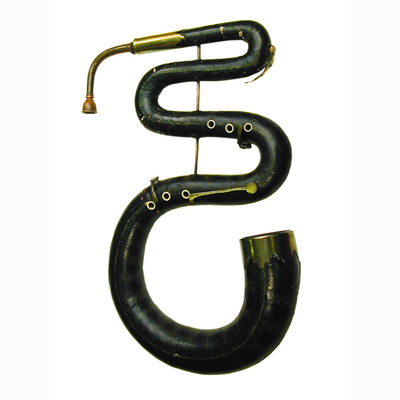
The serpent was invented in France around 1590 to play with church choirs. It accompanied Gregorian chant and later, hymns. It appeared in English churches around 1670 and was a member of military bands. Only occasionally was it included in the orchestra. On the serpent, the tone and volume of different notes is not consistent. The pitch of each note can vary dramatically. Serpent players need an excellent ear, so that they may correct the tuning with the lips. Serpent, wooden body covered in green mottled leather imitating snakeskin, brass stays between upper bends, brass crook, boxwood mouthpiece. Six keys, mounted in saddles. Ivory bushed finger holes. Inscribed ferrule at crook socket. Crenulated brass mount at bell. Bell interior painted red. Stamped: Bilton Westminster Bridge Road London.
Title: serpent
Description:
The serpent was invented in France around 1590 to play with church choirs.
It accompanied Gregorian chant and later, hymns.
It appeared in English churches around 1670 and was a member of military bands.
Only occasionally was it included in the orchestra.
On the serpent, the tone and volume of different notes is not consistent.
The pitch of each note can vary dramatically.
Serpent players need an excellent ear, so that they may correct the tuning with the lips.
Serpent, wooden body covered in green mottled leather imitating snakeskin, brass stays between upper bends, brass crook, boxwood mouthpiece.
Six keys, mounted in saddles.
Ivory bushed finger holes.
Inscribed ferrule at crook socket.
Crenulated brass mount at bell.
Bell interior painted red.
Stamped: Bilton Westminster Bridge Road London.
Related Results
Krishna Quells the Serpent Kaliya (painting, recto), illustration from the Bhagavata Purana
Krishna Quells the Serpent Kaliya (painting, recto), illustration from the Bhagavata Purana
This painting depicts blue-skinned Hindu god Krishna’s subjugation of the serpent king Kaliya in the waters of River Yamuna. Kaliya wreaked havoc on the town of Vrindavan, poisonin...
Krishna Quells the Serpent Kaliya (painting, recto), folio from a Bhagavata Purana series
Krishna Quells the Serpent Kaliya (painting, recto), folio from a Bhagavata Purana series
This painting depicts Krishna’s subjugation of the serpent king Kaliya in the waters of River Yamuna. Kaliya wreaked havoc on the town of Vrindavan, poisoning their source of water...
Sea Serpent (al-Tannin)
Sea Serpent (al-Tannin)
Barely contained within a thinly-painted gold border is a large serpentine figure. Its coiling, sinuous, gray body is covered in small and large circular scales, and its back featu...
The Brazen Serpent
The Brazen Serpent
The scene depicts the Old Testament story of how God punished the Israelites for their impatience on their journey through the wilderness from Egypt to Canaan by setting venomous s...
Stater of Alexander the Great, Lampsakos
Stater of Alexander the Great, Lampsakos
Obverse: Head of Athena r. wearing triple-crested Corinthian helmet; on bowl, coiled serpent.
Reverse: Nike standing three-quarter l. holding wreath and stylis; to l., buckle (or...
Krishna Subdues the Serpent King Kaliya (painting, recto; text, verso), folio from a Bhagavata Purana series
Krishna Subdues the Serpent King Kaliya (painting, recto; text, verso), folio from a Bhagavata Purana series
The folio depicts the blue-skinned Hindu god Krishna’s subjugation of the Serpent King Kaliya in the waters of the river Yamuna. The artist depicts Krishna three times to illustrat...
Coin of Prusias ad Hypium under Domitian
Coin of Prusias ad Hypium under Domitian
Obv.: Head of Domitian, r., laureate.
Rev.: Female figure standing to l., holding branch in r. hand and cornucopiae over l. shoulder; at her feet, a serpent...