
Search engine for discovering works of Art, research articles, and books related to Art and Culture


Javascript must be enabled to continue!
Foreigners Enjoying a Party at the Gankirō Tea House
View through The Met
Triptych of woodblock prints; ink and color on paper, Edo period (1615–1868), Japan
Asian Art, Metropolitan Museum of Art New York NY, Bequest of William S. Lieberman 2005
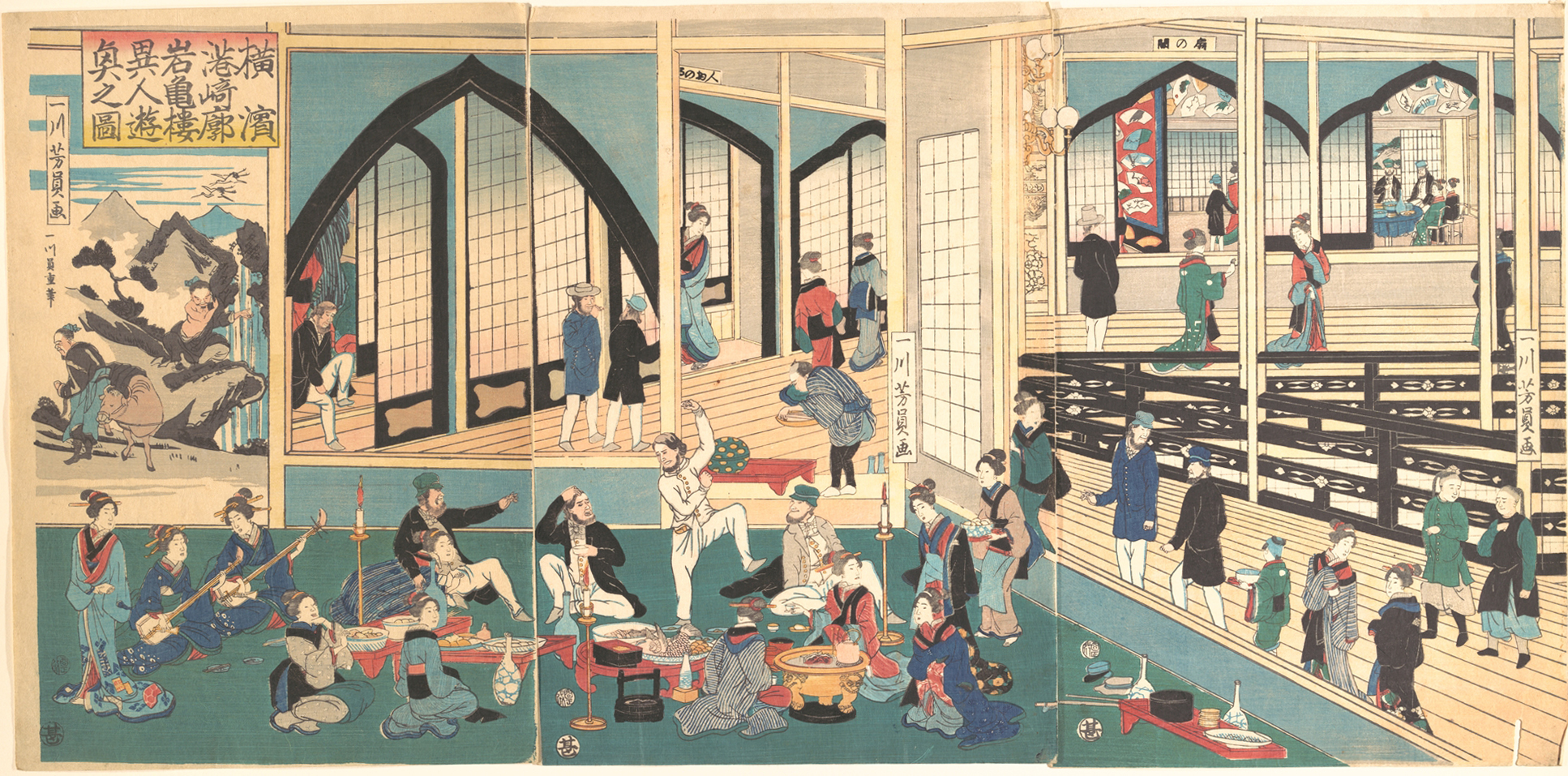
Title: Foreigners Enjoying a Party at the Gankirō Tea House
Description:
Triptych of woodblock prints; ink and color on paper, Edo period (1615–1868), Japan.
Related Results
Foreigners Enjoying Children's Kabuki at the Gankirō Tea House
Foreigners Enjoying Children's Kabuki at the Gankirō Tea House
Triptych of woodblock prints; ink and color on paper, Edo period (1615–1868), Japan...
Tea Bowl with Russet Hare's Fur Markings
Tea Bowl with Russet Hare's Fur Markings
The small, circular foot and lightly indented, vertical lip of this large yankou wan, or funnel-shaped bowl, are connected by steeply sloping walls that show a well defined, angula...
Tea Caddy with Cover
Tea Caddy with Cover
Creamy, yellow-tinged porcelain base, decorated with purple camieau battle scenes. Part of a tea service (originally for 6), consisting of a tea pot, hot water pitcher, tea caddy, ...
Early Spring, Hexagonal Tea Caddy with Decoration of Flowering Plants, Grasses and Pine Needles
Early Spring, Hexagonal Tea Caddy with Decoration of Flowering Plants, Grasses and Pine Needles
Of hexagonal form, this dry lacquer tea caddy is made entirely of lacquer applied over a cloth core, the surface imitating the color and texture of an old bronze vessel. The top an...
Small Tea Bowl with Rounded Sides and Russet Hare's Fur Markings
Small Tea Bowl with Rounded Sides and Russet Hare's Fur Markings
This small tea bowl has rounded sides that rise from its small, circular footring to its circular lip, which is subtly indented just below the top. The bowl's walls are relatively ...
Satin tea gown, probably designed by Worth, Paris, ca. 1900. Satin tea gown with two delicate overlayers of pink chiffon crêpe continuing over the train. The bodice is pouched into a broad satin belt with a falling sash. The gown is machine-stitched with
Satin tea gown, probably designed by Worth, Paris, ca. 1900. Satin tea gown with two delicate overlayers of pink chiffon crêpe continuing over the train. The bodice is pouched into a broad satin belt with a falling sash. The gown is machine-stitched with
Satin tea gown, probably designed by Worth, Paris, ca. 1900. Satin tea gown with two delicate overlayers of pink chiffon crêpe continuing over the train. The bodice is pouched into...