
Search engine for discovering works of Art, research articles, and books related to Art and Culture


Javascript must be enabled to continue!
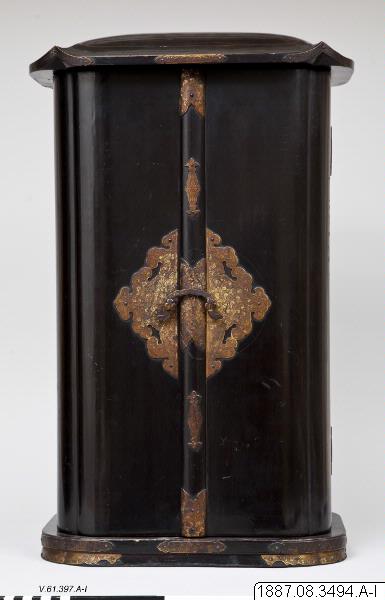
skåp, altarskåp, cabinet
View through Europeana Collections
Altar cabinet with black lacquered outside and gilded inside, containing three figures on cloud formation resting on one in several ledges worked throne. On the lid sides two renderers of donuts, minutiously working with several colours. According to the catalog, these are Amida, Kannon and Seishi. Amida is a Japanese name form for Amitabha Buddha, the Buddha of Unlimited Light. Faith was introduced in China in the 3-400s. It is possible that the root is present in the solar cult already in the early mahayana teachings (practiced by Indo-Persians and Scythians). He is especially asked in the jodo sect and is found in many different forms artistically, e.g. in the famous raigo-zu pictures, where Amida meets the dying or welcomes him to the western paradise. In Japan, he is found, for example, in the Yama-goshi-no-Nyorai form, where he rises behind a fog mountain with light rays from his head and body. He often appears in this altar cabinet flanked by Kannon (Avalokitesvara) and Dai Seishi (Mahasthamaprapta). White.: Edmunds 1934, p 224-25. As for Mahasthamaprapta, he is called Dai Seishi in Japan and it is translated with “he who has gained great strength.” He is a manifestation of the spiritual wisdom of Amida, just as Kannon manifests his compassion and appears as in the object, but the mudro does not match. Edmunds 1934, p 253. In Fredrick W Bunce. 1993. An Encyclopedia of Buddhist Deities, Demigod, Godlings, Saints and Demons. Dehli, pp. 319-20 there are two figures, both Mahasthamaprapta and Mahasthamaprata. There, Mahasthamaprapta says that he is one of Avalokitesvara’s 108 forms in Kathmandu, Nepal, according to Battacharyya and that he is an emanation of Dhyani Buddha Amitabha. On Mahasthamaprata, it says in Bunce 1993 precisely “he has been exposed to great power” and that he is called Dai Seishi in Japan, very similar to Edmund’s text. He is to be very popular in China compared to India. Neither in this case does the mudra description fit into the object. (PH)
Title: skåp, altarskåp, cabinet
Description:
Altar cabinet with black lacquered outside and gilded inside, containing three figures on cloud formation resting on one in several ledges worked throne.
On the lid sides two renderers of donuts, minutiously working with several colours.
According to the catalog, these are Amida, Kannon and Seishi.
Amida is a Japanese name form for Amitabha Buddha, the Buddha of Unlimited Light.
Faith was introduced in China in the 3-400s.
It is possible that the root is present in the solar cult already in the early mahayana teachings (practiced by Indo-Persians and Scythians).
He is especially asked in the jodo sect and is found in many different forms artistically, e.
g.
in the famous raigo-zu pictures, where Amida meets the dying or welcomes him to the western paradise.
In Japan, he is found, for example, in the Yama-goshi-no-Nyorai form, where he rises behind a fog mountain with light rays from his head and body.
He often appears in this altar cabinet flanked by Kannon (Avalokitesvara) and Dai Seishi (Mahasthamaprapta).
White.
: Edmunds 1934, p 224-25.
As for Mahasthamaprapta, he is called Dai Seishi in Japan and it is translated with “he who has gained great strength.
” He is a manifestation of the spiritual wisdom of Amida, just as Kannon manifests his compassion and appears as in the object, but the mudro does not match.
Edmunds 1934, p 253.
In Fredrick W Bunce.
1993.
An Encyclopedia of Buddhist Deities, Demigod, Godlings, Saints and Demons.
Dehli, pp.
319-20 there are two figures, both Mahasthamaprapta and Mahasthamaprata.
There, Mahasthamaprapta says that he is one of Avalokitesvara’s 108 forms in Kathmandu, Nepal, according to Battacharyya and that he is an emanation of Dhyani Buddha Amitabha.
On Mahasthamaprata, it says in Bunce 1993 precisely “he has been exposed to great power” and that he is called Dai Seishi in Japan, very similar to Edmund’s text.
He is to be very popular in China compared to India.
Neither in this case does the mudra description fit into the object.
(PH).
Related Results
Ralph Steadman, Cabinet Of The Mind - Home Secretary; Cabinet Of The Mind – Defense; Cabinet Of The Mind – Environment; Cabinet Of The Mind - Exchequer; Cabinet Of The Mind - Prime Minister; Cabinet Of The Mind - Social Services (1989)
Ralph Steadman, Cabinet Of The Mind - Home Secretary; Cabinet Of The Mind – Defense; Cabinet Of The Mind – Environment; Cabinet Of The Mind - Exchequer; Cabinet Of The Mind - Prime Minister; Cabinet Of The Mind - Social Services (1989)
Each screenprint in colours on Bockingford Mould 400gsm, 96 × 112 cm...
Ralph Steadman, Cabinet Of The Mind - Home Secretary, 1989; Cabinet Of The Mind – Defense, 1989; Cabinet Of The Mind – Environment, 1989; Cabinet Of The Mind - Exchequer, 1989; Cabinet Of The Mind - Prime Minister, 1989; Cabinet Of The Mind - Social Servi
Ralph Steadman, Cabinet Of The Mind - Home Secretary, 1989; Cabinet Of The Mind – Defense, 1989; Cabinet Of The Mind – Environment, 1989; Cabinet Of The Mind - Exchequer, 1989; Cabinet Of The Mind - Prime Minister, 1989; Cabinet Of The Mind - Social Servi
Each screenprint in colours on Bockingford Mould 400gsm...
Höjd m lock:900 mm.
Smh ID 102267, urna.
Från skåp 69, stor monter.
Höjd m lock:900 mm.
Smh ID 102267, urna.
Från skåp 69, stor monter.
Height m lid: 900 mm.
Smh ID 102267, urn.
From cabinet 69, large stand....
Wooded Mountain Landscape with Waterfall and Travellers
Wooded Mountain Landscape with Waterfall and Travellers
Wooded Mountain Landscape with Waterfall and Travellers is a magnificent fantasy landscape in the Flemish tradition, painted in the first half of the 17th century by the Antwerp pa...
Wilhelm Kempe med anhöriga
Wilhelm Kempe med anhöriga
WILHELM KEMPE, JOHANNA KEMPE WALLIS, WALTHER VON HALLWYL, WILHELMINA VON HALLWYL KEMPE, EBBA VON HALLWYL, WILHELM VON ECKERMANN and ELLEN and IRMA VON HALLWYL, 1885. Photographs, e...