
Search engine for discovering works of Art, research articles, and books related to Art and Culture


Javascript must be enabled to continue!
The "Summer Spire" on the Chalk Cliffs of the Island Møn. Moonlight
View through National Gallery of Denmark
Sødring was among the few Danish artists of this period to look to Romantic landscape painting for inspiration, and this painting is radically different from the majority of paintings created in Denmark around 1830.
Frederik Sødring’s painting of the Summer Spire on the Cliffs of Møn differs greatly from the general feel of most paintings created in Denmark around 1830, first and foremost because it is a nocturnal scene, but also because of the way in which the motif has been treated. The artist has chosen to view the Summer Spire against a dramatic night sky where the moon breaks through the clouds and makes the chalk cliffs appear luminously white against the dark surroundings.
Sødring was among the very small number of Danish artists who looked towards the Dresden school of Romantic landscape painting from the very outset. The art of J. C. Dahl was particularly important to him; for his debut at Charlottenborg in 1828 Sødring presented two copies after Dahl, and in the years that followed the Norwegian painter’s views on art and artistic principles came to be of crucial importance to Sødring’s own work. However, some of his paintings show that he must also, at an early stage, have become interested in the German landscape painter Caspar David Friedrich’s work and artistic devices. Several features of the Summer Spire scene are very reminiscent of the German artist (the moonlight breaking through the clouds, reflected on the sea; and the tree silhouetted against the sky). However, none of the Friedrich paintings that Sødring is known to have had the opportunity to see before 1831 are obvious role models, so in all likelihood Friedrich’s impact has been mediated through Dahl’s moonlit scenes.
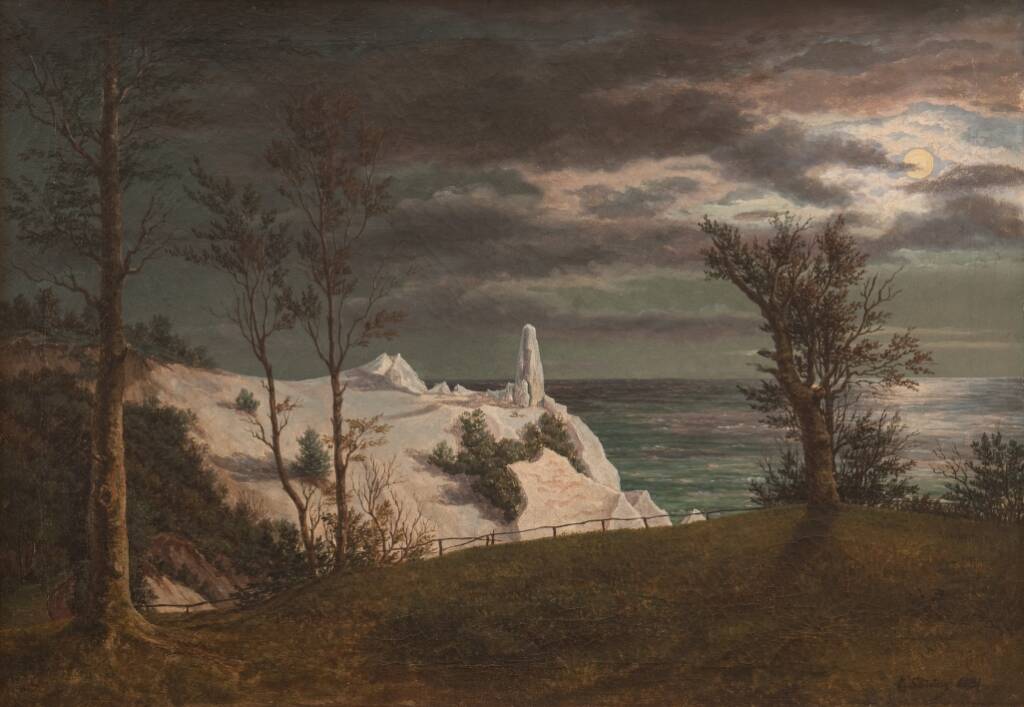
Title: The "Summer Spire" on the Chalk Cliffs of the Island Møn. Moonlight
Description:
Sødring was among the few Danish artists of this period to look to Romantic landscape painting for inspiration, and this painting is radically different from the majority of paintings created in Denmark around 1830.
Frederik Sødring’s painting of the Summer Spire on the Cliffs of Møn differs greatly from the general feel of most paintings created in Denmark around 1830, first and foremost because it is a nocturnal scene, but also because of the way in which the motif has been treated.
The artist has chosen to view the Summer Spire against a dramatic night sky where the moon breaks through the clouds and makes the chalk cliffs appear luminously white against the dark surroundings.
Sødring was among the very small number of Danish artists who looked towards the Dresden school of Romantic landscape painting from the very outset.
The art of J.
C.
Dahl was particularly important to him; for his debut at Charlottenborg in 1828 Sødring presented two copies after Dahl, and in the years that followed the Norwegian painter’s views on art and artistic principles came to be of crucial importance to Sødring’s own work.
However, some of his paintings show that he must also, at an early stage, have become interested in the German landscape painter Caspar David Friedrich’s work and artistic devices.
Several features of the Summer Spire scene are very reminiscent of the German artist (the moonlight breaking through the clouds, reflected on the sea; and the tree silhouetted against the sky).
However, none of the Friedrich paintings that Sødring is known to have had the opportunity to see before 1831 are obvious role models, so in all likelihood Friedrich’s impact has been mediated through Dahl’s moonlit scenes.
Related Results
Album of Drawings
Album of Drawings
1) Pen and brown ink brush and gray wash.
2) Pen and brown ink over black chalk.
3)
4) Black chalk.
5) Pen and brown ink over black chalk.
6) Pen and br...
The Devil's Cleft at Liselund Manor. The Island of Møn
The Devil's Cleft at Liselund Manor. The Island of Møn
Here, Eckersberg has depicted one of the most romantic and picturesque views of the garden at the manor of Liselund. The central motif – the cleft with the small waterfall – is fra...
Landscape with a Stile. The Isle of Møn
Landscape with a Stile. The Isle of Møn
Eckersberg would have picked this scene while standing near the Cliffs of Møn, looking west out across the island. The painting is based on a drawing made in bright daylight in fro...
Abandoned Skiff
Abandoned Skiff
Frederic Church, one of the leading landscape artists of the Hudson River School, produced an outstanding gallery of pictures both of his own country and of the different exotic la...
Mark Freeman, Concrete Cliffs, alternatively titled Manhattan Cliffs (1936)
Mark Freeman, Concrete Cliffs, alternatively titled Manhattan Cliffs (1936)
Lithograph in yellow and black on paper...