
Search engine for discovering works of Art, research articles, and books related to Art and Culture


Javascript must be enabled to continue!
Anonymous, The culmination of Renaissance ingenuity and scientific achievement: Celestial sphere with traces of a mechanism. (c1540-c1550)
View through Artsy
Celestial sphere, two large brass fretwork hemispheres joined at the equator with two sets of rings. The first set consists of five parallel horizontal rings representing the Equator, Tropics of Cancer and Capricorn, and both polar circles as well as vertical colures and meridians intersecting both poles and crossing the equator at 30 degrees. The second set consists of six rings intersecting the equatorial poles at an angle of 23.5 degrees – this angle would allow the now-missing inner terrestrial sphere to consistently point to the north and south equatorial poles of the celestial sphere. Placed atop this set of 17 rings are the 48 Ptolemaic constellations and two non-Ptolemaic ones. The Lynx (LE LYNX) located between the Great Bear and Leo and the constellation of Eridanus, depicted as a naked female figure, were both added later. The planetary symbols and series of stars up to five magnitudes are engraved on the figures of each constellation. The celestial sphere is mounted on a graduated brass meridian ring held in place by two recesses on the horizon ring. One face of the meridian is stamped with a scale of 360 degrees, and an hour-ring and index is mounted at the North Pole. A set of four brackets support the horizon ring with engraved acanthus leaf decoration and foliage, which terminate in scrolls with a pierced opening holding a peg attached to the horizon. The upper face of the horizon features an inner scale of 360 degrees divided into 12 signs for the zodiac labelled in Latin and depicted with its symbol. An outer scale depicts the Julian calendar with the names of the months stamped in Roman capital letters. The first point of Aries coincides with the 11th of March. The 12 winds are engraved at the outer edge as blowing figures. The sphere is supported by a chased-brass circular base with four grotesque human figures amongst arabesque decoration. The sphere rests on a cylindrical marble stand with minor chips consistent with age., 86 × 33 × 33 cm
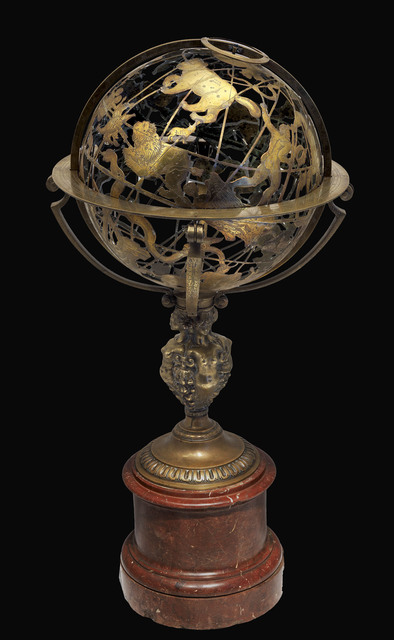
Title: Anonymous, The culmination of Renaissance ingenuity and scientific achievement: Celestial sphere with traces of a mechanism. (c1540-c1550)
Description:
Celestial sphere, two large brass fretwork hemispheres joined at the equator with two sets of rings.
The first set consists of five parallel horizontal rings representing the Equator, Tropics of Cancer and Capricorn, and both polar circles as well as vertical colures and meridians intersecting both poles and crossing the equator at 30 degrees.
The second set consists of six rings intersecting the equatorial poles at an angle of 23.
5 degrees – this angle would allow the now-missing inner terrestrial sphere to consistently point to the north and south equatorial poles of the celestial sphere.
Placed atop this set of 17 rings are the 48 Ptolemaic constellations and two non-Ptolemaic ones.
The Lynx (LE LYNX) located between the Great Bear and Leo and the constellation of Eridanus, depicted as a naked female figure, were both added later.
The planetary symbols and series of stars up to five magnitudes are engraved on the figures of each constellation.
The celestial sphere is mounted on a graduated brass meridian ring held in place by two recesses on the horizon ring.
One face of the meridian is stamped with a scale of 360 degrees, and an hour-ring and index is mounted at the North Pole.
A set of four brackets support the horizon ring with engraved acanthus leaf decoration and foliage, which terminate in scrolls with a pierced opening holding a peg attached to the horizon.
The upper face of the horizon features an inner scale of 360 degrees divided into 12 signs for the zodiac labelled in Latin and depicted with its symbol.
An outer scale depicts the Julian calendar with the names of the months stamped in Roman capital letters.
The first point of Aries coincides with the 11th of March.
The 12 winds are engraved at the outer edge as blowing figures.
The sphere is supported by a chased-brass circular base with four grotesque human figures amongst arabesque decoration.
The sphere rests on a cylindrical marble stand with minor chips consistent with age.
, 86 × 33 × 33 cm.
Related Results
Chinese woodcut: Eye diagnosis -- the five spheres (wu lun)
Chinese woodcut: Eye diagnosis -- the five spheres (wu lun)
Lettering: PICTURE TITLE: Five spheres (wu lun). OTHER LETTERING: Neizi (inner canthus of the eye); spleen; ruizi (acute canthus, i.e. outer canthus of the eye); heart; liver; lung...
The Constellation Cassiopeia (painting, recto; text, verso), folio from an Arabic manuscript of the Kitab Suwar al-Kawakib of al-Sufi
The Constellation Cassiopeia (painting, recto; text, verso), folio from an Arabic manuscript of the Kitab Suwar al-Kawakib of al-Sufi
Gold disks scattered across this seated figure mark the major stars of the constellation Cassiopeia. Named “The Enthroned One” (dhat al-kursi) in Arabic, this constellation of the ...
Suit piped with silk: coat, waistcoat and breeches
Suit piped with silk: coat, waistcoat and breeches
Court costumes typically featured white piping. Before ascending the Dutch throne, Willem I spent many years at the British court. This style of trimming was common there. When he ...
Portrait of Marie Lemasson
Portrait of Marie Lemasson
Emile Bernard was a precocious, well-educated, intense sixteen-year-old when he entered the studio of the academic painter Fernand Cormon at Paris’s Ecole National des Beaux-Arts, ...
Pond with Water Lilies
Pond with Water Lilies
From his earliest years as a painter, Monet’s art was rooted in the direct and prolonged analysis of nature. Throughout his career, he grappled with the task of developing techniqu...
Scenes from the Buddha’s Life
Scenes from the Buddha’s Life
This painting is composed of three vignettes from the Buddha’s life.
The primary scene begins in the top right corner of the painting. It shows the Buddha ascended to the Trayas...
Dorothy Hood: Celestial Voids
Dorothy Hood: Celestial Voids
McClain Gallery is pleased to present "Dorothy Hood: Celestial Voids," an exhibition of paintings by the late artist. This marks Hood’s second solo painting exhibition with the gal...