
Search engine for discovering works of Art, research articles, and books related to Art and Culture



Javascript must be enabled to continue!
IRON AGE MINIATURE OBJECT
View through Europeana Collections
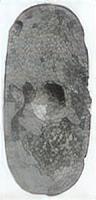
The object is a miniature shield, which has been made from cast copper alloy. These shields date to the Iron Age period, Dr. JD Hill (British Museum) comments that dating the shield is difficult, but is probably mid to late Iron Age c. 400 BC – 43 AD. In plan the shield is an oval shape. In the centre there is a circular dome (which is hollow on the reverse) which represents a shield boss. Decoration consists of a single fine linear grooved border. Within this border is a series of low-relief dots. Further decoration consists of a roundel formed by a circle of low-relief dots with a single dot in the centre. The roundels appear in the field above and below the boss. The roundels and boss are encompassed with a low-relief curvaceous linear border, which follows the contours of the decoration. On the reverse there is no decoration, but in some areas, towards the edge there are high-relief bumps from the circular dots being impressed. In the centre, where the boss is hollow a handle has been attached. The handle is joined by two integral rivets either side of the boss. A strip of copper alloy which has had the rivets puncture it forms the handle, and then the rivets have been flattened. The handle in the central portion has had the two long edge folded to meet each other, therefore the width of he handle has decreased, but the thickness increased. The surface of the brooch is slightly abraded, but where the patina remains it is well developed, shiny and has a grey/green colour. The shield measures 78.5mm long, 36.5mm wide and 6.7mm thick.
The Portable Antiquities Scheme
Title: IRON AGE MINIATURE OBJECT
Description:
The object is a miniature shield, which has been made from cast copper alloy.
These shields date to the Iron Age period, Dr.
JD Hill (British Museum) comments that dating the shield is difficult, but is probably mid to late Iron Age c.
400 BC – 43 AD.
In plan the shield is an oval shape.
In the centre there is a circular dome (which is hollow on the reverse) which represents a shield boss.
Decoration consists of a single fine linear grooved border.
Within this border is a series of low-relief dots.
Further decoration consists of a roundel formed by a circle of low-relief dots with a single dot in the centre.
The roundels appear in the field above and below the boss.
The roundels and boss are encompassed with a low-relief curvaceous linear border, which follows the contours of the decoration.
On the reverse there is no decoration, but in some areas, towards the edge there are high-relief bumps from the circular dots being impressed.
In the centre, where the boss is hollow a handle has been attached.
The handle is joined by two integral rivets either side of the boss.
A strip of copper alloy which has had the rivets puncture it forms the handle, and then the rivets have been flattened.
The handle in the central portion has had the two long edge folded to meet each other, therefore the width of he handle has decreased, but the thickness increased.
The surface of the brooch is slightly abraded, but where the patina remains it is well developed, shiny and has a grey/green colour.
The shield measures 78.
5mm long, 36.
5mm wide and 6.
7mm thick.
Related Results
Emperor Leopold I elevates Mark Putz von Adlersthurn, court chamber council and secret secretary, to the old knight’s state, improves his coat of arms and improves his predicate on von Putz zu Adlerßthurn and grants him a new predicate Edler von Schrotten
Emperor Leopold I elevates Mark Putz von Adlersthurn, court chamber council and secret secretary, to the old knight’s state, improves his coat of arms and improves his predicate on von Putz zu Adlerßthurn and grants him a new predicate Edler von Schrotten
Character: description on folk. 5b and 6a, miniature on folk. 5a, 166 x 151 mm.
Quarter shield with crowned heart plate. It is red with a silver crossbar, above the crossbar is the...
Emperor Francis I elevates Ludwig Müllner, the governor of the artillery field arms office, to a noble state, grants him a predicate von Mühlburg and a coat of arms
Emperor Francis I elevates Ludwig Müllner, the governor of the artillery field arms office, to a noble state, grants him a predicate von Mühlburg and a coat of arms
Character: description on folk. 5b, 6b, miniature on folk. 6a, 172 x 284 mm.
A fourth shield. 1. and 4. in gold is a flying black eagle (1) holding a sword (2) in the right joint, ...
Emperor Leopold I elevates Johann Ulrich Kleblsperg, lieutenant colonel of the Duke of Lorraine Cavalry Regiment, to the Czech state of free lords, improves his coat of arms and awards him predicates Wohlgeborn and Freyherr
Emperor Leopold I elevates Johann Ulrich Kleblsperg, lieutenant colonel of the Duke of Lorraine Cavalry Regiment, to the Czech state of free lords, improves his coat of arms and awards him predicates Wohlgeborn and Freyherr
Character: description on folk. 5b - 7b, miniature on folk. 7a, 161 x 171 mm.
Quarterly shield with heart label that is pollen. On the right in the red one lies two Turkish heads i...
Ivory pendant in the shape of a miniature mask
Ivory pendant in the shape of a miniature mask
There are various interpretations of its function in the literature. One emphasizes the protective and healing influence of the pendant on the wearer. The other states that the pen...
Emperor Ferdinand II elevates Jan the Elder Pacht, a town town of Hříuje uje uje uje, to the Czech Vladycký state, awards him a coat of arms and a predicate from Raijov
Emperor Ferdinand II elevates Jan the Elder Pacht, a town town of Hříuje uje uje uje, to the Czech Vladycký state, awards him a coat of arms and a predicate from Raijov
Character: description, miniature in the middle of the leaf, 109 x 128 mm.
In the red - blue obliquely divided gable, a golden double-tailed lion with a red tongue holding a silver...
František Adam Eusebius the Reich Earl of Žďár, the Lord on the Red Oujezci, Vytčice and Gottrsdorf, the Council of the Court and the Chamber Court, on the basis of the Palatinate awarded to him by the charter of Emperor Ferdinand II. given in Vienna 3. J
František Adam Eusebius the Reich Earl of Žďár, the Lord on the Red Oujezci, Vytčice and Gottrsdorf, the Council of the Court and the Chamber Court, on the basis of the Palatinate awarded to him by the charter of Emperor Ferdinand II. given in Vienna 3. J
Character: description, miniature in the middle of the leaf, 111 x 111 mm.
In the blue shield there is a corrugated heel of seawater color on which stands boar 2) with silver tusks...
Emperor Charles VI. elevates Jacob Otto [Otto] to the Bohemian peerage, grants him the predicate von Ottlilienfeld and the coat of arms
Emperor Charles VI. elevates Jacob Otto [Otto] to the Bohemian peerage, grants him the predicate von Ottlilienfeld and the coat of arms
Character: description, miniature in the middle of the leaf, 99 x 119 mm.
Pollen shield. On the right there are six red hearts in silver 1). On the left is a blue oval green laurel...
Illustrated manuscript of Khusraw and Shirin of Sheyhi
Illustrated manuscript of Khusraw and Shirin of Sheyhi
This is an illustrated manuscript of the Khusraw and Shirin of Sheyhi, composed in Turkish. The small manuscript is copied in vocalized naskh in two columns and fifteen lines to a ...